
Meta Patents AR and VR Devices That Learn to Read Hand and Eye Sequences
Most gesture systems treat each hand movement as its own isolated command. Meta's new patent is built around the idea that the order and timing of gestures matters just as much as the gestures themselves.
What Meta's time-aware gesture system actually does
Every time you try to select something in a VR headset by pinching your fingers, the system has to figure out whether you meant to do that or just scratched your nose. Getting that wrong is one of the most frustrating parts of using AR and VR glasses today.
Meta's new patent tackles this by teaching the headset to look at sequences of gestures, not just single movements in isolation. Instead of asking "what is this hand motion?", the system asks "what did the user do just before this, and how long ago?" By factoring in that timing, it can make a much more confident guess about what you actually intended.
So if you glance at a menu item and then pinch your fingers a half-second later, the system can recognize that combination as a deliberate selection, rather than two unrelated events. The result is a headset that feels less like it's guessing and more like it's listening.
… identifying, using at least one processor, based on at least one of the first signal or the second signal and temporal information relating to the first and second times, a user intent associated with at least one of the first gesture-input or the second gesture-input …
Translation: The device figures out what you want to do by analyzing the timing and sequence of your physical movements.
How the system links two gestures across time into one command
Temporal gesture recognition is the core idea here. The patent describes a method where a VR headset or AR glasses capture a first gesture at one point in time and a second gesture at a later point, then use the relationship between those two moments to figure out what the user meant.
The system works by receiving two signals from the device's sensors (cameras, eye-trackers, or other hardware) and combining them with temporal information (basically, a timestamp and the gap between the two events). From that combined picture, the processor derives a "user intent" linked to a specific gesture identifier, then triggers the appropriate action on the device.
- Supported inputs include eye movements, hand motions, and finger gestures like pinches
- The two gestures can be the same type or different types (for example, a look followed by a pinch)
- The system outputs a third signal that actually drives the task being performed
The practical upshot is that the headset can treat a timed sequence of small movements as a single meaningful command, rather than misreading either gesture on its own. That distinction matters a lot when your hands and eyes are always in motion.
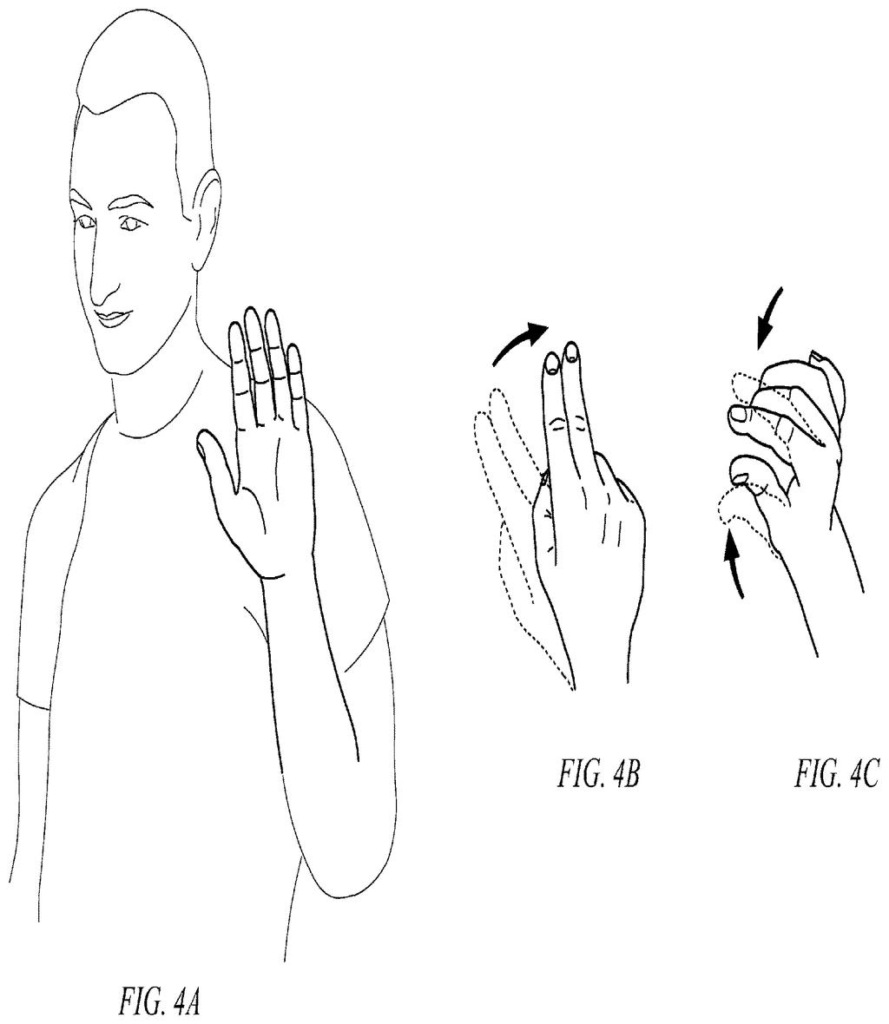
The gesture-inputs may include eye movements, hand motions, finger movements such as pinch gestures, or combinations thereof, detected by cameras or other sensors on the VR/AR device.
Translation: The system tracks specific actions like eye tracking or finger pinching to understand your commands.
What this means for hands-free AR and VR control
For anyone who has wrestled with accidental selections or unresponsive controls in a VR or AR headset, this kind of improvement would be felt immediately. Gesture control is still the biggest usability barrier for mainstream AR glasses: people give up when the device misreads them. A system that understands sequences rather than snapshots has a much better shot at being reliable enough for daily use.
Meta is clearly pushing toward a future where Ray-Ban smart glasses and the Quest headsets respond to natural, multi-step hand and eye input without a controller in sight. This patent is one piece of that effort, and it sits alongside a steady stream of new tech patents in the AR and VR gesture-control space that hint at how aggressively companies are racing to make hands-free interfaces feel natural.
Claim 1 is written with real breadth: it covers any two sensor-based gesture signals at different times, combined with temporal information, to infer intent on a VR or AR device. That scope is wide enough to potentially cover a large portion of multi-step gesture interfaces, regardless of whether the gestures involve eyes, hands, or fingers. If granted as written, this claim could give Meta a toll position over a basic and widely needed interaction pattern in AR and VR. The breadth cuts both ways though: wide claims attract more scrutiny during examination, and the concept of using timing to interpret sequences of inputs has prior art in touch interfaces and speech recognition that patent examiners will almost certainly surface.
There are more where this came from
We read every patent application Big Tech publishes and send you the ones worth knowing. Plain English, free, every week.
The drawings
10 drawing sheets from US 2026/0237198 A1 · click any drawing to enlarge


Want this weekly breakdown for a company we don't cover? Patentlyze Pro →
Be the first to weigh in