
Microsoft Patents a Chip That Loads AI Model Data Before It Is Required
Microsoft has filed a patent for a dedicated coprocessor that tries to predict, in advance, which chunks of an AI language model will be needed next, and loads them into a cache buffer before the main AI chip even asks.
What Microsoft's AI weight-prefetching coprocessor actually does
You're waiting for an AI assistant to finish generating a long response, watching it tick out words one by one, slower than you'd like. A big reason for that delay is memory: large AI models are enormous, and the chip has to constantly fetch the right pieces of the model from memory every time it produces a new word.
Microsoft's patent describes a dedicated helper chip, a coprocessor, whose entire job is to predict which pieces of the AI model will be needed next and load them into a fast memory buffer before the main AI chip requests them. Think of it like a sous chef who pre-chops the vegetables before the head chef calls for them. If the prediction turns out to be wrong, the system can roll back and try again.
This is about making AI text generation faster without necessarily needing a bigger or more expensive main processor. The coprocessor sits alongside the AI chip and the regular CPU, coordinating memory traffic so the AI chip spends less time waiting.
… predicting a subset of large language model (LLM) weights, the subset LLM weights for the use of generating a next token by an LLM executing in the AI accelerator; and initiating caching of the subset of LLM weights into the cache buffer.
Translation: The system guesses which data the AI will need next and moves that information into a temporary storage area ahead of time.
How the coprocessor predicts and caches LLM weights ahead of time
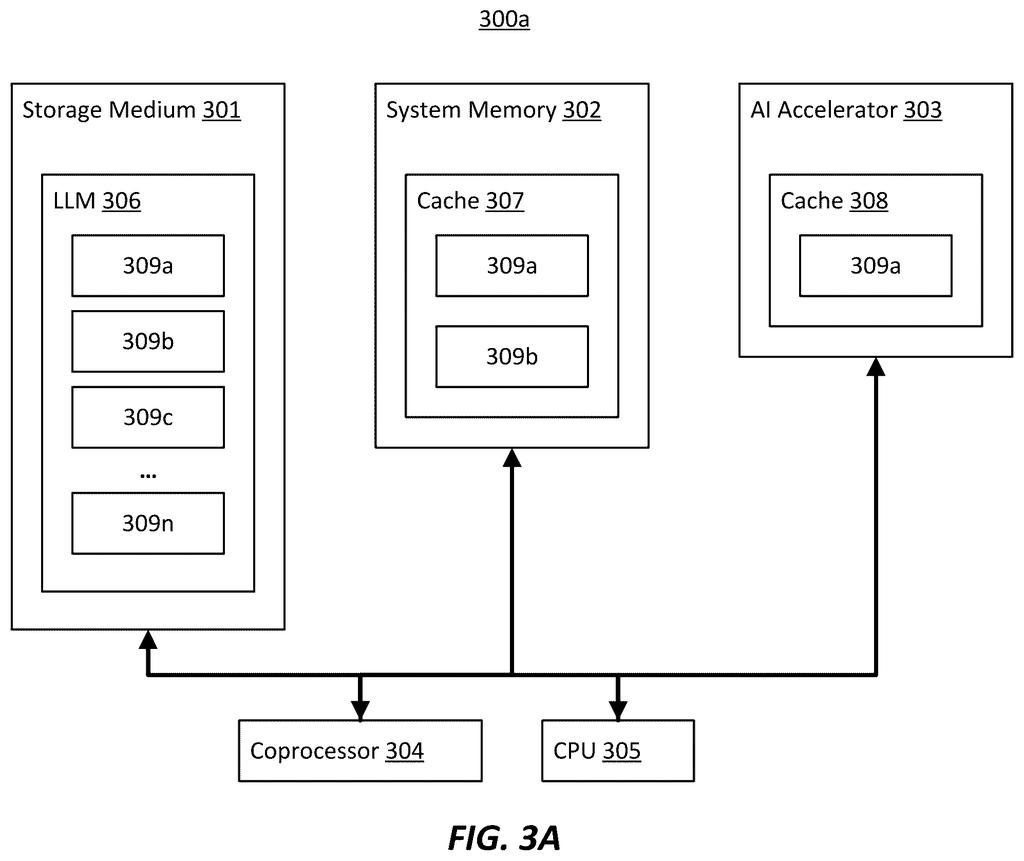
The patent describes a data management coprocessor that works alongside an AI accelerator (the specialized chip that runs the language model) and a standard CPU inside a computer system.
Here is how the system operates:
- Allocates a cache buffer in a separate region of memory, giving itself a dedicated staging area for incoming data.
- Predicts which LLM weights will be needed for generating the next token (a token is roughly a word or word-fragment). Large language models contain billions of numerical parameters called weights; at any moment, only a subset of those weights is actually needed to produce the next output.
- Initiates early caching of that predicted subset, moving the data into the buffer before the AI accelerator formally requests it, so the accelerator spends less time idle.
- Handles mispredictions by monitoring a confidence score. If the score indicates the prediction was wrong, the coprocessor can roll back the AI model's internal state and correct course.
The speculative approach here is borrowed from a technique decades old in CPU design called speculative execution (where a processor guesses which instructions come next and runs them early, then discards the work if the guess was wrong). Microsoft is applying that same idea to the memory-fetching problem specific to large language models.
The data management processor may also roll back a state of the LLM executing in the Al accelerator when a confidence score for the next token meets a criterion indicating a misprediction.
Translation: If the system makes a wrong guess about what the AI will do, it can undo the action and return to a previous state.
What this means for faster, cheaper AI inference hardware
AI inference, the act of running a trained model to generate answers, is expensive and slow largely because of memory bandwidth. The model weights have to travel from storage or main memory to the accelerator chip repeatedly, and that journey is a bottleneck. A coprocessor dedicated to anticipating and smoothing that traffic could meaningfully cut the time users spend waiting, without requiring a faster or larger main AI chip.
The rollback mechanism is also notable. It means the system is designed to fail gracefully rather than produce wrong output silently when a prediction misfires. For enterprises running AI inference at scale, even modest latency gains translate into real cost reductions across millions of requests. This filing sits squarely in the current wave of AI chip architecture patents covered in this week's Big Tech patents, where companies are racing to optimize the hardware layer beneath the models themselves.
This patent describes new hardware, which immediately makes the path to shipping longer than a pure software fix would be. A dedicated coprocessor requires silicon design, validation, integration with existing AI accelerator platforms, and a supply chain, none of which are small lifts. The speculative-prefetch idea is well-proven in CPU design, so the engineering concept is solid, but translating it to LLM weight management means solving a harder prediction problem: CPU branch predictors deal with relatively structured code paths, while LLM weight access patterns shift with every different prompt and model architecture. The shortest route to a product is probably not a standalone chip but rather logic baked into a future Microsoft-designed AI accelerator, assuming the company continues moving toward custom silicon for its data centers.
There are more where this came from
We read every patent application Big Tech publishes and send you the ones worth knowing. Plain English, free, every week.
The drawings
5 drawing sheets from US 2026/0236679 A1 · click any drawing to enlarge


Want this weekly breakdown for a company we don't cover? Patentlyze Pro →
Be the first to weigh in