
Microsoft Patents a Way to Keep Chip Memory Stable During Speed Changes
Every time a processor speeds up or slows down to save power, its memory circuits have to follow along without corrupting data. Microsoft has filed a patent for a system that makes those transitions safer and more predictable.
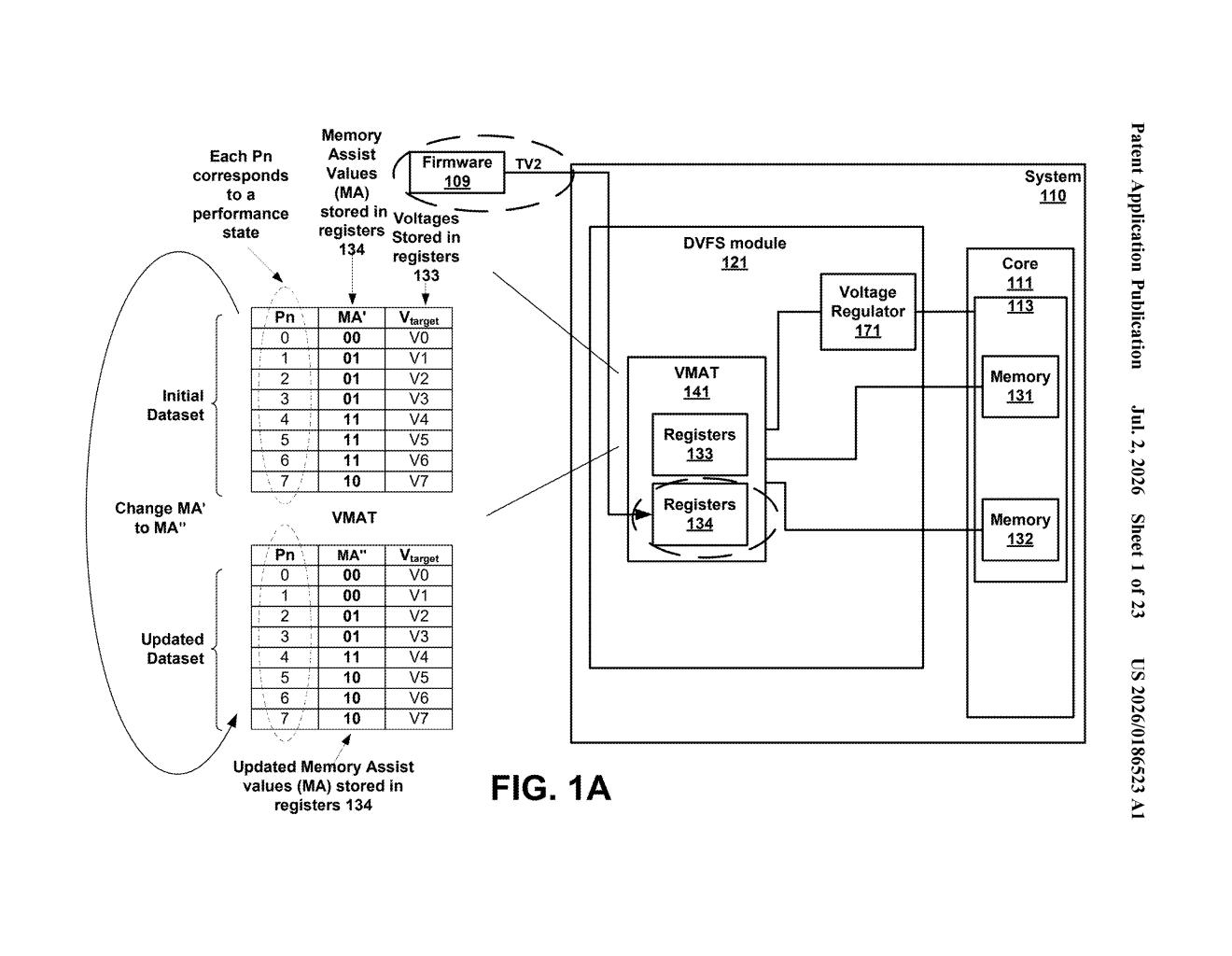
What Microsoft's memory assist system actually does
Imagine a car engine that constantly adjusts its power output depending on whether you're idling, cruising, or flooring it. Modern chips do something similar: they dial their speed and voltage up or down depending on the workload, partly to save battery or reduce heat.
The tricky part is that when a chip shifts gears, its memory also has to shift. If the memory receives conflicting signals during that handoff, data can get scrambled. Microsoft's patent describes a lookup table baked into the chip's firmware that stores the exact voltage and memory settings for every performance level, so when a transition happens, the chip knows exactly what settings to apply.
To prevent errors that can happen when two different parts of the chip are running on different clock rhythms, the patent uses a technique called Gray coding. Instead of flipping several signal bits at once (which risks a garbled in-between state), Gray coding ensures only one bit changes at a time. It's a small but important guard rail that keeps memory reliable during every speed change.
How Gray coding prevents errors at the clock boundary
The patent describes a Dynamic Voltage and Frequency Scaling (DVFS) module, which is the part of a chip responsible for adjusting power and speed in real time. The key addition is a Voltage and Memory Assist Table (VMAT), a set of firmware-programmable registers (small, configurable storage slots in hardware) that hold two pieces of information for each performance state:
- The target voltage the core should run at for that state
- The memory assist values, which are settings that tune how the on-chip memory cells behave at a given voltage
When the chip needs to move from one performance state to another, it looks up both values in the VMAT and applies them together. Because the table is firmware-programmable, engineers can tune these values after the chip is manufactured, without a hardware redesign.
The most technically specific part is the use of Gray coding on the memory assist values. The chip's memory and the register table run on different internal clocks, creating what's called a clock domain boundary. When signals cross that boundary, multiple bits changing simultaneously can produce a brief garbage value. Gray coding sidesteps this by encoding the values so that any transition between adjacent states flips exactly one bit, eliminating the ambiguous in-between states that cause errors.
What this means for Microsoft's custom chip ambitions
Custom silicon has become a major part of Microsoft's infrastructure strategy, with Azure chips and Surface processors designed in-house. Getting power management right at the hardware level is one of the most direct ways to improve performance-per-watt, which directly affects server costs and battery life.
This patent is a low-level building block rather than a consumer feature, but it addresses a real engineering pain point. The ability to tune memory assist values via firmware (rather than hardcoding them at manufacturing time) gives chip designers much more flexibility to optimize for different workloads after a chip ships. For data center processors in particular, where workloads shift dramatically throughout the day, that kind of adaptability has measurable real-world value.
This is genuinely useful chip engineering work, not a flashy filing. The Gray-coding approach to clock-domain crossings is an established technique in hardware design, but combining it with a firmware-programmable assist table in a unified DVFS module is a practical improvement that reflects serious in-house chip development maturity at Microsoft. It's worth watching as a signal that Microsoft is doing real silicon design work, not just branding off-the-shelf parts.
Get our take in your Top Stories
Liked this breakdown? Add Patentlyze as a preferred source on Google, and our plain-English take shows up more often in your Top Stories the next time Microsoft patent news breaks.
There are more where this came from
We read every patent application Big Tech publishes and send you the ones worth knowing. Plain English, free, every week.
Want this weekly breakdown for a company we don't cover? Patentlyze Pro →