
Sony's New Patent Encodes Game Video by Region Using Hidden Image Data
Sony has found a way to teach a video encoder which parts of a frame deserve more care, by hiding instructions inside data that normally controls image transparency.
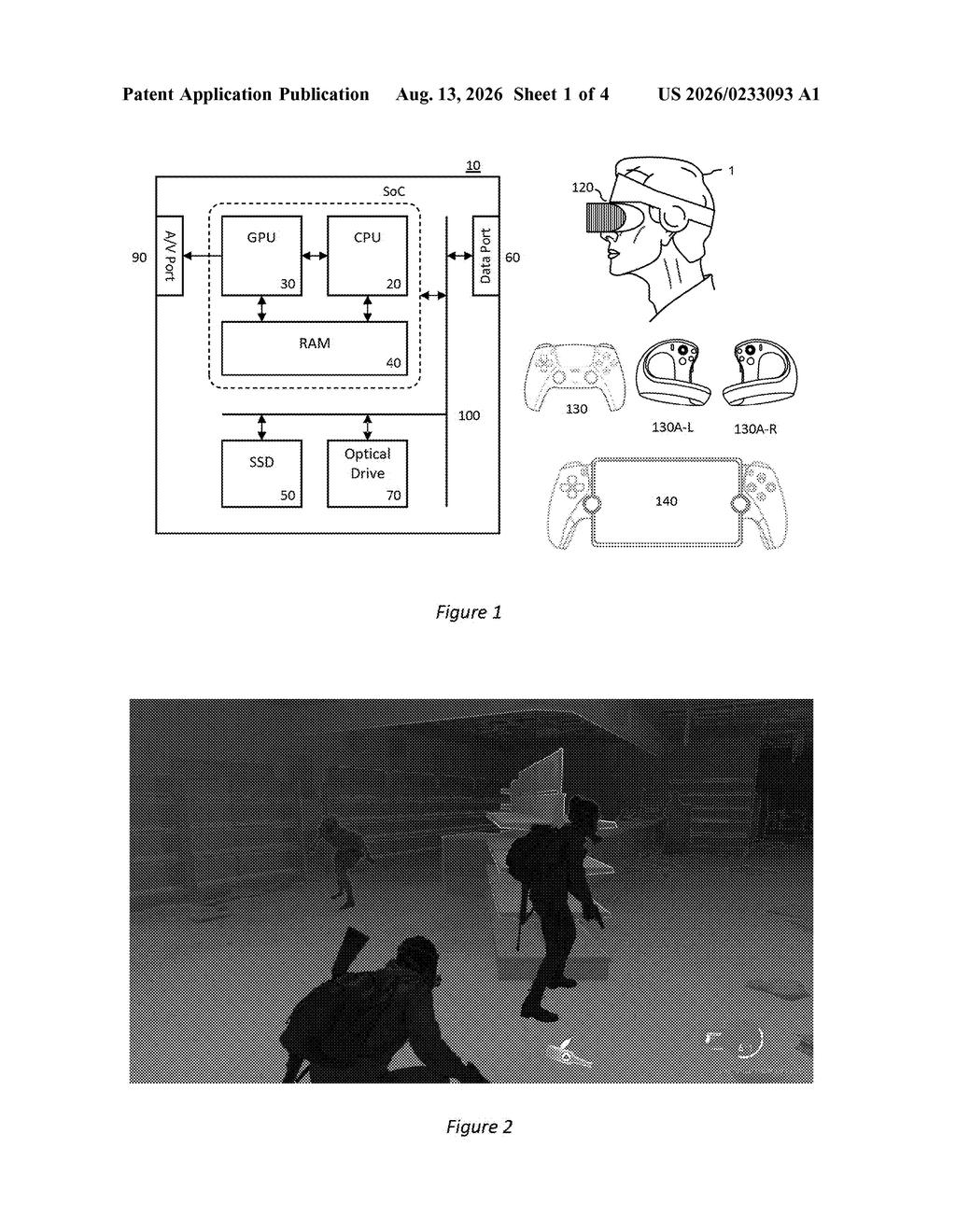
How Sony's alpha channel codec idea actually works
A game streams to your TV and the picture looks blurry the moment the action heats up. A fire-fight in the background smears into mud while the sharp HUD text somehow stays crisp. That tradeoff is compression making hard choices at the worst moment, and you feel it.
Sony's patent attacks that problem from the rendering stage, before compression even starts. As the game engine draws each frame, it spots regions that matter, say, a UI element, a fast-moving crowd, or a flat sky, and stamps a small label onto the alpha channel (a layer of the image file normally used for transparency). The encoder reads those labels and applies different compression settings to each region rather than treating the whole frame the same way.
The effect is that the parts of a frame that need accuracy get it, and the parts where aggressive compression is fine absorb the savings. You get better-looking output without necessarily paying a bigger bandwidth bill.
… logging the one or more predetermined properties using a respective predetermined reserved value within a corresponding region of an alpha channel associated with the image …
Translation: It hides special property data inside the image's transparency channel.
How the alpha channel carries encoder instructions per region
Standard video encoders compress entire frames using a single set of rules, occasionally adjusted by general scene-change detection. Sony's approach inserts a feedback channel between the renderer and the encoder so that region-specific knowledge can travel with the image data.
During rendering, the system scans the frame for regions with predetermined properties: things like flat, uniform color (a sky), high-frequency detail (text or fine texture), or transparency. Each detected region is marked with a reserved value written into the corresponding area of the alpha channel (the per-pixel layer that ordinarily stores how transparent or opaque each pixel is, used widely in compositing). Because those reserved values do not conflict with normal transparency data, the channel doubles as a metadata carrier at no extra cost.
When the encoder receives the frame, it reads those alpha-channel labels and selects encoder settings matched to each region:
- High-detail regions can get lower quantization (less data-throwing-away).
- Flat or less-important regions can absorb heavier compression.
- Regions with specific known properties, such as UI overlays, can get settings tuned for sharp edges.
The method works entirely within the existing image pipeline. No new file formats or separate metadata streams are required because the alpha channel is already part of the image structure.
… encoding the image, wherein the step of encoding the image comprises, for at least a first region within the image, using one or more encoder settings selected in response to a predetermined reserved value in the corresponding region of the alpha channel …
Translation: The video compressor changes its settings for specific areas based on that hidden data.
What this means for PlayStation streaming and video quality
Game streaming is the obvious home for this. Services like PlayStation Now push full rendered frames over a network connection in real time, and every kilobit saved is either a quality improvement at the same bandwidth or the same quality at a lower connection requirement. Per-region encoding has always been theoretically attractive but difficult to implement because the encoder traditionally knows nothing about what the renderer just drew. Sony's patent closes that gap by having the renderer annotate its own output.
The technique also matters for local recording and capture cards, where fixed bitrate caps force the same tradeoffs. Sony's PlayStation hardware ecosystem, spanning consoles, remote play, and the PlayStation Portal handheld streamer, gives this approach a clear runway. Alongside game-streaming codec work, video-quality patents like this one sit comfortably among the interesting tech patents tracking where console makers are pushing image-delivery infrastructure right now.
Compression artifacts during fast-moving scenes are one of the most complained-about problems in game streaming, and the cost is real: blurry visuals reduce perceived quality even on technically capable connections. Sony's approach addresses the root cause directly, which is that encoders compress blindly because they lack context about what they are compressing. Feeding renderer knowledge into the encoder via the alpha channel is an efficient, low-overhead way to fix that, and it does not require inventing a new format. The problem is large enough and the approach fits it tightly enough that this is worth following as PlayStation's streaming ambitions grow.
There are more where this came from
We read every patent application Big Tech publishes and send you the ones worth knowing. Plain English, free, every week.
The drawings
4 drawing sheets from US 2026/0233093 A1 · click any drawing to enlarge


Want this weekly breakdown for a company we don't cover? Patentlyze Pro →
Be the first to weigh in