
Tesla Patents a Soda Ash HVAC Filter That Stops Bacteria Growing in Your Car
Tesla wants to stop bacteria and mold from taking root in your car's air filter by coating it with soda ash, a cheap alkaline powder that makes the filter inhospitable to microbes.
What Tesla's pH-raising cabin filter actually does
Imagine sitting in your car on a hot day with the AC blasting, not knowing that the filter pulling in outside air could be breeding mold and bacteria. That's a real problem with standard automotive air filters, and Tesla's new patent targets it directly.
The idea is straightforward: coat the filter material with soda ash (sodium carbonate, the same family of minerals used in water treatment and food processing) to raise its pH level. A higher pH makes the filter surface too alkaline for most microbes to survive, so the filter stays cleaner between replacements.
This applies to the filter that sits between the outside air and your car's cabin, the part that catches dust, pollen, and other particles before the air reaches you. Tesla is describing a specific filter assembly designed to bolt onto a vehicle chassis, with the soda ash baked into the design from the start.
… soda ash applied to the one or more layers of filter media to raise a pH of the filter assembly that is exposed to the airstream.
Translation: Tesla adds washing soda to the filter layers to make the surface less acidic.
How soda ash changes the filter's chemistry
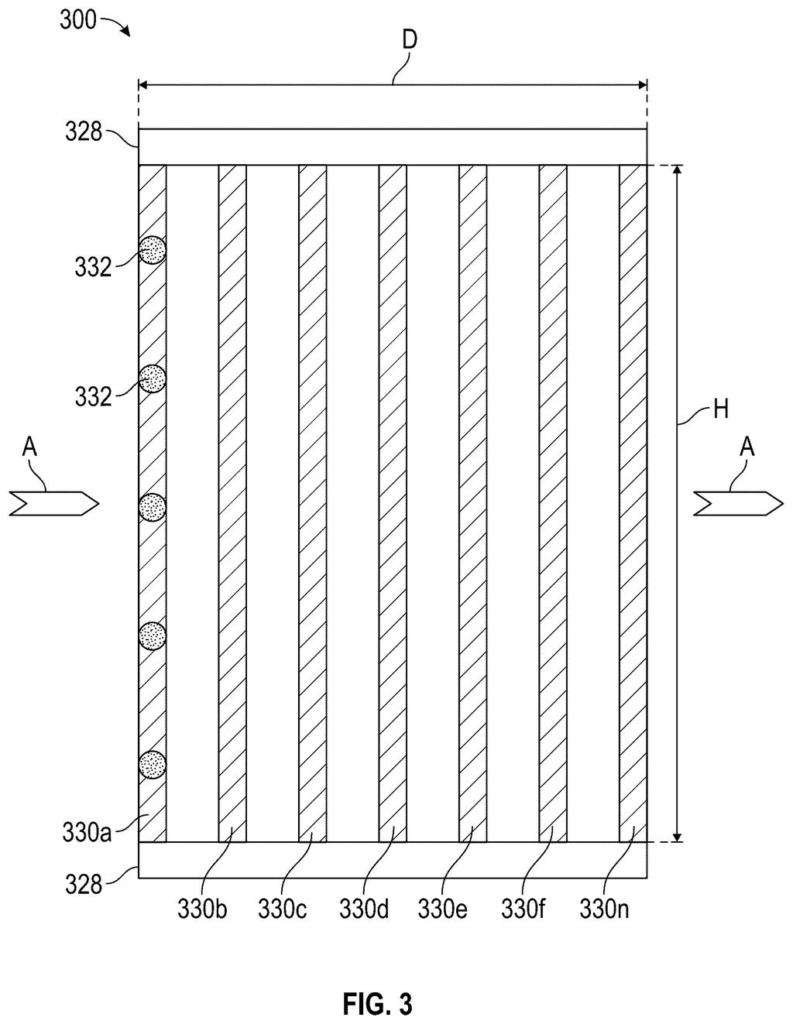
The patent covers a biostatic filter assembly (a filter that actively discourages biological growth, rather than just trapping particles). It has three core components:
- Filter housing: a rigid frame that attaches directly to the vehicle's chassis or substructure, so the filter unit is a self-contained module.
- Filter media layers: one or more sheets of filtration material that air passes through, capturing particulate (dust, pollen, exhaust soot) before it reaches the cabin.
- Soda ash coating: sodium carbonate applied to the filter media to raise the pH (a measure of acidity; higher numbers are more alkaline) of the surfaces that contact incoming air.
The mechanism is chemical rather than mechanical. Bacteria and mold generally thrive in neutral-to-slightly-acidic environments. By pushing the filter's surface into alkaline territory, the soda ash makes it a hostile place for microbes to colonize. This approach is called biostatic treatment because it inhibits biological growth without necessarily killing organisms outright.
Claim 1 is deliberately broad: it covers any filter assembly for any automotive vehicle that uses soda ash on filter media to raise pH in the path of the airstream. The claim does not specify a particular vehicle model, filter shape, or concentration of soda ash.
… one or more layers of filter media secured to the filter housing. The one or more layers of filter media can be configured to receive an airstream therethrough and to filter particulate from the airstream before delivery of the airstream to a cabin …
Translation: The filter uses multiple layers to clean the air before it enters the car interior.
What this means for cabin air quality in EVs
Car cabin air quality has become a real consumer concern, especially as people spend long stretches in vehicles and EVs recirculate interior air more aggressively than traditional cars. A filter that resists biological contamination between service intervals could mean fresher air for longer without asking drivers to swap filters more often. For Tesla, which has marketed its HEPA-grade filtration on Model S and Model X as a health feature, extending that story to the filter's biostatic properties fits an existing line of thinking about cabin wellness.
The claim's breadth is worth noting for practical reasons: by covering any automotive filter assembly using soda ash for pH elevation, Tesla is staking out a wide territory around a chemically simple solution. Whether that breadth survives examination at the USPTO is a separate question, but it positions the company to control this specific approach across its lineup. Automotive HVAC filtration sits alongside chips, sensors, and software as an area where new tech patents from major manufacturers increasingly reveal health and comfort as a competitive front.
Tesla's 27th filing among patents we've tracked since May joins earlier work like fume-absorbing plastic parts and dual-purpose suspension sensing in our full Tesla coverage.
Claim 1 is about as broad as a single-ingredient patent can get: any automotive filter, any vehicle, any amount of soda ash applied to raise pH in the airstream path. That breadth is both the claim's strength and its vulnerability. If the USPTO finds prior art showing soda ash or similar alkaline coatings on automotive filters (a category that has existed for decades), the claim will likely need to narrow significantly. What Tesla has done here is plant a flag on a chemically simple, low-cost approach to a real problem, and the claim language gives them room to cover a wide range of implementations if it holds.
Get our take in your Top Stories
Liked this breakdown? Add Patentlyze as a preferred source on Google, and our plain-English take shows up more often in your Top Stories the next time Tesla patent news breaks.
There are more where this came from
We read every patent application Big Tech publishes and send you the ones worth knowing. Plain English, free, every week.
The drawings
5 drawing sheets from US 2026/0241319 A1 · click any drawing to enlarge


Want this weekly breakdown for a company we don't cover? Patentlyze Pro →
Be the first to weigh in