
Sony
Sony · Sensor · Filed Dec 27, 2024 · USPTO published Aug 27, 2026 · Aug 27 release
Sony Files Patent for a Compact Signal-Tracking System That Pinpoints Where a Transmission Comes From
Sony is patenting a way to figure out which direction a radio signal is coming from using a chain of antennas wired together on a single line, a design that trades complexity for compactness in ways that could matter for sensors packed into small devices.
- Publication number
- US 2026/0254132 A1(US20260254132A1)
- Applicant
- SONY SEMICONDUCTOR SOLUTIONS CORPORATION
- Filed · Published
- Dec 27, 2024 · Aug 27, 2026
- Inventors
- MASAHIRO UNO
- Status when we published
- Waiting for an examiner
- Document
- 19 claims
- US classification
- 342/153
- Examiner
- ZHU, NOAH YI MIN (Art Unit 3648)
- Parent application
- National Stage Entry of PCT/JP2023/024116 (filed Jun 29, 2023)(PCTJP2023024116)
How Sony's daisy-chain antenna finds signal direction
Most systems that track where a radio signal comes from need each antenna to have its own dedicated wire running back to a central processor. That adds bulk, cost, and wiring complexity, which is a real constraint when you're trying to fit directional sensing into something small.
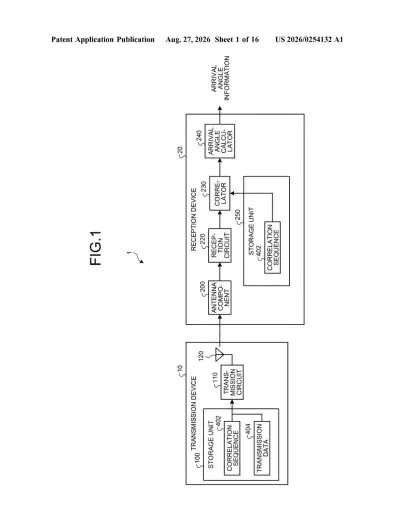
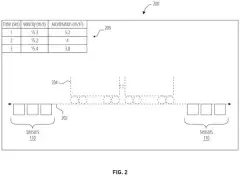
Sony's patent describes a different approach: string several antennas together on one shared wire, like beads on a necklace. Each antenna picks up the incoming signal and passes everything along that single line. A processor at the end then compares what each antenna received and uses the tiny time differences between them to calculate the arrival direction of the signal.
The idea is to do more with less wiring. Instead of routing separate cables to every antenna, you get direction-finding capability from a simpler, more compact hardware layout. That could matter for radar sensors, location tags, or any gadget where space is tight.
an antenna component including a plurality of antenna elements that receives a predetermined radio wave transmitted from a predetermined transmission device, and a transmission line that connects the plurality of antenna elements in series and transmits a radio wave received by each of the antenna elements; …
Translation: A series of linked antennas catches incoming signals along a connected line.
How the correlator turns daisy-chained antenna data into an angle
The patent describes a reception device built around three main parts.
- Antenna component: Multiple antenna elements wired together in series on a single transmission line. Each element captures the incoming radio wave independently, but they all share that one wire back to the processor.
- Correlator: A processing unit that reads the signals from each antenna off the shared line and calculates the correlation (essentially, how closely the signal from each antenna matches a known reference signal, and by how much it is shifted in time or phase). Those shifts are the raw data that reveal direction.
- Arrival direction calculation unit: Using the correlation results, this unit works out the angle from which the radio wave arrived. The principle is similar to how your ears determine which direction a sound came from: two receivers separated by a small distance each hear the same thing at slightly different times, and the brain triangulates from that difference.
The key engineering choice is the series transmission line. Instead of parallel wiring (one cable per antenna), all antennas share one cable. This simplifies the physical layout significantly but introduces a challenge: signals from antennas farther down the chain travel a longer distance to the processor, which means each antenna's signal arrives with a slightly different inherent delay. The correlator has to account for that when computing the true arrival angle.
… a correlator that acquires the radio wave via the transmission line and calculates a correlation between the radio wave received by each of the antenna elements and the predetermined radio wave; and an arrival direction calculation unit that calculates an arrival direction of the radio wave on the basis of the calculated correlation.
Translation: Specialized software compares the timing of signals across the antennas to figure out where they came from.
What this means for compact radar and location hardware
Direction-finding is the core capability behind radar, indoor positioning, drone detection, and some styles of wireless localization. Devices that can do it compactly, without a tangle of wiring, are easier to embed in consumer electronics, vehicles, or infrastructure hardware. Sony Semiconductor Solutions makes components that end up inside many other companies' products, so a simpler antenna architecture here could flow downstream into a wide range of sensors.
The design does make a real tradeoff: a shared transmission line is less expensive to build but introduces signal degradation and coupling noise that parallel wiring avoids. Whether Sony's correlator can compensate cleanly enough for demanding applications, like precise indoor positioning or automotive radar, is the open question this patent does not fully answer. Antenna and radar direction-finding are among the new Big Tech patents appearing across semiconductor makers as the push to shrink sensing hardware into consumer and automotive devices accelerates.
That makes this Sony's seventh filing in the sensor patents we cover since June, which already includes one on farm soil moisture and one merging mismatched 3D sensors.
Source: US 2026/0254132 A1 at the USPTO (PDF). Full patent text and figures are in the official publication.
Get our take in your Top Stories
Liked this breakdown? Add Patentlyze as a preferred source on Google, and our plain-English take shows up more often in your Top Stories the next time Sony patent news breaks.
Add Patentlyze on Google
One click.
There are more where this came from
We read the new patents from Big Tech, carmakers and more and send you the ones worth knowing. Plain English, free, every week.
The drawings · 16 sheets
16 drawing sheets from US 2026/0254132 A1 · click any drawing to enlarge


Show the other 8 sheets


More from Sony
All 722 Sony patents →
More in Hardware
All 2,375 Hardware patents →
Samsung
Samsung Patents an Air Conditioner That Adjusts Based on Where You Move
Samsung
Samsung Patents a Two-Sensor Method for Telling When You're Actually Wearing a Device
Tesla
Tesla Patents a Soda Ash HVAC Filter That Stops Bacteria Growing in Your Car
Disney