
Qualcomm Patents a System That Alerts Networks When a Device Goes Off-Route
Your phone always knows where it is, but it rarely knows when something about that location feels wrong. Qualcomm has filed a patent for a system that watches a device's motion and surroundings in real time and fires off an alert the moment they stop matching what was expected.
How Qualcomm's off-route detection actually works
Ever driven a route you've taken a hundred times and suddenly realized something felt off before you could explain why? That gut feeling is essentially what Qualcomm is trying to build into wireless devices.
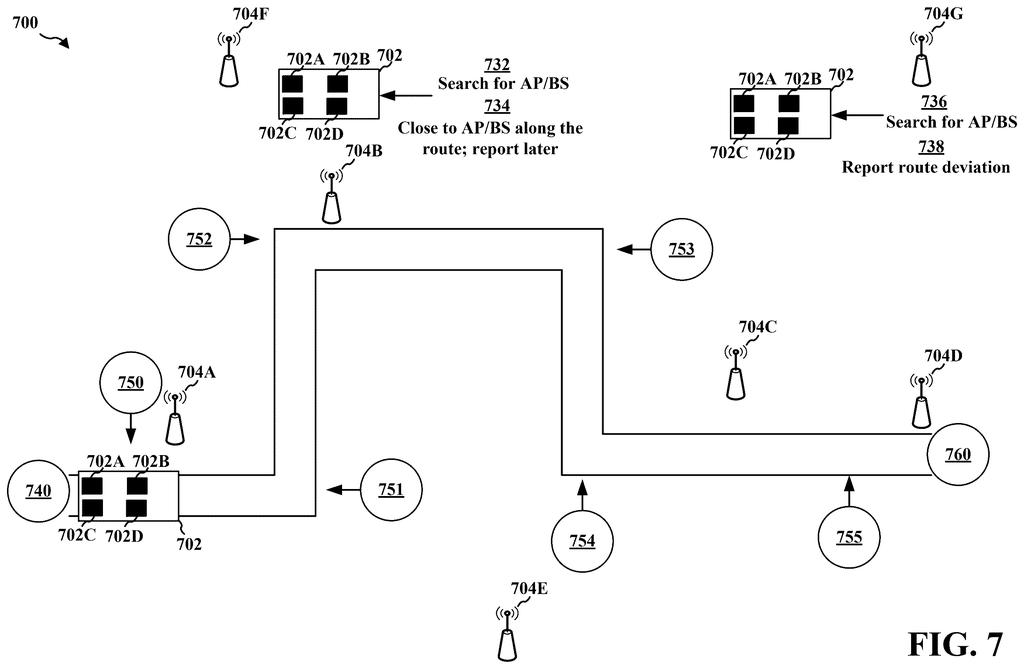
The patent describes a system where a phone or connected device monitors its own movement and its surroundings as it travels along a known route. If what the device is actually doing, such as its speed, direction, or the wireless signals around it, doesn't match what the system expected to see at that point on the route, the device automatically sends a report to flag the discrepancy. You don't have to notice anything or push a button; the device catches the mismatch and communicates it on its own.
Think of it like a motion tripwire: set expectations for a path, and the system monitors until reality and expectation stop lining up. At that point, it tells the network something unexpected has happened.
… transmit, when the obtained information is inconsistent with at least one of an expected motion pattern of the device or an expected environmental pattern of the device along the route, information indicating that the obtained at least one of the motion information or the environmental information is inconsistent …
Translation: The device sends an alert if its movement or surroundings do not match what was expected for its planned path.
How the device compares live motion to expected patterns
The patent centers on what Qualcomm calls motion-triggered waypoint reporting. A device, which could be a smartphone, a vehicle module, or an IoT tracker, collects two kinds of data as it moves along a route.
- Motion information: speed, direction, acceleration, or other physical movement data gathered by onboard sensors.
- Environmental information: signals from the surrounding wireless environment, such as nearby cell towers or access points, that change predictably as a device moves through space.
The system compares this live data against expected patterns (pre-stored or server-provided baselines for what motion and environment should look like at each waypoint on the route). When the observed data is inconsistent with those expectations, the device transmits an alert describing the mismatch. The transmission is conditional: if everything matches expectations, nothing is sent, which preserves bandwidth.
The logic can live on the device itself or on a server that receives raw data and runs the comparison remotely. That flexibility means the same approach could apply to a budget GPS tracker with minimal processing power or a full-featured connected car.
The apparatus may obtain, along a route of the device, at least one of motion information of the device or environmental information associated with the device.
Translation: The system tracks the device's movement and its immediate surroundings as it travels along a set path.
What this means for location accuracy and connected devices
Location reporting today tends to be either continuous (draining battery and clogging networks) or interval-based (missing the moments that actually matter). A system that only speaks up when something looks wrong is a practical improvement for fleet management, package tracking, asset monitoring, and emergency response, where the interesting event is precisely when a device stops behaving as expected.
The deeper value is in reducing noise: instead of a server processing thousands of routine location pings, it only has to act on reports that flag a real anomaly. Qualcomm already supplies the modem chips inside a huge portion of the world's smartphones and connected devices, so a reporting standard built at the chip level could propagate widely. Wireless location patents are a steady thread among the new Big Tech patents Patentlyze tracks, and this filing adds a behavioral-mismatch trigger to an otherwise crowded field of passive location schemes.
Qualcomm's 309th filing among the patents we've tracked in our Qualcomm coverage since May adds to a run that includes phones reporting AI capacity and finding devices by microphone.
The problem this patent attacks is real and measurable: continuous location pinging wastes battery, saturates networks, and still manages to miss the exact moment a delivery truck takes the wrong turn or an asset leaves a geofenced zone. Qualcomm is not solving a theoretical edge case. The conditional-transmission approach, only report when something is wrong, is well matched to the scale of the problem because it converts a volume problem (too many routine pings) into a signal problem (only meaningful alerts reach the server). Whether the expected-pattern baselines are accurate enough in the messy real world to keep false alerts low is the open engineering question this document leaves unanswered.
Get our take in your Top Stories
Liked this breakdown? Add Patentlyze as a preferred source on Google, and our plain-English take shows up more often in your Top Stories the next time Qualcomm patent news breaks.
There are more where this came from
We read every patent application Big Tech publishes and send you the ones worth knowing. Plain English, free, every week.
The drawings
21 drawing sheets from US 2026/0247103 A1 · click any drawing to enlarge


Show the other 13 sheets


Want this weekly breakdown for a company we don't cover? Patentlyze Pro →
Be the first to weigh in