
Disney Patents an AI That Matches Bonus Content to Shows and Their Viewers
Disney has filed a patent for a system that picks supplemental content, think ads, trailers, or bonus clips, by scoring how well each option fits both the show being watched and the specific person watching it.
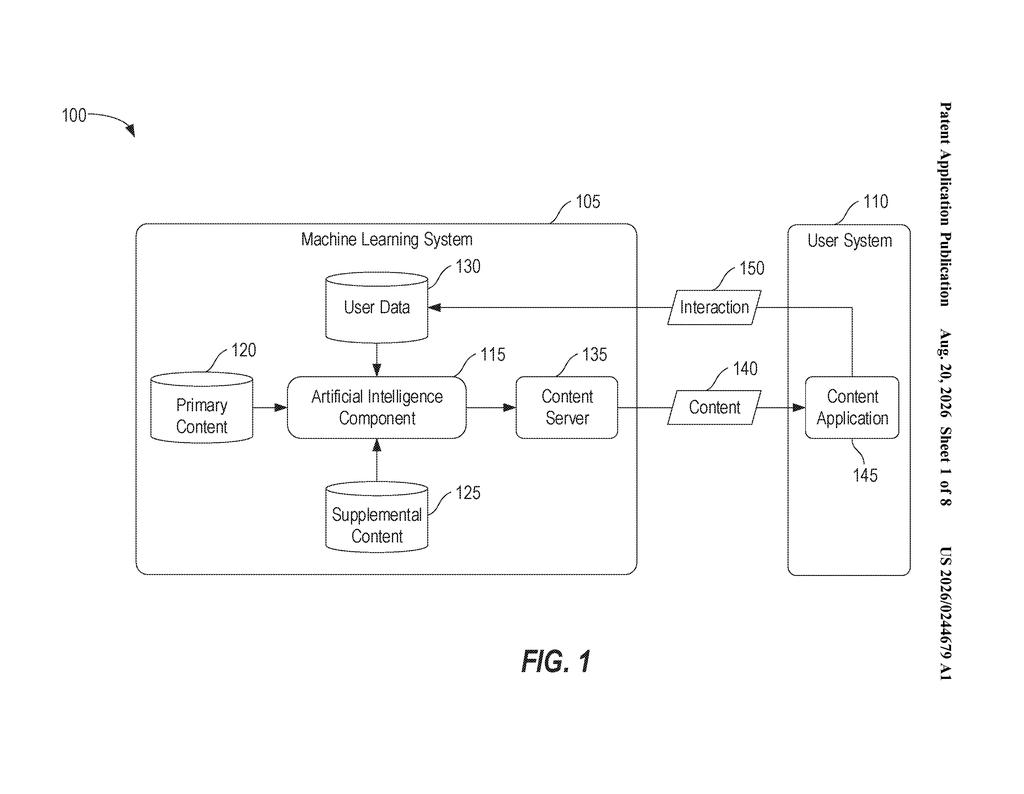
What Disney's content-matching AI actually does for viewers
You're deep into a movie on a streaming service, and an ad break hits. Instead of a random car commercial, you get a trailer for a sequel in the same franchise. That's the kind of moment this patent is designed to create, and it describes a system for making it happen automatically.
Disney's patent describes an AI model that holds three pieces of information at once: what it knows about you as a viewer, what it knows about the show or movie you're watching, and a list of candidate pieces of supplemental content (ads, bonus clips, trailers). The model scores each candidate on how well it fits the combination of your profile and the media, then picks the best one.
The key idea is that the decision isn't just based on your history or the show's genre, but on how all three factors interact together. A trailer might score high for a sci-fi fan watching a thriller but lower for a casual viewer watching the same film.
… generating a set of interaction scores based on processing the user embedding, the media embedding, and the set of supplemental content embeddings using an interaction machine learning model, wherein the set of interaction scores indicate predicted cohesion between the media content item and each of the candidate supplemental content items …
Translation: The system uses AI to calculate how well a specific piece of bonus content fits with both the show and the viewer.
How the interaction model scores each content candidate
The system works by representing three different things as embeddings (numerical summaries that capture meaning in a format a machine can compare). One embedding represents the user, one represents the media content item being watched, and a set of embeddings represents the pool of candidate supplemental content items.
All three are fed into what the patent calls an interaction machine learning model. This model is specifically designed to evaluate how the three pieces relate to one another, not just how similar the user is to the content in isolation. It outputs a set of interaction scores, each one representing the predicted "cohesion" (how naturally a candidate item fits) between the show and one of the candidates, given the viewer's profile.
The candidate with the best score is selected as the supplemental content for that request. The patent emphasizes the multimodal nature of the approach:
- User data (viewing history, preferences) informs the user embedding
- The show's metadata and content inform the media embedding
- Each ad or bonus clip is represented by its own embedding
By processing all three simultaneously, the model can catch interactions that a simpler, single-factor system would miss, such as a genre match that only matters for a particular viewer segment.
A request for supplemental content to be provided in association with a media content item is received, and a set of candidate supplemental content items for the request is determined. A user embedding corresponding to a user embedding corresponding to a user associated with the media content item …
Translation: The patent describes a process for identifying extra content by analyzing a digital profile of the person watching the show.
What this means for ads and extras on Disney's platforms
Disney runs several major platforms where supplemental content appears, including Hulu (which carries ads) and Disney+. A system that picks ads or extras based on a joint model of the viewer and the specific show being watched could improve relevance scores and, from a business standpoint, ad performance. The patent covers the selection logic itself, not a new ad format, so it could sit inside existing player infrastructure without requiring new client-side hardware.
The approach is software-only, which means the shortest path from patent to deployed feature is shorter than most AI filings that require new sensors or chips. What has to exist first is a robust embedding pipeline for users and content, something large streaming platforms typically already maintain. Disney's work here fits a broader pattern of media companies applying ML to content decisions that used to rely on simple rules, and it's the kind of filing that shows up regularly among the interesting tech patents in the streaming and ad-tech space.
Disney's 32nd filing in our Disney coverage since June adds to a run that includes ride vehicle tracking and projecting onto moving surfaces.
From a production standpoint, this idea has a clear path to reality. The building blocks Disney needs already exist inside Hulu: viewer profiles, show data, and ad libraries. The real work is training the software that connects them.
The patent describes something specific enough to protect an actual system, not just a broad concept. Disney is not patenting a dream. It is documenting infrastructure that likely already has a home inside Hulu's ad business.
There are more where this came from
We read every patent application Big Tech publishes and send you the ones worth knowing. Plain English, free, every week.
The drawings
8 drawing sheets from US 2026/0244679 A1 · click any drawing to enlarge


Want this weekly breakdown for a company we don't cover? Patentlyze Pro →
Be the first to weigh in