
Microsoft Patents an AI System That Builds Web User Profiles From Scattered Browsing Data
Every click, scroll, and search you make online tells a story, but the raw data is a mess. Microsoft has filed a patent for an AI pipeline that reads all of that chaos and condenses it into a clean, structured profile that any downstream service can actually use.
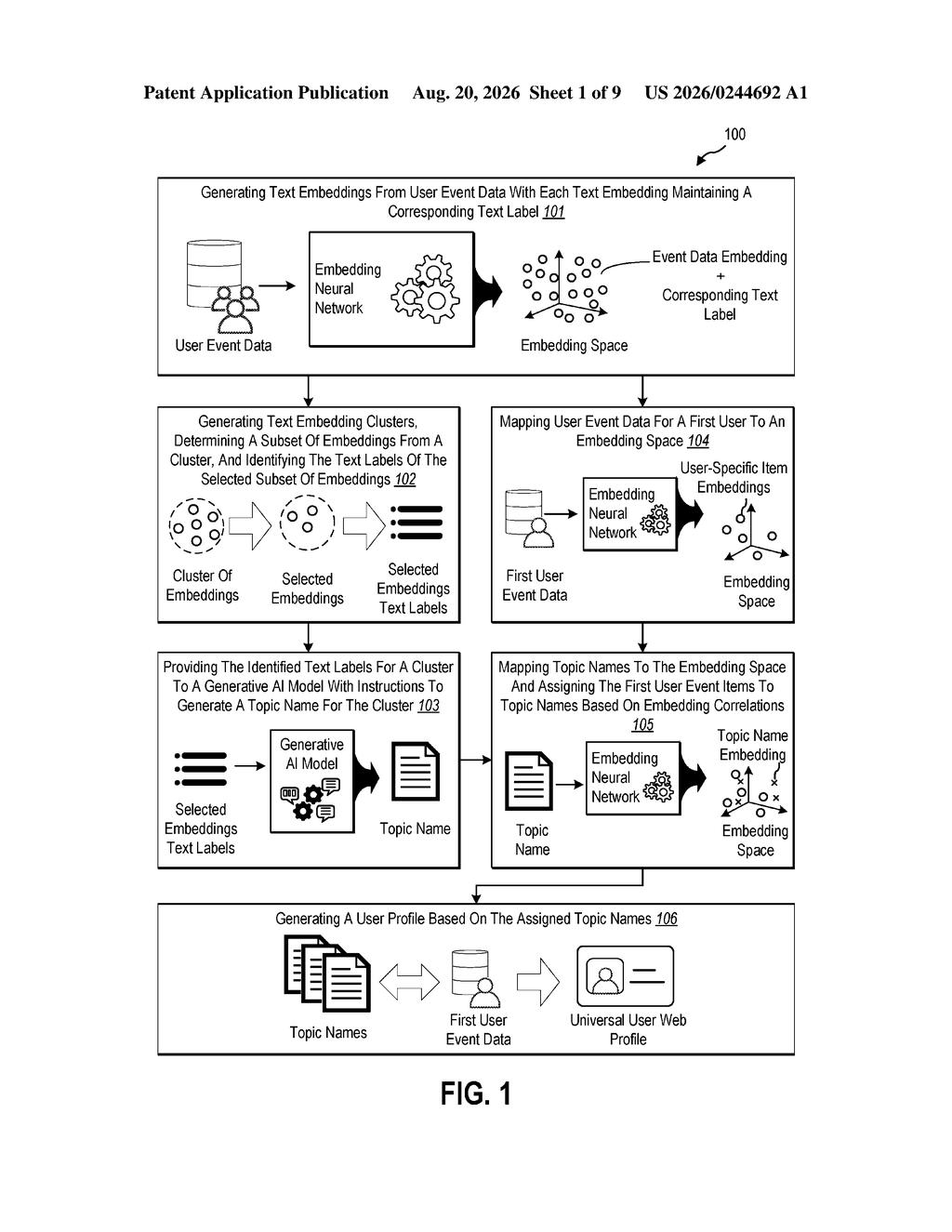
How Microsoft's AI turns your browsing into a tidy profile
Imagine you visit a dozen websites in one afternoon: a recipe blog, a sports highlights page, a flight-search tool, a news article about electric vehicles. Each of those sites logs that visit differently, using its own labels and categories, which means the picture of you that any one service sees is patchy and inconsistent.
Microsoft's patent describes an AI system designed to fix that. It takes all those scattered browsing events, groups them by meaning rather than by which site used which label, gives each group a plain-language name ("cooking enthusiast" or "travel planner," for example), and then builds a single universal profile for you that any service on the platform can read the same way.
The goal is consistency: instead of every ad, recommendation, or personalization tool having to decode its own version of your history, they all draw from the same tidy summary. You probably wouldn't notice the system directly, but it's the kind of infrastructure that makes recommendations feel less random.
converting a set of user events with text labels into a set of embeddings; determining a subset of embeddings within a first embedding cluster; identifying a subset of text labels that are assigned to the subset of embeddings within the first embedding cluster; …
Translation: The system groups labeled browsing actions into clusters of related data points.
How the system clusters events and names the topics
The system works in a few distinct steps, each handled by a different layer of AI.
- Event conversion: Raw browsing events (page visits, clicks, searches) each carry a text label describing what happened. The system converts those labels into embeddings, which are numerical representations that capture the meaning of each label so that "best pasta recipe" and "easy dinner ideas" end up close together in a mathematical space, even though the words differ.
- Clustering: A neural network groups the embeddings into clusters. Events that share underlying meaning land in the same cluster, regardless of which site generated them or what vocabulary that site used.
- Topic naming: Here is where a generative AI model (think a large language model) comes in. It looks at all the text labels inside a cluster and produces a single, human-readable topic name for that cluster, a concept like "home improvement" or "sports betting."
- Profile assembly: The system checks how strongly each user's events correlate with each named topic, then writes that user's profile using those topic names as structured fields.
Because all profiles use the same set of topic names (the "universal taxonomy"), any service that reads them gets a consistent view of the user, without needing to translate or reconcile different labeling conventions.
… generates universal web profiles for users by consolidating extensive user data into a concise and insightful format.
Translation: It boils down massive amounts of scattered browsing history into a single clean summary.
What this means for personalization and ad tech
For the average person, this filing sits firmly in the plumbing layer of the internet: the part you never see but that shapes what ads, recommendations, and search results you get. A well-built universal profile means those suggestions pull from a more complete picture of your interests rather than whatever narrow slice of data one particular service happened to capture. A poorly built or inconsistent one means the recommendations feel like they were made for someone else entirely.
For Microsoft, whose advertising and cloud businesses both depend on turning user data into actionable signals, a standardized profiling layer has obvious strategic value. The AI-generated taxonomy step is the piece worth watching: it is what lets the system stay current as new kinds of browsing behavior emerge, without requiring engineers to hand-code new categories every time. Coverage of filings like this one sits squarely in the Big Tech patent news that tracks how ad tech and personalization infrastructure is being rebuilt around generative AI.
Microsoft's tenth filing we've tracked in our AI assistants that remember you watch since June builds on earlier applications like one routing tasks across devices and one adapting prompts to documents.
If you have ever clicked through a recommendation that felt completely off, this patent is designed to prevent exactly that. The concrete payoff is consistency: a single AI-generated summary of your interests that every service on a platform reads the same way, rather than each service building its own incomplete version. Most users will never notice the change if it works, but they will absolutely notice when personalization is wrong, and reducing that failure is what this system is built to deliver.
There are more where this came from
We read every patent application Big Tech publishes and send you the ones worth knowing. Plain English, free, every week.
The drawings
9 drawing sheets from US 2026/0244692 A1 · click any drawing to enlarge


Want this weekly breakdown for a company we don't cover? Patentlyze Pro →
Be the first to weigh in