Google
Google · AI / ML · Filed Apr 3, 2026 · USPTO published Aug 27, 2026 · Aug 27 release
Google Patents a Browser AI That Reads the Page Before Writing Your Reply
Google is patenting a browser feature that watches what web page you are on rewrites your rough-draft prompt to match the context of that page, and then hands the improved prompt to an AI to write your final reply. It is the difference between asking a friend "write something about my package" and asking them "write a shipping complaint to FedEx in a professional tone."
- Publication number
- US 2026/0252790 A1(US20260252790A1)
- Applicant
- GOOGLE LLC
- Filed · Published
- Apr 3, 2026 · Aug 27, 2026
- Inventors
- Benjamin Albert Azose, Max Benjamin Christoff
- Status when we published
- Waiting for an examiner
- Document
- 20 claims
- US classification
- 715/256
- Parent application
- Continuation of PCT/US2024/049449 (filed Oct 1, 2024)(PCTUS2024049449)
What Google's browser drafting assistant actually does
Imagine you are filling out a customer feedback form on a retailer's website. You type a loose note like "unhappy with delivery" into the text box and ask an AI assistant to help you write something. Normally the AI has no idea where you are or what the form is for, so its reply can be generic.
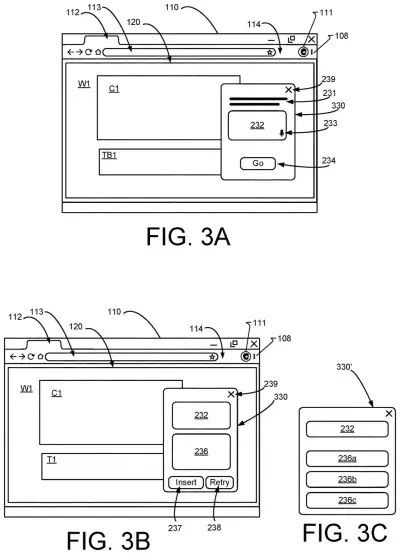
Google's patent describes a system that solves this by reading the page around that text box before it ever sends your request to the AI. It looks at things like the site's purpose, the tone of the surrounding text, and what kind of response the box seems to be asking for. It then silently rewrites your rough prompt to include all of that context, so the AI produces a reply that actually fits the form you are filling out.
The result you see is a draft that matches the style and purpose of the page, not just a generic answer to whatever you typed. You can accept it, edit it, or ignore it entirely.
… generating a modified prompt by adding words to the prompt based on context identified using the web page, the words including an instruction to phrase a response to the prompt in a style that is based on an attribute of the web page identified using the context …
Translation: The browser automatically rewrites your request to match the tone and style of the website you are currently visiting.
How the assistant rewrites your prompt using page context
The system sits inside a browser and activates when a user asks for help with a text box on a web page. The core trick is prompt engineering done automatically: instead of sending your raw, short instruction directly to a language model, the browser first enriches it.
Here is how the pipeline works:
- The browser scans the web page around the text box to gather contextual signals, things like the site category, nearby labels or headings, and the apparent tone of the page (formal support ticket vs. Casual review form).
- It generates a modified prompt by appending those signals to whatever the user typed, including an instruction telling the AI what writing style to use.
- That expanded prompt goes to a generative language model (a large AI text system, similar in kind to ChatGPT or Gemini).
- The model's response is returned and dropped directly into the text box as a ready-to-use draft.
The patent's key claim is the style-matching step: the assistant does not just answer the user's question, it answers it in the voice appropriate for that specific page. A legal complaint form would get formal language; a social media caption box would get something casual. That tonal matching is driven by attributes the system reads off the page automatically, not by the user configuring anything.
Implementations dynamically engineer/enhance prompts based on the context of the web page, thereby facilitating more accurate and relevant responses from the generative language model.
Translation: The system improves your AI prompts by automatically adding details from the webpage to get better results.
What this means for AI writing tools built into browsers
For everyday users, this is the difference between a generic AI writing tool and one that actually understands what you are trying to do. Most current AI assistants require you to spell out the context yourself, "write a formal apology email to a customer" rather than just "help me write this." Google's design offloads that work to the browser, which already has access to the page you are on.
The tradeoff worth watching is privacy: reading the content of a page to enrich your prompt means the browser is processing more of what you see, potentially including sensitive page content you did not explicitly share. That cost may be acceptable when the page is a public form, but it gets complicated on pages with personal data. Browser AI tools sit at the intersection of new tech patents in productivity, privacy, and natural-language interfaces, and this filing shows how much automatic context-gathering a single feature can require.
Google files its 26th patent we've tracked since May on AI assistants that remember you, building on earlier applications like recommending products through conversation and predicting words before you speak.
Source: US 2026/0252790 A1 at the USPTO (PDF). Full patent text and figures are in the official publication.
Get our take in your Top Stories
Liked this breakdown? Add Patentlyze as a preferred source on Google, and our plain-English take shows up more often in your Top Stories the next time Google patent news breaks.
Add Patentlyze on Google
One click.
There are more where this came from
We read the new patents from Big Tech, carmakers and more and send you the ones worth knowing. Plain English, free, every week.
The drawings · 7 sheets
7 drawing sheets from US 2026/0252790 A1 · click any drawing to enlarge


More from Google
All 1,127 Google patents →
More in AI / ML
All 2,745 AI / ML patents →
Microsoft
Microsoft Patents an AI System That Builds Web User Profiles From Scattered Browsing Data
Nvidia
Nvidia Patents a System That Lets AI Models Select Their Own Training Data
IBM
IBM Patents a System That Catches Two Types of AI Lies in Summaries
Adobe