
Intel Patents a Way to Decode Only the Parts of a Video Frame You Need
Intel has patented a way to make video decoders skip the parts of a frame nobody is looking at, potentially reducing the processing work needed for high-quality live video streams.
What Intel's selective frame decoding actually does
Imagine you're watching a live broadcast and the director has zoomed in on a single player on a football field. Your device is still decoding the entire video frame, including all the empty stands and sidelines nobody cares about in that moment.
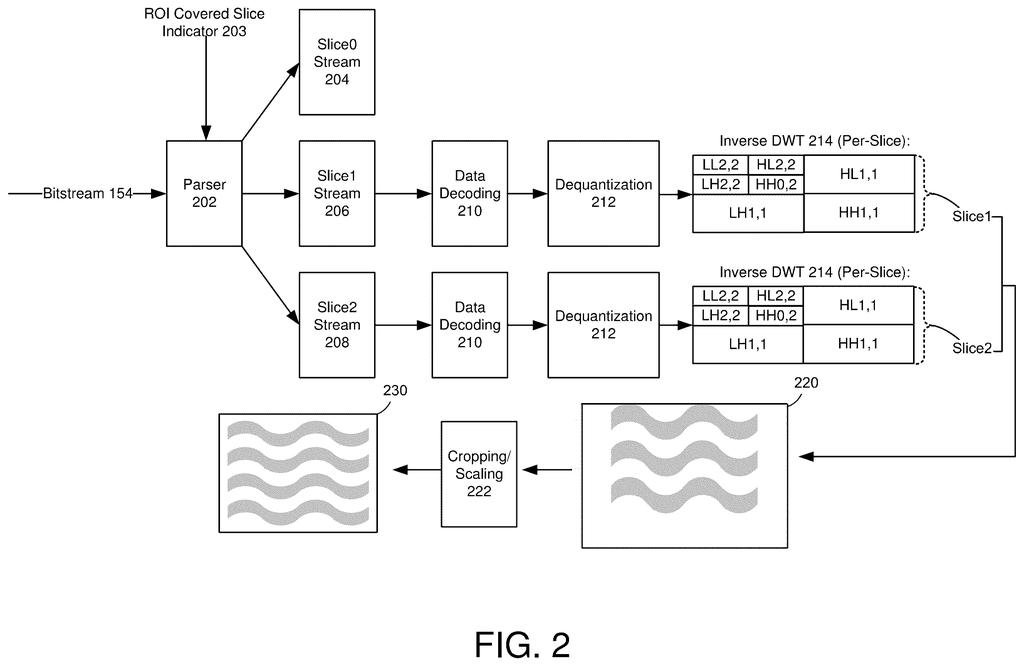
Intel's patent describes a decoder that can identify a region of interest inside a video frame and then simply throw away the surrounding slices before doing the heavy math of turning compressed data into a picture. The decoder processes only the part of the frame that matters, and stitches together a reconstructed image from that selected piece.
The compression format at the center of this is JPEG XS, a low-latency standard used in professional broadcast and media production. It's not the JPEG on your phone; it's a format built for studios and live production pipelines where every millisecond counts.
… discard the second slice based on the determination that the second slice is not located within a region of interest of the video frame …
Translation: The system throws away unneeded parts of the video to save processing work.
How Intel's decoder skips slices outside the region of interest
The patent describes a decoding pipeline built around JPEG XS, a compression format designed for professional video with very low processing delay. A standard JPEG XS decoder would process every slice of every frame regardless of whether that content is needed.
Intel's approach adds a selection step at the front of that pipeline:
- The decoder receives a compressed video bitstream and divides it into slices (rectangular sections of the frame).
- It checks each slice against a defined region of interest, a rectangular area of the frame that has been flagged as the part that matters.
- Slices that fall outside that region are discarded before any heavy decoding work begins.
- Only the relevant slices get the full treatment: an inverse wavelet transformation (a mathematical process that unpacks the compressed data back into pixel values) is applied to reconstruct them.
The output is a reconstructed video frame that contains the region of interest and omits everything else. This means the decoder avoids doing the most computationally expensive work on data that will be discarded anyway, saving processing cycles.
What this means for live video and broadcast hardware
For professional broadcast and live production workflows, JPEG XS is increasingly the format of choice precisely because it keeps latency low. Adding the ability to skip irrelevant frame sections could make decoders faster or allow lower-power hardware to handle streams that would otherwise require beefier chips. That has practical value in camera systems, remote production setups, and any pipeline where bandwidth or compute is a constraint.
The approach is fairly software-defined: JPEG XS already divides frames into independent slices by design, so the core infrastructure for this kind of selective decoding already exists in the format spec. Intel's contribution is the decision logic for what to skip and when, which puts this filing among the interesting tech patents targeting the broadcast and professional video chip space rather than consumer streaming.
This is the 56th chip patent from Intel we've tracked since May, adding to filings like one on faster matrix math and one on memory spying defense.
The idea is straightforward: when decoding a video stream, skip the parts of the frame nobody needs right now and only reconstruct the selected region. That is almost entirely a software decision, and the video format this targets already carves frames into discrete chunks that make skipping easy.
Getting from patent to product here is unusually short. A working decoder for this format already exists, and adding a discard step before reconstruction is an incremental change, not a rebuild from scratch.
The harder version, embedding this logic inside dedicated broadcast hardware, is not described in the document, so that remains an open engineering problem. As a software feature on top of existing tools, though, this one is close.
Get our take in your Top Stories
Liked this breakdown? Add Patentlyze as a preferred source on Google, and our plain-English take shows up more often in your Top Stories the next time Intel patent news breaks.
There are more where this came from
We read every patent application Big Tech publishes and send you the ones worth knowing. Plain English, free, every week.
The drawings
5 drawing sheets from US 2026/0254996 A1 · click any drawing to enlarge


Want this weekly breakdown for a company we don't cover? Patentlyze Pro →
Be the first to weigh in