
Apple Patents a Two-Sender System That Confirms Wireless Audio Delivery
Apple has filed a patent for a wireless audio system that uses two separate radio chips working in tandem to shuttle sound from a source device to a speaker, with no physical connection required at any point in the chain.
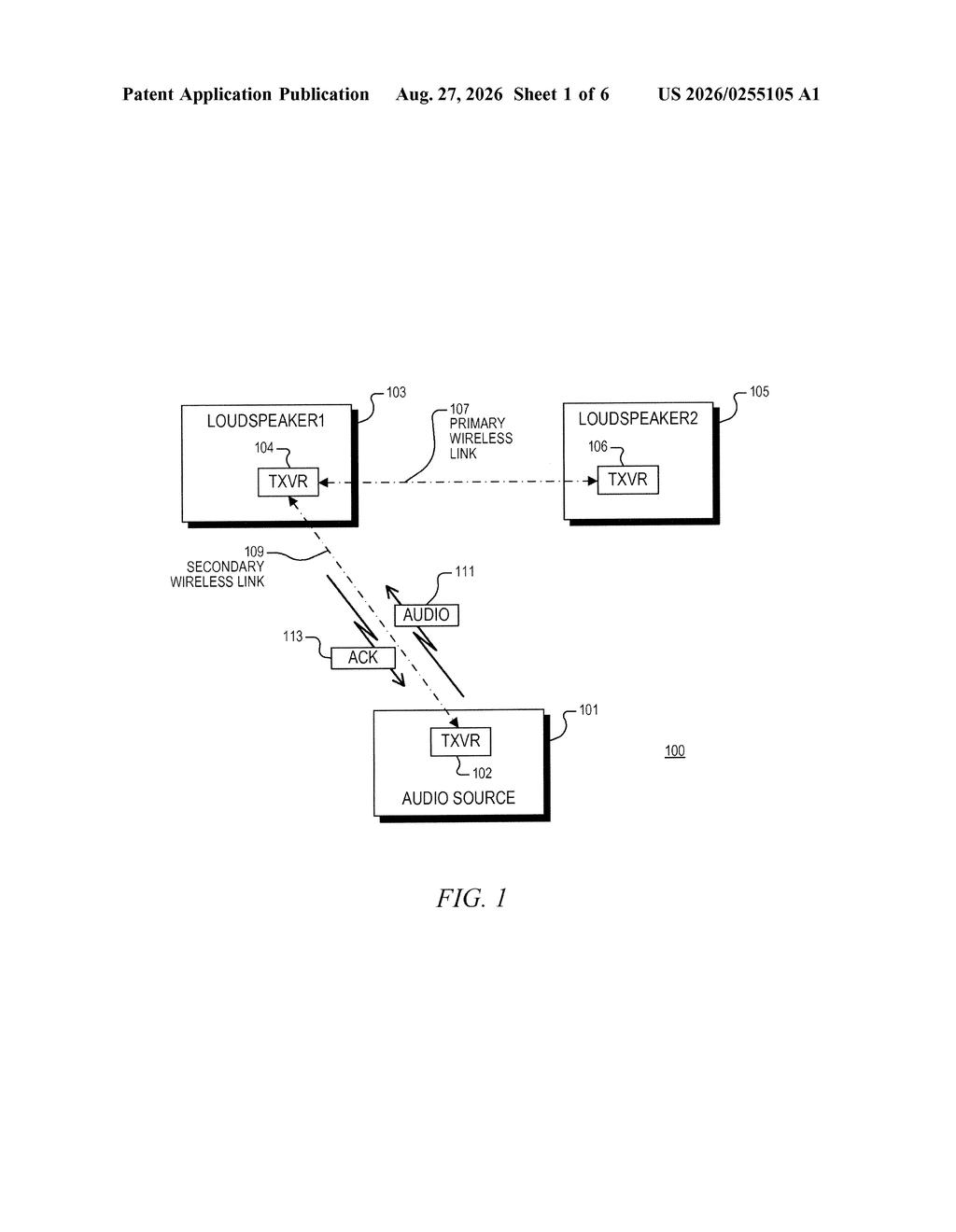
What Apple's untethered speaker setup actually does
You're setting up a speaker across the room and realize you've run out of ways to get audio there without running a cable or putting the source device right next to it. Apple's patent describes a fix for exactly that.
The idea is to use two small wireless radios as middlemen. One radio talks to your phone or tablet, confirms it received the audio correctly, then passes that audio along to a second radio via its own separate link. The speaker at the end of that chain plays the sound. No wires, no hub, no single point where the whole thing falls apart.
The system is designed around standard wireless protocols, meaning it would work with existing radio standards rather than requiring proprietary hardware on the source side. That makes it potentially compatible with a wide range of audio sources, not just Apple devices.
The first wireless transceiver establishes a bidirectional secondary wireless link with the audio source for receiving and acknowledging receipt of the audio information.
Translation: One speaker connects to the music player to receive songs and send confirmation messages back.
How the two transceivers split the audio relay job
The patent describes a wireless speaker system built around two transceivers (radio chips that can both send and receive signals). These two chips work as a relay team.
The first transceiver connects to the audio source (your phone, laptop, or streaming device) over what the patent calls a secondary wireless link. This link runs on a standard wireless protocol, such as Bluetooth or Wi-Fi. Crucially, the first transceiver sends an acknowledgment back to the source each time it successfully receives a chunk of audio data. That two-way handshake prevents the source from moving on before the audio is safely received.
The two transceivers then talk to each other over a separate channel called the primary wireless link. This internal link is distinct from the link to the audio source, which helps avoid interference and keeps the audio pipeline clean.
- Audio source sends data to Transceiver 1 via the secondary link
- Transceiver 1 confirms receipt back to the source
- Transceiver 1 forwards the audio to Transceiver 2 via the primary link
- Transceiver 2 delivers audio to the speaker output
The net result is a fully wireless chain from source to speaker, with built-in error checking at the first hop.
What this means for cable-free home audio setups
For everyday listeners, this kind of system would mean placing a speaker anywhere in a room without worrying about Wi-Fi dead zones, Bluetooth range limits, or which device needs to sit closest to the speaker. The two-transceiver relay effectively extends the reliable range of a wireless audio connection by breaking it into two managed hops instead of one long, error-prone one.
From a product standpoint, the architecture fits naturally with home audio gear where the speaker and its wireless radio are physically separate units. The filing covers wireless audio networking, an area where several of the newest Big Tech patents are pushing toward multi-device relay setups that reduce dependence on a single, centralized hub.
This is the 15th Apple filing in our chip patents we cover since May, which already includes one on faster 3D caching and one shrinking AI data on chip.
The hardware this patent describes already exists in everyday wireless earbuds and speakers, so getting from this document to a real product is mostly a software and coordination problem rather than a ground-up build. The key detail that would make it feel reliable is the confirmation loop, where the receiving speaker signals that it actually received the audio before the system moves on.
What the filing leaves open is how much delay that two-hop routing adds, and that gap matters because once sound drifts more than a fraction of a second behind what you see on screen, listeners notice immediately. The document offers no answer to that, so either the solution lives elsewhere or it remains a real obstacle.
As a foundation, this is credible and close. Nothing here requires an entirely new category of device to exist first, which means the shortest path to a product is shorter than most patents suggest.
Get our take in your Top Stories
Liked this breakdown? Add Patentlyze as a preferred source on Google, and our plain-English take shows up more often in your Top Stories the next time Apple patent news breaks.
There are more where this came from
We read every patent application Big Tech publishes and send you the ones worth knowing. Plain English, free, every week.
The drawings
6 drawing sheets from US 2026/0255105 A1 · click any drawing to enlarge


Want this weekly breakdown for a company we don't cover? Patentlyze Pro →
Be the first to weigh in