
Samsung Patents a Screen Coating That Cuts Glare Without Sacrificing Scratch Resistance
Samsung is trying to solve one of the oldest trade-offs in screen design: the more you reduce glare, the easier it is to scratch the surface. A new patent describes a coating that tackles both at the same time.
What Samsung's layered screen coating actually does
Every time you pull your phone out under bright sunlight, you're fighting glare from the screen's outer surface. That glare comes from light bouncing off the glass or film on top of the display, and cutting it usually means applying a softer anti-reflective layer that scratches more easily.
Samsung's patent describes a coating built from three distinct chemical layers stacked in a specific order. One type of molecule handles low reflection, another handles hardness, and a third blends both. By arranging them in a precise sequence, the coating can be both harder and less reflective than existing single-layer approaches.
The result, if it works as described, is a screen surface that looks clearer outdoors and holds up better to everyday wear. That combination is especially useful for foldable phones, where the flexible screen cover is already under more mechanical stress than a flat pane of glass.
… the refraction layer comprises a first silsesquioxane copolymer comprising a fluoro-based silsesquioxane polymer chain; a second silsesquioxane copolymer comprising an acrylic-based silsesquioxane polymer chain; and a third silsesquioxane copolymer comprising the first silsesquioxane copolymer and the second silsesquioxane copolymer …
Translation: The screen coating is made of three distinct chemical layers that combine fluorine and acrylic materials.
How the three-layer silsesquioxane stack is built
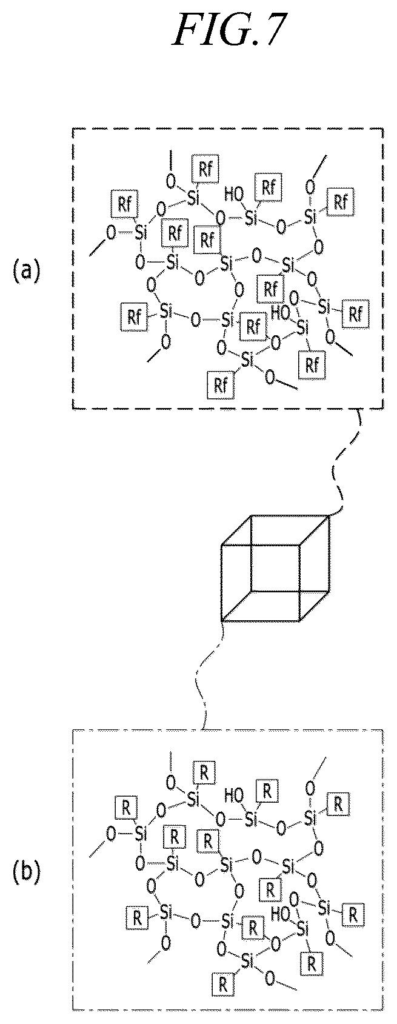
The patent centers on a refraction layer, a thin coating placed on top of a base film, which is the flexible sheet that sits over a display panel. The refraction layer is made from a family of materials called silsesquioxanes (cage-like silicon-oxygen molecules that can be tuned to be either hard or slippery depending on what chemical groups are attached to them).
Three distinct versions of this material are used:
- First copolymer: fluoro-based (fluorine-rich), which gives low surface energy and low light refraction, meaning less glare and better anti-smudge properties.
- Second copolymer: acrylic-based, which contributes hardness and structural rigidity.
- Third copolymer: a blend of both, acting as a chemical bridge between the other two layers.
Critically, these are not just mixed together. They are sequentially laminated, meaning the acrylic layer goes down first, then the blended layer, then the fluoro layer on top. That ordering matters because it creates a gradual transition in physical properties from stiff-at-the-bottom to slippery-at-the-top, rather than forcing two incompatible materials to coexist at the same depth.
The manufacturing method involves depositing each copolymer in turn, most likely through a coating or vapor process, so the final stack is only a few hundred nanometers thick but structurally distinct across its depth.
… the present disclosure provides a window having low-refraction characteristics and high-hardness characteristics by sequentially depositing copolymers respectively including a fluoro-based silsesquioxane polymer chain, an acrylic-based silsesquioxane polymer chain and a fluoro-based silsesquioxane polymer chain, and an acrylic-based silsesquioxane polymer chain …
Translation: Samsung creates a screen that is both resistant to scratches and effective at reducing glare by layering specific polymers.
What this means for foldable and flexible displays
For foldable phones, the outer screen layer is a known weak point. Flexible covers made from plastic-like films scratch far more easily than the glass on a conventional phone, which is why most foldables still carry visible handling marks after a few weeks of use. A coating that can deliver both low glare and meaningful scratch resistance at a thin, flexible scale would directly address one of the category's most common complaints.
This is a materials-chemistry filing, not a software update, so there is real manufacturing work between this patent and a shipping product. The chemistry described here would need to be validated at scale, integrated into an existing production line, and tested for durability over thousands of folds. Samsung Display, the subsidiary filing this patent, supplies panels to Samsung Electronics and other device makers, so any successful coating could appear across a range of products rather than a single phone. The latest Big Tech patents in the flexible-display materials space show a steady push to close the durability gap between foldable film covers and traditional glass, and this filing sits squarely in that effort.
That makes this Samsung's 88th filing we've tracked in our display technology watchlist since May, adding to work like the angle-aware notification screen and multi-screen chip sync.
Samsung has found a specific stacking order for three coating layers on a screen surface, each with a different job, that together reflect less light and resist scratches better than either property alone. The chemistry is precise and the target is clear.
Getting this onto an actual phone requires answering a question the patent does not touch: whether those layers survive a foldable screen bending hundreds of thousands of times without peeling apart. That is years of physical testing, separate from whether the formula works in a laboratory.
If the durability question gets resolved, the result is a foldable screen that handles daily life without needing a protective case, which is something most people would notice immediately. That practical destination is what makes slow, careful materials research matter.
Get our take in your Top Stories
Liked this breakdown? Add Patentlyze as a preferred source on Google, and our plain-English take shows up more often in your Top Stories the next time Samsung patent news breaks.
There are more where this came from
We read every patent application Big Tech publishes and send you the ones worth knowing. Plain English, free, every week.
The drawings
10 drawing sheets from US 2026/0255515 A1 · click any drawing to enlarge


Want this weekly breakdown for a company we don't cover? Patentlyze Pro →
Be the first to weigh in