
Samsung Patents a Way to Keep Multiple Screens Perfectly in Sync on One Chip
Every time a device drives two or more screens at once, there's a hidden timing problem: keeping all those image streams perfectly aligned so they don't flicker, tear, or drift apart. Samsung's new patent tackles that at the chip level.
What Samsung's display sync patent actually does for your screen
A pair of monitors on a gaming PC shows the same scene from two angles, but one screen stutters a half-frame behind the other. The image tears right at the edge where they meet, and the whole effect falls apart. That mismatch is the problem Samsung is trying to solve.
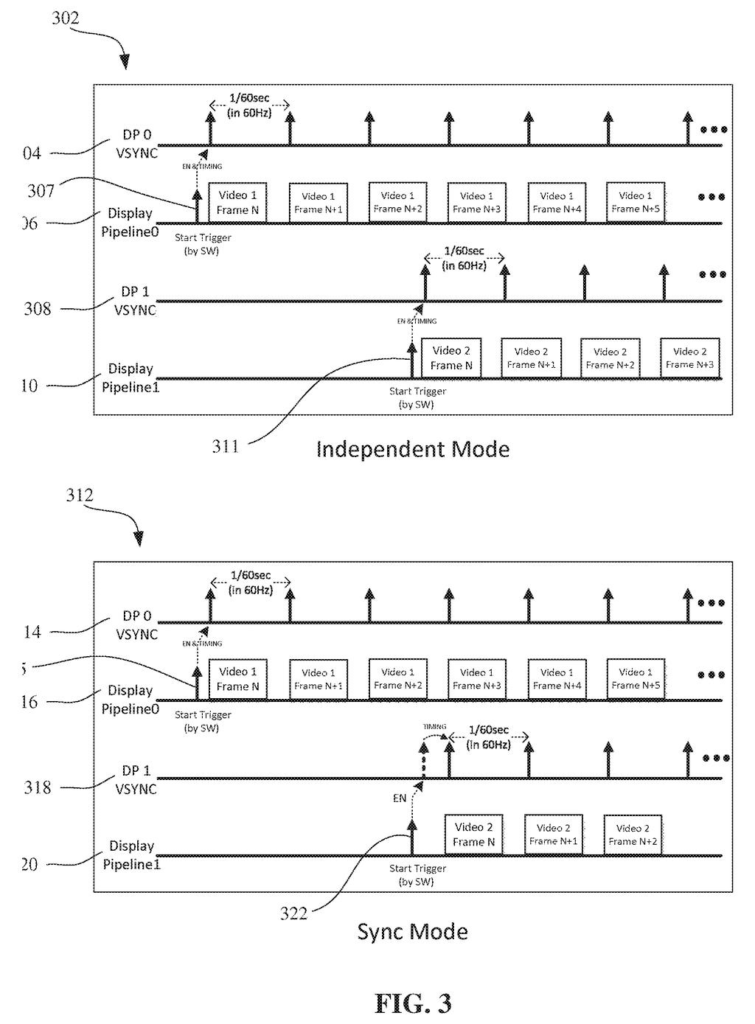
Samsung's patent describes a system inside a processor chip where one internal clock acts as the "conductor." When it fires, it sends a timing pulse to start the first display stream, and that same pulse immediately triggers a second clock for the second display. Because the second clock takes its cue from the first, both screens start their image cycles at exactly the same moment.
The result is that multiple screens driven by the same chip stay frame-perfectly aligned without extra software tricks or external synchronization hardware. Whether you're running two monitors, a phone with a secondary display, or a foldable screen with separate display halves, the frames should stay in lockstep automatically.
… starting the first video timer and outputting a first synchronization signal to the first display pipeline to initiate the first display stream and to the at least one second video timer; and generating, by the at least one second video timer, a second synchronization signal based on the first synchronization signal …
Translation: The master timer starts the process and tells a second timer when to begin.
How Samsung's video timers chain together to lock displays in step
At the core of every display is a video timer, a hardware counter that fires at regular intervals to tell the display pipeline when to push the next frame. On a device with two displays, you normally have two independent timers, and even tiny differences in when they start can cause visual mismatches.
Samsung's method solves this by making the timers talk to each other. The first video timer outputs what the patent calls a synchronization signal, a timing pulse that does two things at once: it kicks off the first display stream, and it is routed directly to the second video timer as a trigger. The second timer then generates its own synchronization signal based on that incoming pulse, so both display pipelines begin their cycles in phase with each other.
The patent also describes selectable synchronization signals, meaning the system can choose which timer signal to use as the trigger, giving chip designers flexibility when scaling up to three or more displays.
- First display pipeline: generates the primary display stream, driven by the master timer.
- Second display pipeline: generates additional streams, slaved to the primary timer's output.
- Display ports: carry the now-synchronized streams out to physical screens.
All of this happens inside the data processing unit (the chip), so no external synchronization hardware is needed.
By coordinating video timer outputs through selectable synchronization signals, multiple display pipelines can operate in precise temporal alignment to generate synchronized streams through one or more display ports.
Translation: Linked timers keep multiple screens working together in exact time.
What this means for multi-screen Samsung devices
For engineers building chips that drive two or more displays, frame sync is one of those problems that looks simple on paper and turns nasty in practice. A few nanoseconds of timing drift can produce visible screen tearing, inconsistent refresh rates, or flicker on foldable or multi-panel devices. Solving it in hardware, rather than patching it in software or requiring an extra component, keeps the design simpler and the result more reliable.
Samsung makes the processors inside many of its own Galaxy phones, tablets, and foldables, so a hardware-level display sync method is relevant across a wide product family. Chip teams, display engineers, and product planners working on any multi-screen device are the people this filing touches most directly, and for them it represents a tidy answer to a real design headache. Samsung's display-chip work sits alongside a broader wave of display-timing patents that plain-English patent summaries on Patentlyze have been tracking as foldable and multi-screen devices become more common.
Samsung has filed its 85th application we've tracked in our display technology watchlist since May, building on work like the noise-blocking touch layer and the curved-screen LED laser system.
Samsung's design puts one clock in charge of telling every screen when to update. If that clock breaks or is set up wrong, every screen fails at once.
For most devices, that is a fine trade. One carefully built clock is more reliable than juggling several independent ones. The weak spot is variety. Screens that need to refresh at different speeds, or that need their updates staggered rather than simultaneous, are harder to support. The patent's switchable signal option is the workaround Samsung built in for exactly those cases.
There are more where this came from
We read every patent application Big Tech publishes and send you the ones worth knowing. Plain English, free, every week.
The drawings
6 drawing sheets from US 2026/0244386 A1 · click any drawing to enlarge


Want this weekly breakdown for a company we don't cover? Patentlyze Pro →
Be the first to weigh in