
Samsung Patent Trains Microphones to Lock Onto Voices and Filter Out Noise
Samsung wants to teach an AI to do what expensive microphone arrays do today, and it plans to train that AI entirely on computer-generated fake audio rather than months of real-world recording.
How Samsung's synthetic audio training actually works
Most microphones pick up everything around them: your voice, background noise, echoes off walls, and the hum of appliances. The hardware trick that isolates just your voice, called beamforming, usually requires a careful setup of multiple microphones and a lot of signal processing that can't easily be handed off to a simpler AI model.
Samsung's patent describes a training system that sidesteps the need for huge libraries of real recorded audio. The device builds its own practice examples by pulling a clean voice from a database, adding simulated room echoes, and then layering in noise from another database, all in software. It then runs that noisy mix through a traditional beamforming process to produce a clean reference signal, and uses the difference between what the AI guesses and what beamforming produces to correct the AI over and over.
The end goal is an AI that can do the same focusing job on its own, without needing the full array of microphones or the heavy processing that traditional beamforming demands. For you, that could mean clearer voice calls or better voice-assistant pickup on a device with fewer microphones.
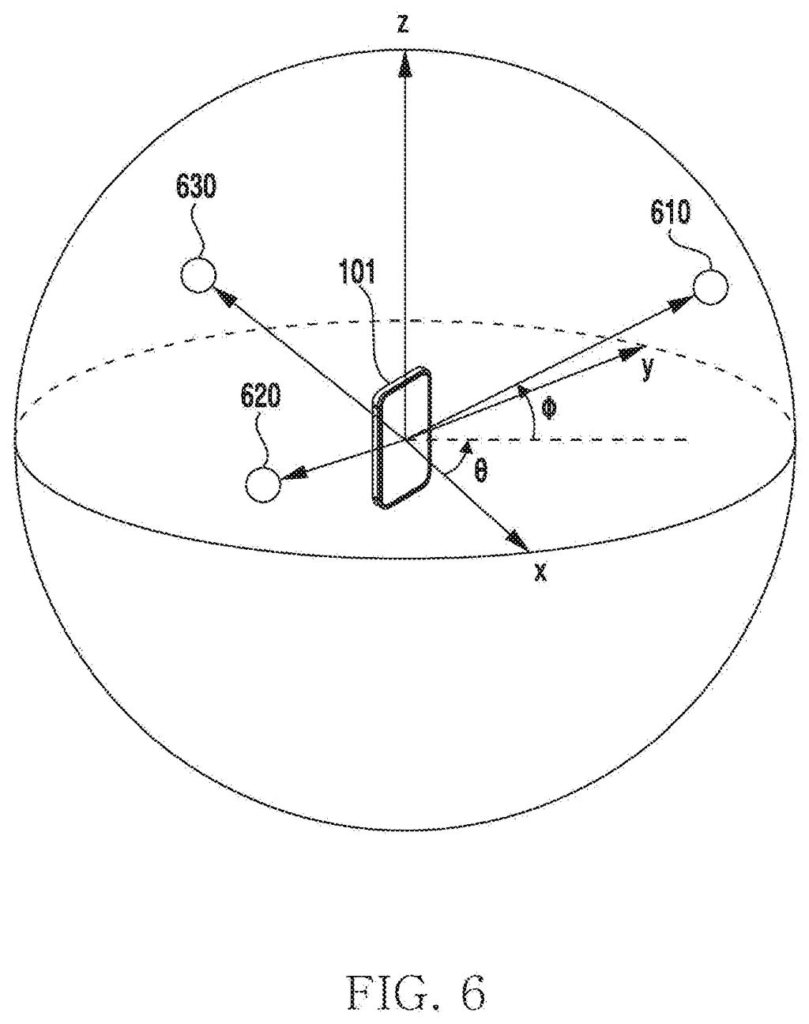
… generate an output audio signal based on the input audio signal by reducing the noise of the input audio signal and applying at least one of a beamforming direction or a beamforming beamwidth to the first audio signal of the input audio signal …
Translation: The device cleans up audio by filtering out background noise and focusing its microphones on a specific direction or width.
How the AI model learns from beamforming's output signal
The patent describes an AI training pipeline built entirely from synthetic audio. Here is how the pieces fit together:
- Sound source database: a library of clean voice recordings the system can sample from.
- Channel impulse response database: a collection of mathematical fingerprints that describe how sound bounces around different rooms. Applying one of these to a voice signal simulates how that voice would sound if spoken in, say, a tiled bathroom or a carpeted office.
- Channel noise database: a library of real-world background noises (fans, crowds, traffic) that get mixed into the simulated signal to make it realistically messy.
The device combines all three into a synthetic noisy recording, then runs it through a conventional beamforming process. Beamforming (focusing a microphone array on one direction, like pointing an invisible ear at a speaker) produces a clean output that acts as the gold-standard answer the AI is trying to match.
The AI model takes the same noisy input and produces its own version of the cleaned signal. The training loop measures how far apart the AI's answer and beamforming's answer are, then nudges the AI's internal parameters to shrink that gap, repeating until the AI can reliably replicate the beamforming result on its own.
Critically, the system trains the AI model on the device itself, not just in a data center, which means it can potentially keep adapting to new acoustic environments over time.
… generates an artificial intelligence (AI) adjustment output audio signal on the basis of applying an AI model to the input audio signal, and causes the AI model to be trained on the basis of reducing the difference between the AI adjustment output audio signal and the output audio signal.
Translation: The system improves its performance by comparing its AI results against a standard filter and learning from the difference.
What this means for voice pickup in Samsung devices
For Samsung, the practical payoff is a model that could deliver focused voice pickup without requiring a large, precisely spaced microphone array. That matters for thin phones, earbuds, smart speakers, and wearables where you cannot always fit four or more microphones at optimal distances. A well-trained AI model could approximate that hardware capability at lower cost and in a smaller footprint.
The design also sidesteps one of the most expensive parts of building audio AI: collecting and labeling hours of real recorded speech in real environments. By generating training data synthetically, Samsung can simulate acoustic conditions that would be hard or dangerous to record in the field. Audio processing is one of the steadier currents running through new Big Tech patents, and Samsung's approach here sits squarely in that stream, reflecting a broader push to replace fixed signal-processing hardware with models that can be updated in software.
That makes this Samsung's 64th filing we've tracked since May in our 5G and network work, adding to efforts like fixing overlapping emergency video and training AI across network nodes.
Samsung's system learns to filter out noise and echoes by practicing on a library of fake room recordings, which saves enormous time but surrenders something real: any room the library never imagined, whether a half-open door or an unusual wall material, can produce echoes the system has no training to handle. The AI is also measured against Samsung's existing audio-filtering pipeline, meaning it can only ever match that pipeline, not beat it.
That trade reads as cautious but honest, more about saving battery life and processing power than pushing sound quality forward. The sharpest unknown is where the learning actually happens, on a factory floor, a remote server, or your phone itself.
That single missing detail determines whether this technology improves your device over time or arrives fully baked and never grows, and it changes the story considerably.
Get our take in your Top Stories
Liked this breakdown? Add Patentlyze as a preferred source on Google, and our plain-English take shows up more often in your Top Stories the next time Samsung patent news breaks.
There are more where this came from
We read every patent application Big Tech publishes and send you the ones worth knowing. Plain English, free, every week.
The drawings
12 drawing sheets from US 2026/0252304 A1 · click any drawing to enlarge


Want this weekly breakdown for a company we don't cover? Patentlyze Pro →
Be the first to weigh in