Samsung
Samsung · AI / ML · Filed Apr 8, 2026 · USPTO published Aug 20, 2026 · Aug 20 release
Samsung Patents an AI Assistant That Auditions Answers Before Speaking
Most voice assistants grab the first answer they find and read it back to you. Samsung's new patent describes a system that gathers answers from several different sources, scores each one for relevance, and only then writes a final reply.
- Publication number
- US 2026/0244660 A1(US20260244660A1)
- Applicant
- Samsung Electronics Co., Ltd.
- Filed · Published
- Apr 8, 2026 · Aug 20, 2026
- Inventors
- Sangmin PARK, Gajin SONG, Kyungtae KIM
- Status when we published
- Waiting for an examiner
- Document
- 19 claims
- US classification
- 707/770
- Parent application
- Continuation of PCT/KR2024/096264 (filed Oct 10, 2024)(PCTKR2024096264)
How Samsung's multi-source voice assistant works
Imagine you ask your phone a question and, behind the scenes, it consults your calendar, a web search, and a local database all at the same time. Right now, most assistants pick one of those sources and run with it, whether or not it was the best fit.
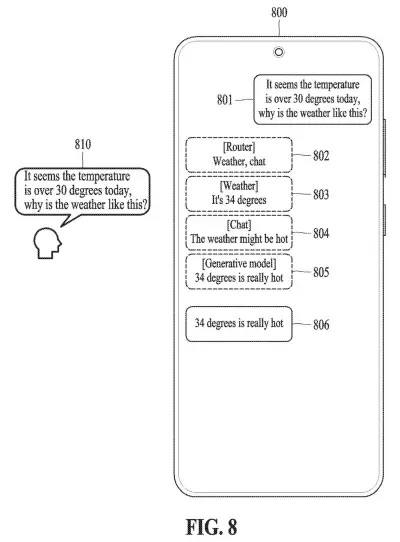
Samsung's patent describes a different approach. The device collects a batch of candidate answers from different types of sources, then measures how well each one actually matches what you asked. Only the most relevant answers move forward, and they get bundled into a single prompt that a generative AI model uses to write the final response you hear or read.
The practical effect is that your assistant's answer would be built on a cross-checked foundation rather than a single lucky guess. Think of it like asking three informed people the same question and then summarizing what they agreed on, instead of just taking the first person's word for it.
obtain a plurality of first responses from different types of data sources based on an intent of a user utterance, select one or more first responses from the plurality of first responses based on a correlation between each of the plurality of first responses and the user utterance …
Translation: The system gathers initial answers from various places and picks the most relevant ones.
How the device selects and ranks candidate responses
The patent outlines a four-step pipeline running on a device with at least one processor and local memory.
- Intent detection: The system first figures out what the user actually wants from the utterance, not just what words were used.
- Multi-source retrieval: It queries several different types of data sources simultaneously. The patent doesn't lock in which sources, but the framing implies a mix of on-device data, cloud databases, and possibly external APIs.
- Correlation scoring: Each candidate answer is evaluated against the original utterance for relevance. Answers that score below a threshold are dropped, so the noisy or off-topic ones never reach the final stage.
- Prompt generation and generative output: The surviving answers are assembled into a structured prompt, which is fed to a generative model (an AI that writes fluent text). The model's output becomes the response the user sees.
This architecture is a form of retrieval-augmented generation (RAG), a technique where an AI writes its answer by grounding itself in retrieved documents rather than relying purely on what it memorized during training. The patent's specific contribution appears to be the filtering step: selecting only the subset of retrieved answers that correlate well with the query before the generative model ever sees them.
… generating a prompt corresponding to the one or more first responses, outputting a second response based on a result output by a generative model using the prompt.
Translation: It feeds those selected answers into an AI model to produce a final reply.
What this means for Bixby and on-device AI replies
The filtering step is the part worth paying attention to. Generative AI models are sensitive to the quality of the context they're given: feed them bad or off-topic information and they can write confident-sounding nonsense. By screening candidate answers for relevance before building the prompt, Samsung's design tries to reduce that failure mode at the source.
For users, this would show up as an assistant that gives fewer confidently wrong answers, particularly on questions that touch multiple topics at once. Samsung's Bixby platform is the natural home for this kind of architecture, and the latest Big Tech patents in the AI-assistant space show nearly every major platform moving toward some version of retrieval-augmented generation as the baseline for on-device question answering.
Samsung's fifth filing we've tracked since July in AI models working together adds to a pattern that includes one promoting its best model and one for switching assistants mid-chat.
Source: US 2026/0244660 A1 at the USPTO (PDF). Full patent text and figures are in the official publication.
Get our take in your Top Stories
Liked this breakdown? Add Patentlyze as a preferred source on Google, and our plain-English take shows up more often in your Top Stories the next time Samsung patent news breaks.
Add Patentlyze on Google
One click.
There are more where this came from
We read the new patents from Big Tech, carmakers and more and send you the ones worth knowing. Plain English, free, every week.
The drawings · 11 sheets
11 drawing sheets from US 2026/0244660 A1 · click any drawing to enlarge


Show the other 3 sheets


More from Samsung
All 1,662 Samsung patents →
More in AI / ML
All 2,745 AI / ML patents →
IBM
IBM Patents an AI That Checks Its Own Confidence Before Answering Without a Full Team
Google
Google Patents a Way to Run Safety Drills on Its Own AI — No Humans Required
Google
Google Patents an AI That Rewrites Its Own False Answers Before You See Them
Google