
IBM Patents a Safety-Scoring System for Autonomous Vehicle Drop-Offs
When a self-driving car pulls up to drop you off, should it decide whether that corner is actually safe? IBM thinks so, and it has filed a patent to make it happen automatically.
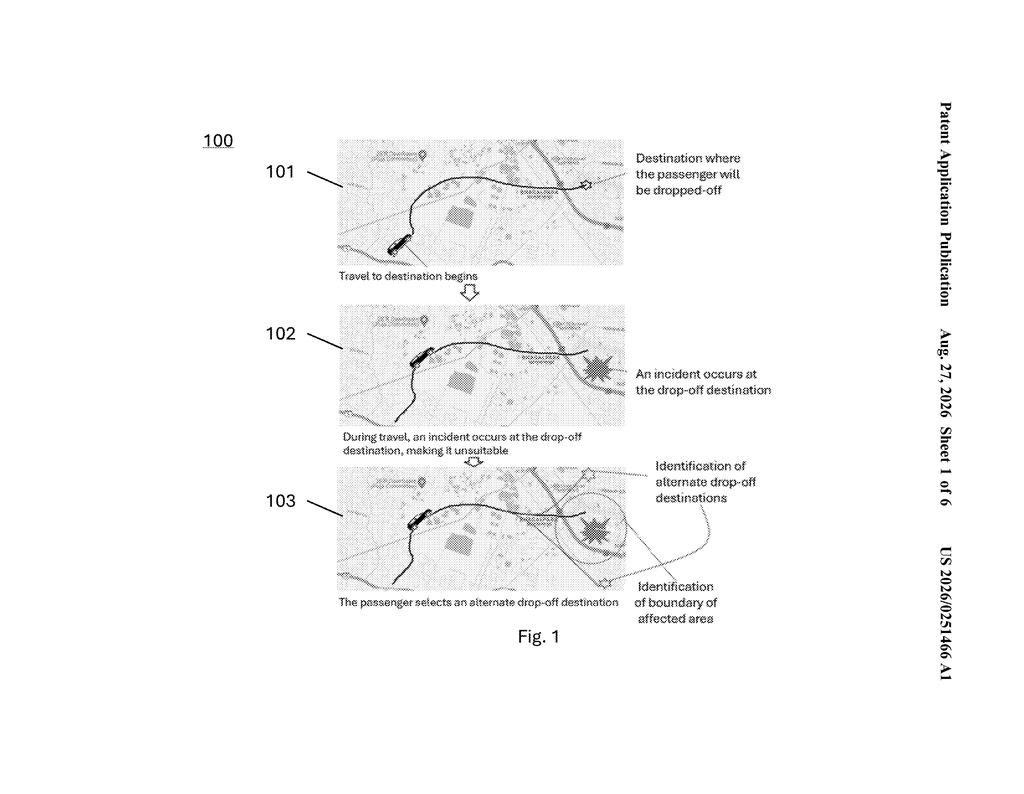
How IBM's AV drop-off risk score actually works
Imagine you book a self-driving taxi and the app sends it to drop you off on a dark, flooded street in the middle of a street-fair crowd. Today, most AV systems just go where you tell them. IBM's patent describes a way for the vehicle's software to check whether that destination is actually a safe place to let you out.
The system pulls in data about the drop-off location, such as local incidents, weather events, or crowd activity, and cross-references it with your passenger profile, which might note that you use a wheelchair or travel with young children. It then assigns a suitability score to the spot. If that score falls below a set threshold, the system figures out how large the problem area is and suggests at least one safer nearby alternative.
You (or whoever booked the ride) then pick from those alternatives. It's a bit like a GPS that refuses to route you the wrong way down a one-way street, except the judgment here is about passenger safety at the end of the trip, not just the route to get there.
… determining a suitability score for the initial drop-off destination based on the data, wherein the suitability score corresponds to a riskiness of dropping-off the one or more passengers at the initial drop-off destination; …
Translation: The system calculates a safety score that measures how risky the requested dropoff spot is for the passengers.
Inside the suitability score and zone-bounding logic
The patent covers a method and software system designed for autonomous vehicles (AVs), the self-driving cars or shuttles that carry passengers without a human driver in control.
Here is how the process flows:
- Input: The system receives an initial drop-off address and collects two kinds of data about it: event data (local incidents, hazards, or conditions around that location) and passenger profile data (information about who is in the vehicle, such as mobility needs or age).
- Scoring: It combines those inputs to produce a suitability score, a single number representing how risky that drop-off spot is for those specific passengers. Higher risk means a lower score.
- Threshold check: The score is compared against a pre-set threshold. Think of it like a minimum passing grade. If the location fails, the system doesn't just reject it and stop.
- Zone mapping: Instead, it maps out the area around the original destination where the unsafe conditions exist, a geographic boundary of the problem zone.
- Alternatives: It then finds at least one drop-off point outside that unsafe zone and presents the options for a human (passenger or dispatcher) to choose from.
The claim is written broadly enough to cover any kind of unsafe condition captured as event data, and any passenger characteristic stored in a profile, without locking the system to specific data sources.
At least one alternate drop-off destination is determined based on the area bounding the initial drop-off destination.
Translation: If the original spot is too unsafe, the car figures out a safer place nearby to let people out.
What this means for AV passenger safety standards
Self-driving vehicle companies are under constant pressure to show regulators and the public that AVs can handle edge cases that a human driver would handle instinctively. A driver notices a flooded curb or a chaotic protest and finds a better spot. This patent describes a formal, software-driven way to replicate that judgment, and to tailor it to who is actually in the car.
The passenger-profile angle is particularly significant. A drop-off spot that is fine for an able-bodied adult may be genuinely dangerous for someone using a wheelchair or a person traveling alone late at night. IBM's system bakes that context into the decision rather than treating all passengers identically. This filing sits alongside the broader wave of latest Big Tech patents targeting AV safety infrastructure, an area where the regulatory stakes are high enough that even incremental improvements in documented safety logic carry real weight.
That makes this IBM's seventh filing we've tracked since May in our self-driving sensing race watchlist, which already includes one reading driver brain signals and one filming road incidents.
Claim 1 covers the full decision pipeline an autonomous vehicle would run before dropping off a passenger: score the planned stop, compare that score to a threshold, map out the unsafe zone if the spot fails, generate alternative stops, and let the passenger pick one. Any self-driving software that follows those steps in that order falls inside the claim, regardless of what data it uses or how it does the math. That sequence is broad enough to matter.
IBM does not specify what counts as a hazard, which passenger details are relevant, or how the score is calculated, so the claim stretches across many possible implementations of the same basic idea. The practical question is enforcement.
IBM does not ship autonomous vehicles, so the value here sits in licensing the patent to companies that do. If granted, this claim gives IBM a toll position on a workflow that most passenger-carrying AV systems would need to implement.
Get our take in your Top Stories
Liked this breakdown? Add Patentlyze as a preferred source on Google, and our plain-English take shows up more often in your Top Stories the next time IBM patent news breaks.
There are more where this came from
We read every patent application Big Tech publishes and send you the ones worth knowing. Plain English, free, every week.
The drawings
6 drawing sheets from US 2026/0251466 A1 · click any drawing to enlarge


Want this weekly breakdown for a company we don't cover? Patentlyze Pro →
Be the first to weigh in