
Sony Patents a Sensor That Detects Nearby Objects Through Invisible Electrical Disturbances
Sony has filed a patent for a sensor that can tell when something conductive (a hand, a wire, a metal surface) gets close to it, just by watching how an electric field changes. No camera, no touch required.
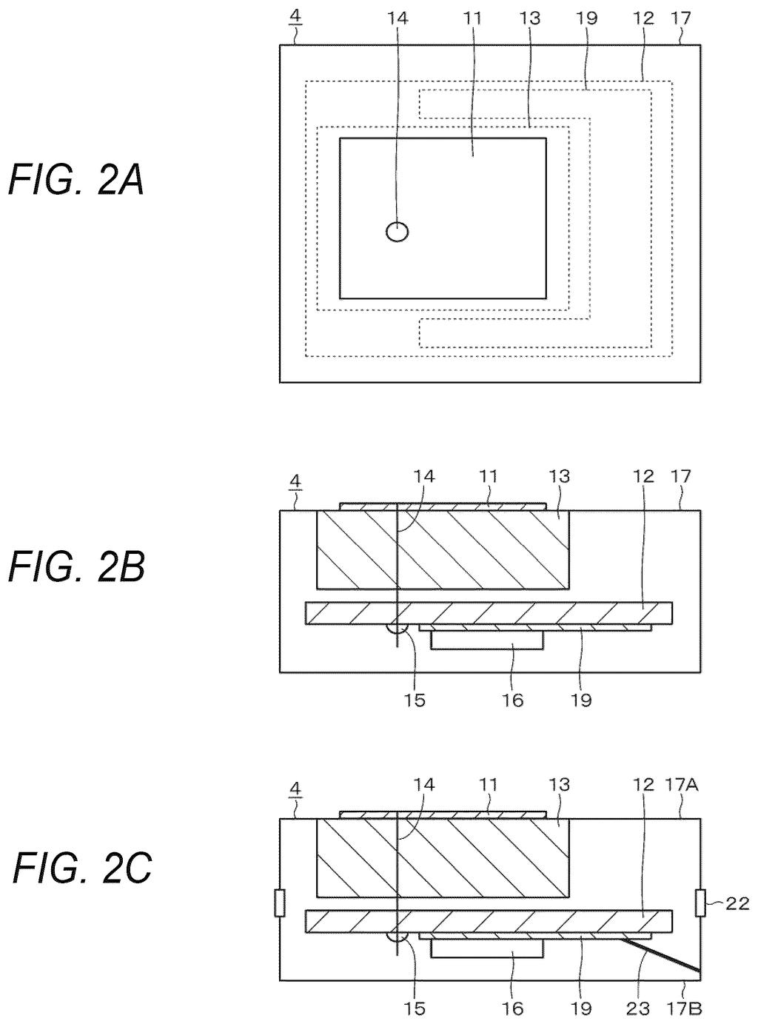
How Sony's electric field sensor spots nearby conductors
Every time your phone senses your hand hovering over the screen, some circuit is deciding whether you're about to touch it. Sony's new patent describes a way to do that kind of detection with a very simple antenna setup, no camera or infrared beam needed.
The sensor works by picking up the faint electric field that surrounds any conductive object, including your body. When something conductive gets close to one of the sensor's two antenna arms, it disturbs a small electrical signal inside the device. The sensor measures that disturbance as a voltage change and uses it to figure out what's happening nearby.
In plain terms: the device is always listening to the electrical 'hum' of its environment, and it notices when that hum shifts. That shift tells it something is there, or has moved, or has made contact with a surface it's monitoring.
an antenna device that has a dipole structure that receives an electric field, the antenna device including a first antenna element connected to or in contact with a ground and a conductor existing with a certain resistance value, and a second antenna element grounded to an earth ground or not grounded to an earth ground …
Translation: The sensor uses a specialized two-part antenna to pick up invisible changes in nearby electric fields.
How the dipole antenna and rectifier circuit read proximity
The patent describes an electric field sensor built around a dipole antenna, which is the same basic two-arm antenna shape used in everything from old TV rabbit ears to modern wireless chips. One arm is connected to a ground reference (a stable electrical baseline), and a conductor with a fixed resistance sits alongside it. The other arm can either be grounded or left floating.
When an outside conductor, such as a person's finger, a metal object, or a wire, comes close to or touches one of those arms, it creates a capacitive coupling (a type of invisible electrical handshake where two conductive objects influence each other without touching). This coupling changes the signal that flows through the antenna.
A rectifier circuit (a component that converts the antenna's oscillating signal into a steady measurable voltage) then feeds that signal to a detection unit. The detection unit watches for changes in that output voltage. A shift in voltage level signals that something has changed in the environment around the antenna.
- The sensor can detect whether contact has been made or broken.
- It can identify spatial proximity, meaning how close something is.
- It can infer the state of the nearby conductor, for example whether a surface is wet, or whether two conductive objects are connected.
… detects a change in level of the output voltage caused when the first antenna element or the second antenna element not grounded to an earth ground is spatially coupled to or in contact with another conductor different from the conductor, and detects a state or a situation of the other conductor …
Translation: It figures out what a nearby object is doing by measuring how it interferes with the sensor's electrical signals.
What this means for touchless sensing in Sony devices
For consumer electronics, a sensor like this could enable touchless controls, smarter stylus detection, or body-proximity awareness without adding a camera or complex optics. Sony makes image sensors, semiconductors, and a wide range of devices, so a small, low-complexity proximity sensor fits into many product lines, from cameras that pause recording when lowered, to earbuds that detect whether they're in your ear.
The deeper interest here is how much this sensor can infer from a single voltage reading. It's not just detecting presence; the patent claims it can detect the "state or situation" of the nearby conductor, which is a broader capability than simple proximity. The sensor-and-detection space is one of the more active corners of the new Big Tech patents that Sony Semiconductor has been filing, as chipmakers look for ways to embed awareness into hardware without relying on power-hungry cameras or microphones.
That makes this Sony's 51st filing in Camera patents we've tracked since May, a run that includes a variable-light lens and a crack-detecting factory sensor.
Claim 1 is written broadly enough to cover a wide range of electric field sensing applications. The core elements are a two-arm antenna, a rectifier, and a unit that watches for voltage changes caused by proximity to any external conductor. That combination is not new in principle, but the claim bundles a specific configuration, one grounded arm plus a resistive conductor, with the ability to detect "state or situation" rather than just presence, which is where the claim tries to carve out something protectable.
The breadth of "state or situation of the other conductor" is doing a lot of work. If granted as written, that language could potentially cover any application where this antenna configuration is used to infer information about a nearby object, whether that's a wet hand, a connected wire, or a human body. That's a wider net than, say, a claim limited to touch detection on a specific surface type.
In practice, the prior art in electric field sensing is dense, and the USPTO will likely push back on how broadly "state or situation" is defined. The real value for Sony may be in narrower dependent claims that describe specific configurations, rather than the wide claim 1 as filed.
Get our take in your Top Stories
Liked this breakdown? Add Patentlyze as a preferred source on Google, and our plain-English take shows up more often in your Top Stories the next time Sony patent news breaks.
There are more where this came from
We read every patent application Big Tech publishes and send you the ones worth knowing. Plain English, free, every week.
The drawings
51 drawing sheets from US 2026/0251688 A1 · click any drawing to enlarge


Want this weekly breakdown for a company we don't cover? Patentlyze Pro →
Be the first to weigh in