
Sony
Sony · Camera · Filed Dec 17, 2024 · USPTO published Aug 27, 2026 · Aug 27 release
Sony Patents a Sensor That Detects Nearby Objects Through Invisible Electrical Disturbances
Sony has filed a patent for a sensor that can tell when something conductive (a hand, a wire, a metal surface) gets close to it, just by watching how an electric field changes. No camera, no touch required.
- Publication number
- US 2026/0251688 A1(US20260251688A1)
- Applicant
- SONY SEMICONDUCTOR SOLUTIONS CORPORATION
- Filed · Published
- Dec 17, 2024 · Aug 27, 2026
- Inventors
- Yoshitaka YOSHINO
- Status when we published
- Waiting for an examiner
- Document
- 15 claims
- US classification
- 324/627
- Examiner
- NGUYEN, TRUNG Q (Art Unit 2858)
- Parent application
- National Stage Entry of PCT/JP2023/022562 (filed Jun 19, 2023)(PCTJP2023022562)
How Sony's electric field sensor spots nearby conductors
Every time your phone senses your hand hovering over the screen, some circuit is deciding whether you're about to touch it. Sony's new patent describes a way to do that kind of detection with a very simple antenna setup, no camera or infrared beam needed.
The sensor works by picking up the faint electric field that surrounds any conductive object, including your body. When something conductive gets close to one of the sensor's two antenna arms, it disturbs a small electrical signal inside the device. The sensor measures that disturbance as a voltage change and uses it to figure out what's happening nearby.
In plain terms: the device is always listening to the electrical 'hum' of its environment, and it notices when that hum shifts. That shift tells it something is there, or has moved, or has made contact with a surface it's monitoring.
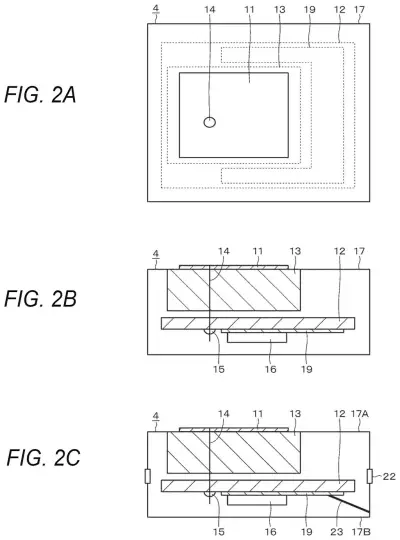
an antenna device that has a dipole structure that receives an electric field, the antenna device including a first antenna element connected to or in contact with a ground and a conductor existing with a certain resistance value, and a second antenna element grounded to an earth ground or not grounded to an earth ground …
Translation: The sensor uses a specialized two-part antenna to pick up invisible changes in nearby electric fields.
How the dipole antenna and rectifier circuit read proximity
The patent describes an electric field sensor built around a dipole antenna, which is the same basic two-arm antenna shape used in everything from old TV rabbit ears to modern wireless chips. One arm is connected to a ground reference (a stable electrical baseline), and a conductor with a fixed resistance sits alongside it. The other arm can either be grounded or left floating.
When an outside conductor, such as a person's finger, a metal object, or a wire, comes close to or touches one of those arms, it creates a capacitive coupling (a type of invisible electrical handshake where two conductive objects influence each other without touching). This coupling changes the signal that flows through the antenna.
A rectifier circuit (a component that converts the antenna's oscillating signal into a steady measurable voltage) then feeds that signal to a detection unit. The detection unit watches for changes in that output voltage. A shift in voltage level signals that something has changed in the environment around the antenna.
- The sensor can detect whether contact has been made or broken.
- It can identify spatial proximity, meaning how close something is.
- It can infer the state of the nearby conductor, for example whether a surface is wet, or whether two conductive objects are connected.
… detects a change in level of the output voltage caused when the first antenna element or the second antenna element not grounded to an earth ground is spatially coupled to or in contact with another conductor different from the conductor, and detects a state or a situation of the other conductor …
Translation: It figures out what a nearby object is doing by measuring how it interferes with the sensor's electrical signals.
What this means for touchless sensing in Sony devices
For consumer electronics, a sensor like this could enable touchless controls, smarter stylus detection, or body-proximity awareness without adding a camera or complex optics. Sony makes image sensors, semiconductors, and a wide range of devices, so a small, low-complexity proximity sensor fits into many product lines, from cameras that pause recording when lowered, to earbuds that detect whether they're in your ear.
The deeper interest here is how much this sensor can infer from a single voltage reading. It's not just detecting presence; the patent claims it can detect the "state or situation" of the nearby conductor, which is a broader capability than simple proximity. The sensor-and-detection space is one of the more active corners of the new Big Tech patents that Sony Semiconductor has been filing, as chipmakers look for ways to embed awareness into hardware without relying on power-hungry cameras or microphones.
That makes this Sony's 51st filing in Camera patents we've tracked since May, a run that includes a variable-light lens and a crack-detecting factory sensor.
Source: US 2026/0251688 A1 at the USPTO (PDF). Full patent text and figures are in the official publication.
Get our take in your Top Stories
Liked this breakdown? Add Patentlyze as a preferred source on Google, and our plain-English take shows up more often in your Top Stories the next time Sony patent news breaks.
Add Patentlyze on Google
One click.
There are more where this came from
We read the new patents from Big Tech, carmakers and more and send you the ones worth knowing. Plain English, free, every week.
The drawings · 51 sheets
51 drawing sheets from US 2026/0251688 A1 · click any drawing to enlarge


Show the other 43 sheets


More from Sony
All 722 Sony patents →
More in Camera
All 279 Camera patents →
Qualcomm
Qualcomm Patents Tech That Lets Users Choose How Their Phone Reads Photos
Apple
Apple Patent Reveals Object Tracking Technology Triggered by Audio and Motion Cues
Samsung
Samsung Patents Technology That Keeps 3D Scene Measurements Sharp During Fast Motion
Nvidia