
Sony's Patent Teaches Cameras To Fix Their Own Data Errors Automatically
Sony has patented a camera that can sense when its own data processing is going wrong and automatically switch to a different way of packing that data, all without any human input. It's a closed feedback loop baked into the sensor itself.
What Sony's self-adjusting event camera actually does
A security camera stares at an empty hallway all night. When something finally moves, it floods a processor with data, and if that data is packaged the wrong way for what the processor needs to do, the analysis can fail or slow to a crawl.
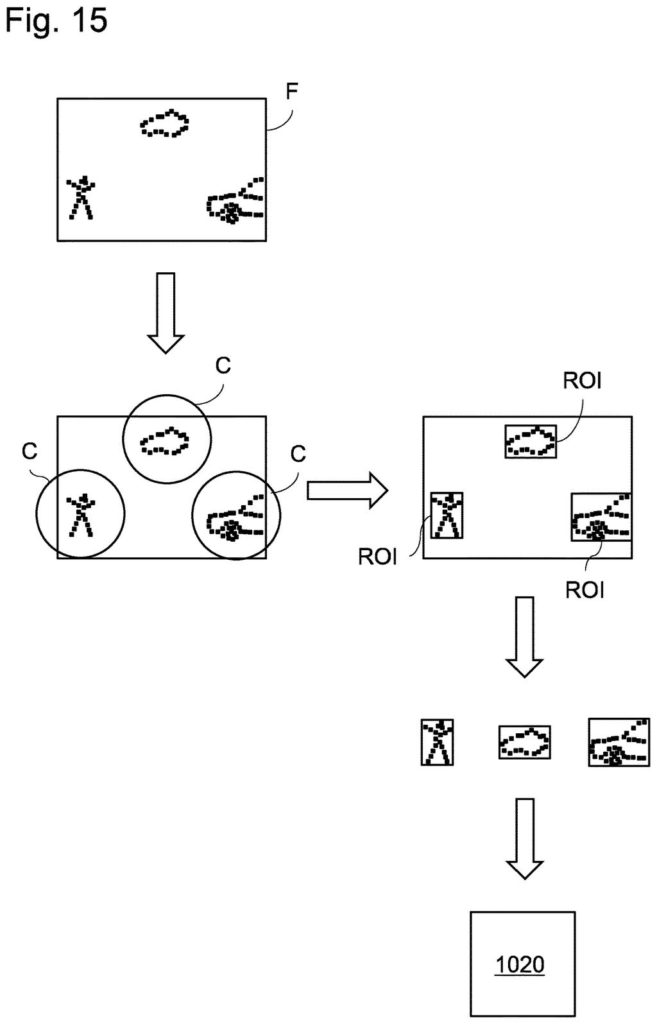
Sony's patent describes a camera that monitors its own performance and fixes that mismatch automatically. The camera uses a special kind of sensor called an event camera, which only records pixels that change, not a full picture every frame. When light hitting a pixel shifts above a certain level, the pixel fires an "event." The camera then compresses those events before sending them to a processor.
Here's the key part: the processor reports back on how well it handled the last batch of compressed data. If the results are poor, the camera switches to a different compression style. Your security or robotics camera, in other words, can tune itself to match whatever task it's running.
… each being configured to receive light and to perform photoelectric conversion to generate event data based on the received light, which event data indicate as an event the occurrence of an intensity change of the light above an event detection threshold …
Translation: The pixels spot changes in light intensity and turn them into digital data signals.
How the feedback loop picks a compression scheme
The patent describes a four-part system working in a continuous loop.
- Event detection pixels: Unlike a regular camera that captures every pixel at a fixed frame rate, each pixel here only reacts when brightness changes past a set threshold. This produces a stream of timestamped "events" rather than full images, which is far more efficient for fast-moving scenes.
- Encoding unit: This component compresses the raw event stream before it travels to the processor. Crucially, it has access to multiple compression schemes and can switch between them on command.
- Processing unit: This is the AI or analysis engine. It receives the compressed events and runs whatever task is assigned, such as motion detection, object recognition, or gesture tracking.
- Control unit: After the processing unit finishes, it sends feedback about its results back to the control unit. The control unit reads that feedback and decides whether the current compression scheme is still appropriate or whether a different one would produce better outcomes next time.
The loop is fully automatic. No engineer needs to pre-configure the compression for a specific task. The system learns from its own output cycle by cycle.
… the control unit selects the compression scheme based on feedback information provided by the processing unit regarding results of the predetermined processing …
Translation: The camera adjusts how it packs down the image data by listening to how well the processor handles past results.
What this means for AI-powered security and robotics cameras
Event cameras are already used in robotics, autonomous vehicles, and industrial inspection because they react in microseconds and consume very little power. The bottleneck has often been the downstream processing: the format in which events arrive at the AI chip can make or break whether the analysis is fast and accurate. Sony's patent addresses that bottleneck at the sensor level, which is a more elegant place to fix it than retooling the AI model each time conditions change.
For end users, this could translate to security and robotics cameras that stay reliable across wildly different conditions, from a dim warehouse at 2 a.m. to a sunlit loading dock at noon, without anyone touching a settings menu. Sony is one of the world's dominant imaging-chip makers, so a patent like this sits close to products that actually ship. The broader push to make sensor hardware aware of its own AI workload is one of the more interesting threads running through the newest Big Tech patents in the imaging and edge-compute space.
This is the 52nd Sony filing we've tracked in our Camera topic since May, adding to work like one sensing electrical disturbances and one bending light across a lens.
Claim 1 is written broadly enough to cover essentially any event camera that (a) supports multiple compression schemes and (b) uses feedback from a downstream processor to choose among them. That's a sweeping scope. It does not specify what the feedback metric must be, what the compression schemes must look like, or how many cycles the loop must run before switching. In practice, that breadth could make this claim difficult to design around.
Any competitor building an event-camera sensor with adaptive, processor-guided compression would need to either license this or argue their feedback mechanism is genuinely different in kind, not just in implementation detail. The narrowing question is whether prior art already covers feedback-driven codec switching in video pipelines. Traditional cameras have used rate-control loops for decades.
Whether event-camera compression with AI-task feedback is distinct enough to survive examination is the real patent-office question. If it does survive, Sony would hold a foundational position in a sensor category that is growing fast.
Get our take in your Top Stories
Liked this breakdown? Add Patentlyze as a preferred source on Google, and our plain-English take shows up more often in your Top Stories the next time Sony patent news breaks.
There are more where this came from
We read every patent application Big Tech publishes and send you the ones worth knowing. Plain English, free, every week.
The drawings
25 drawing sheets from US 2026/0255080 A1 · click any drawing to enlarge


Want this weekly breakdown for a company we don't cover? Patentlyze Pro →
Be the first to weigh in