Nvidia
Nvidia · Camera · Filed Feb 14, 2025 · USPTO published Aug 20, 2026 · Aug 20 release
Nvidia Patents a Fast Way to Catch When Multiple Sensors Fall Out of Step
When a self-driving car's cameras and radar stop agreeing on what time it is, the results can be dangerous. Nvidia's new patent describes a lightweight method for catching that drift before it causes problems.
- Publication number
- US 2026/0246551 A1(US20260246551A1)
- Applicant
- NVIDIA Corporation
- Filed · Published
- Feb 14, 2025 · Aug 20, 2026
- Inventors
- Sean GILLEN
- Status when we published
- Waiting for an examiner
- Document
- 20 claims
- US classification
- 370/503
How Nvidia's sensor timing check actually works
A security camera stares at an empty hallway all night. Now multiply that by a dozen sensors on a robot or a car, each one stamping every reading with a time, and you start to see the problem: if those clocks drift even slightly, the system is making decisions on data that doesn't actually line up.
Nvidia's patent tackles this by sorting each sensor reading into a time "bucket," the way you might sort mail into slots by day of the week. If you pull the matching bucket and the neighboring ones and still can't find a reading from every sensor, something is out of sync and the system can flag it immediately.
The fix is designed to be fast. Instead of comparing every reading against every other reading, the system just checks whether the right number of readings landed in roughly the right time slots. That simplicity is the whole point: a car traveling at highway speed needs this check to happen in milliseconds, not seconds.
generating an index for a data sample from a sensor based on a timestamp associated with the data sample and a temporal resolution for buckets of data associated with different indices; …
Translation: The system tags sensor data using timestamps to sort it into specific time slots.
Inside the bucket-index sync detection method
The patent centers on a bucket-based indexing system for time-series sensor data. Here is how the pieces fit together:
- Index generation: When a reading arrives from any sensor, the system divides its timestamp by a preset time resolution (think: slice time into 10-millisecond windows) to produce an integer index. That index maps the reading to a specific bucket.
- Neighborhood lookup: To account for small timing differences between sensors, the system also checks the buckets immediately before and after the target bucket. This gives the comparison a small tolerance zone without requiring floating-point math on every sample.
- Count check: The system counts how many distinct sensor readings it found across those buckets. If that count is lower than the total number of sensors in the system, a reading is missing, which means at least one sensor is out of sync.
- Action trigger: When the count comes up short, the system can drop the mismatched reading, request re-synchronization, or flag the data for review, depending on how it is configured.
The key engineering choice here is that the comparison is an integer lookup and a counter check, not a full timestamp-difference calculation across every sensor pair. That keeps the computational cost low even when dozens of sensors are running simultaneously.
… determining that a number of samples in the retrieved plurality of data samples is less than a number of sensors from which data samples are obtained; …
Translation: It flags a problem when data is missing from expected sensors.
What this means for self-driving and robotics data
Multi-sensor systems, from autonomous vehicles to warehouse robots to surgical imaging rigs, depend on the assumption that all their sensors are describing the same instant in time. When that assumption breaks, a camera might say a pedestrian is three feet away while the lidar says five, not because the sensors are broken, but because they stopped agreeing on when "now" is. Catching that disagreement quickly is not optional; it is a safety requirement.
Nvidia's approach is notable because it keeps the validation step cheap enough to run continuously on the same hardware already processing the sensor data, rather than requiring a dedicated timing controller. For anyone following how autonomous-system hardware is maturing, this filing sits alongside a broader wave of interesting tech patents in the robotics and self-driving sensor-fusion space, where the hard problems are increasingly about data hygiene rather than raw compute power.
Nvidia's 38th filing we've tracked since May in our self-driving sensing race follows the intersection zone mapper and the object cutter.
Source: US 2026/0246551 A1 at the USPTO (PDF). Full patent text and figures are in the official publication.
Get our take in your Top Stories
Liked this breakdown? Add Patentlyze as a preferred source on Google, and our plain-English take shows up more often in your Top Stories the next time Nvidia patent news breaks.
Add Patentlyze on Google
One click.
There are more where this came from
We read the new patents from Big Tech, carmakers and more and send you the ones worth knowing. Plain English, free, every week.
The drawings · 10 sheets
10 drawing sheets from US 2026/0246551 A1 · click any drawing to enlarge


Show the other 2 sheets


More from Nvidia
All 665 Nvidia patents →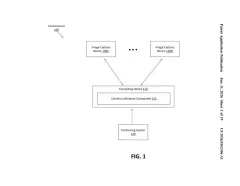
More in Camera
All 278 Camera patents →
Sony
Sony Patent Describes Camera Technology That Monitors and Detects Its Own Lens Degradation
Sony
Sony Patents Technology That Helps Cameras Recognize Glass and Transparent Surfaces
Sony
Sony Patents a Camera System That Reads Colors and Measures Distance Simultaneously
Waymo (Google)