
IBM Patents a VR Interview System Where AI Avatars Skip Questions You Already Answered
IBM has patented a system that puts you in a virtual room with AI-scripted avatars who interview you, watch how you respond, and drop questions the moment your behavior already gives away the answer.
What IBM's AI-driven VR interview system actually does
Ever sat through a survey where every question felt like it was designed for someone else? IBM is working on a VR system that tries to fix exactly that.
The idea is to put you inside a virtual environment with one or more digital characters who ask you questions. Before the session starts, an AI builds a personalized set of questions based on your history and what's happening in real time. A second AI then writes a script for the avatars, so the conversation feels natural rather than robotic.
The clever part comes during the session itself. The system watches how you behave, not just what you say. If your actions inside the VR world already make the answer to a question obvious, the avatars skip it. The whole interview adapts on the fly, so you never answer something twice.
… determining whether an answer can be derived above a threshold confidence level for one or more questions presented by the one or more virtual avatars in accordance with the transcript based on the first one or more interactions …
Translation: The system checks if it already knows your answer well enough from past data to skip asking you again.
How three AI models script, film, and adapt the avatar interview
The patent describes a pipeline involving three distinct AI components working in sequence.
- First generative AI model: Takes in real-time data (what you're doing right now in VR) and historical data (past behavior, preferences, prior sessions) to produce a personalized questionnaire. This isn't a fixed list of questions; it's built around your profile.
- Second generative AI model: Converts that questionnaire into a dialogue script for one or more virtual avatars, giving them lines that feel conversational rather than bureaucratic.
- Generative adversarial network (GAN): A type of AI that generates synthetic video by having two neural networks compete against each other, one creates footage, the other critiques it until it looks convincing. Here it produces the actual video of the avatar interaction session.
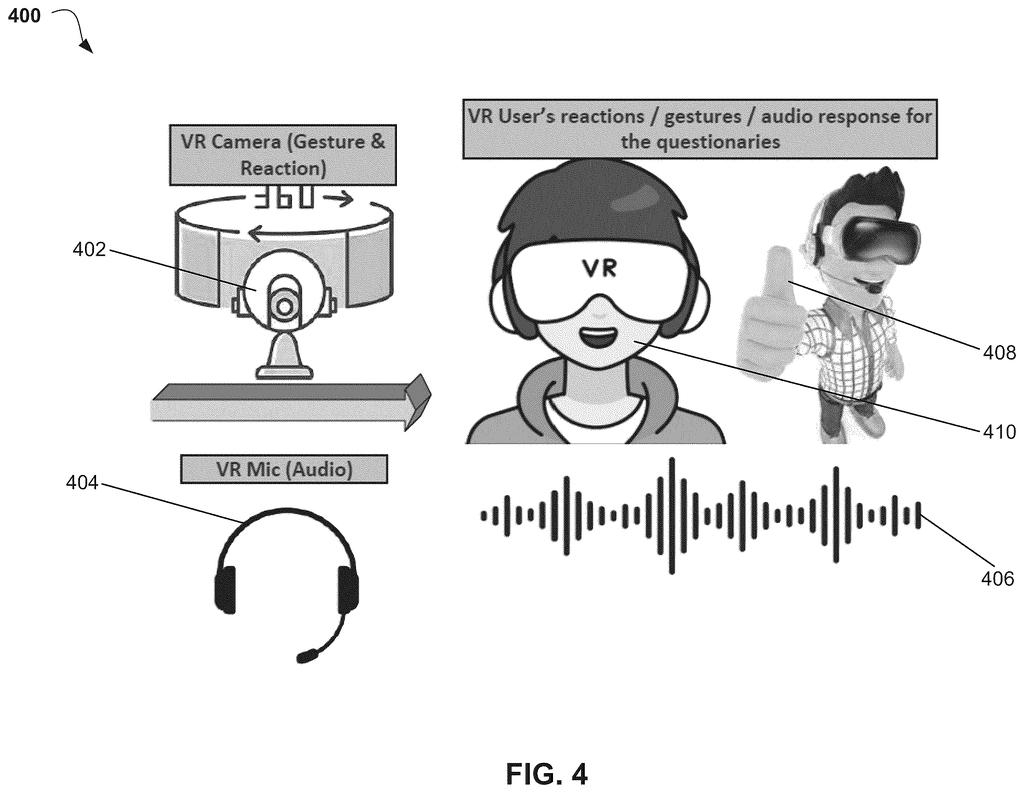
Once the session is running, the system tracks your first-order interactions (movements, choices, responses, and body language within the VR space). If it determines, above a set confidence threshold, that your behavior already answers a pending question, the GAN adapts the video in real time and the avatar moves on.
The net effect is a dynamic interview that shortens itself based on evidence, rather than grinding through a fixed script regardless of what you've already shown.
… generating a video of a virtual interaction session between the one or more virtual avatars and the user in the VR environment.
Translation: An artificial intelligence video generator creates the face-to-face virtual reality interview.
What this means for VR training and research applications
The most obvious use cases are VR-based training and assessment, the kind companies use for onboarding, soft-skills coaching, or research studies. Today those sessions typically rely on static surveys administered after the fact, which means researchers are guessing at what happened from self-reported memory. A system that captures behavioral signals during the experience and folds them back into the interview in real time could produce much richer data.
For IBM's broader push into enterprise AI tools, this fits a pattern of applying generative AI to workflows that have historically required a human facilitator. Whether it arrives as a product is a separate question, but the underlying problem it targets, clunky post-session surveys that ignore what just happened, is real.
IBM's 323rd filing in our IBM coverage since May follows work on AI object spotting and secure cloud data transfer.
The concept is genuinely interesting, but the distance from this patent to a shippable feature is considerable. The system requires a working VR environment, two fine-tuned generative AI models, a GAN capable of producing real-time avatar video, and a behavioral-signal pipeline that can interpret user actions with enough confidence to skip questions. Each of those pieces is its own engineering project.
The GAN-based real-time video generation step is the biggest bottleneck. GANs are well-established for generating static images, but producing adaptive, low-latency avatar video inside an interactive session is a much harder problem. The patent does not describe how latency is managed or what hardware is assumed.
The idea that an AI can infer your answer from your behavior before you give it is also something that needs careful handling in practice. A high confidence threshold helps, but skipping questions based on inferred intent introduces real risk of misreading a user, particularly in high-stakes assessment contexts. IBM's researchers will have a lot of validation work ahead before this is anything you'd trust with an employee review.
There are more where this came from
We read every patent application Big Tech publishes and send you the ones worth knowing. Plain English, free, every week.
The drawings
5 drawing sheets from US 2026/0260438 A1 · click any drawing to enlarge


Want this weekly breakdown for a company we don't cover? Patentlyze Pro →
Be the first to weigh in