
Nvidia Patents a Way for Cameras to Track Exactly Where Objects Are Moving in Video
Knowing not just where an object is in a single photo, but where it's going from frame to frame, is one of the hardest problems in computer vision. Nvidia's latest patent describes a system that does exactly that, using neural networks to build a kind of 3D bounding box that follows objects through video.
How Nvidia's object-tracking patent works in plain English
Imagine you're watching a robot arm on an assembly line reach for a bolt. The camera can see the bolt in one frame, but if the bolt shifts slightly, or the camera angle changes, the robot needs to know exactly where the bolt is at every moment. That's much harder than it sounds.
Nvidia's patent describes a system that watches video and continuously figures out the position and orientation of objects across multiple frames. It doesn't just snap a single photo and guess, it tracks how an object moves from one image to the next, using AI-generated heatmaps that highlight the object's center and key corner points. From those, it constructs a 3D box around the object so a machine always knows where to reach.
This kind of technology matters most in robotics and augmented reality, where a system has to respond to a moving world in real time. Getting the position wrong by even a centimeter can mean a robot misses a grab or an AR overlay floats off into space.
… generating one or more first heatmaps based, at least in part, on a centroid of the one or more objects and a plurality of keypoints of the one or more objects …
Translation: It maps the center and key points of moving objects.
Inside Nvidia's heatmap-and-cuboid tracking pipeline
The system works in two stages, comparing what it saw before with what it sees now.
Stage one: The camera captures a first image of an object. A neural network generates a heatmap (a kind of heat-colored overlay that highlights important spots) centered on the object's centroid (its geometric middle) and a set of keypoints, think of keypoints as the corners and edges of the object that help define its shape and orientation.
Stage two: The camera captures a second image. The system calculates pixel offsets, how far each keypoint and the centroid appear to have shifted between the two frames. A second heatmap is built from those offsets, encoding the motion information.
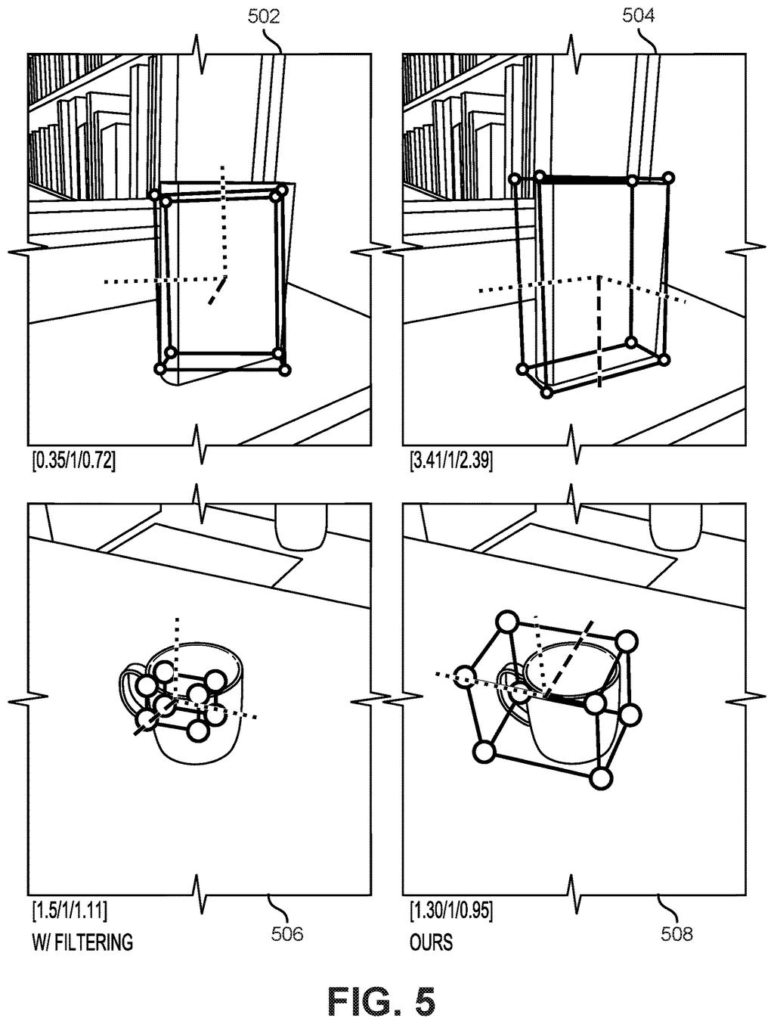
From both sets of heatmaps, the system generates a tracking cuboid: a 3D rectangular box (like a wireframe crate) fitted snugly around the object. That cuboid encodes not just where the object is but how it's oriented in three-dimensional space, its pose, in computer-vision terminology. The neural network also produces a distribution of possible poses (a range of guesses with confidence scores), which is then filtered down to the most likely single answer, reducing jitter and error across frames.
Apparatuses, systems, and techniques to determined a pose of an object from a plurality of images. In at least one embodiment, the pose of an object is determined from at least two images of a video sequence using one or more neural networks …
Translation: AI figures out how an object is positioned using video frames.
What this means for robots and real-time computer vision
For robotics, pose tracking is table stakes. A robot that can pick up an object reliably needs a continuous, accurate read on that object's position and angle, not just a one-shot detection. Nvidia's steady investment in robot perception makes this filing a natural fit for its Isaac robotics platform, where real-time video understanding is a core requirement.
For your everyday life, the downstream effects show up in warehouse automation, surgical robots, and AR headsets that need virtual objects to stick convincingly to real surfaces. If this system performs as described, it could reduce the compute cost of accurate 3D tracking, which today often requires expensive depth cameras. A standard video feed doing the same job is a meaningful step forward.
That makes this Nvidia's 29th filing we've tracked since May in our robot grasping and movement work, adding to one universal robot controller and one on labeled 3D parts.
Claim 1 is broad in a way that will attract attention during examination. It covers the full pipeline: capturing two images, generating heatmaps from centroids and keypoints, computing pixel offsets, generating a second set of heatmaps from those offsets, and producing a tracking cuboid. That sequence of steps is described at a fairly high level of abstraction, which means the claim could potentially reach a wide range of implementations that follow the same logical flow.
The practical question is how much prior art already describes heatmap-based keypoint tracking across video frames. That field has been active for years in academic computer vision, and the patent office will scrutinize whether the specific two-stage heatmap-plus-offset structure is distinct enough from existing methods.
If the claim survives in something close to its current form, it could give Nvidia leverage over a broad class of video-based 3D object tracking systems, not just its own implementations. That's a meaningful position to hold as robotics and augmented reality scale up. Narrow it gets granted; broad it gets challenged.
There are more where this came from
We read every patent application Big Tech publishes and send you the ones worth knowing. Plain English, free, every week.
The drawings
58 drawing sheets from US 2026/0268515 A1 · click any drawing to enlarge


Want this weekly breakdown for a company we don't cover? Patentlyze Pro →