
Google Patents a Double-Ended Qubit Readout That Extracts Two Results at Once
Every time you measure a qubit in a quantum computer, the act of measuring disturbs it — so knowing what state the qubit landed in *after* the measurement is almost as important as knowing what it read *during* it. Google's new patent proposes squeezing both answers out of the same signal.
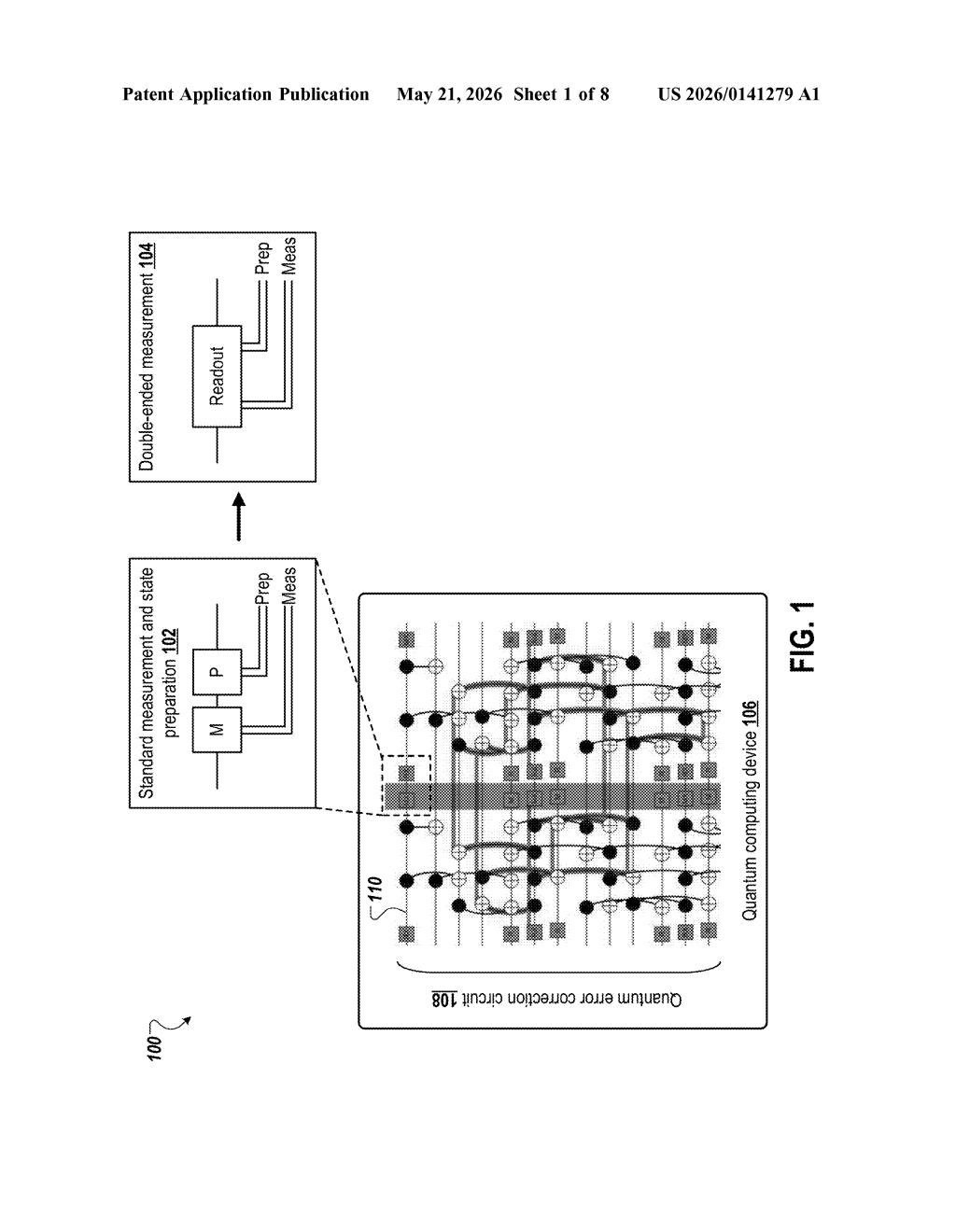
What Google's double-ended qubit readout actually does
Imagine a doctor taking your blood pressure: the cuff reads your pressure during the squeeze, but the doctor also wants to know what your blood pressure is after the cuff releases. In quantum computing, something similar happens every time you check a qubit — the measurement itself nudges the qubit into a new state, and you need to track both the original reading and what the qubit looks like afterward.
Google's patent describes a technique called double-ended measurement. Instead of capturing just one number from the hardware signal that comes back from a qubit, the system processes that same raw signal twice — using two different mathematical filters called integration weights. The first filter tells you the result of the measurement. The second filter tells you what quantum state the qubit ended up in after being measured.
The key insight is that you don't need to run the readout hardware a second time to get the post-measurement state — it's already encoded in the same signal, just in a different part of it. This could make quantum error correction faster and less disruptive to the qubits around it.
How two integration-weight sets split one readout signal
In a superconducting quantum computer, reading out a qubit involves coupling it to a readout resonator — a microwave cavity that picks up a signal whose phase or amplitude shifts depending on the qubit's state. That analog signal is digitized and then processed to extract a classical bit: 0 or 1.
The problem is that this readout process isn't perfectly non-destructive. The qubit can be left in a superposition or even flipped by the readout itself — a phenomenon called measurement-induced state transition. Quantum error correction schemes, like the surface code Google uses on its Sycamore processors, need to know not just what the qubit measured, but what state it's in after measurement so the next round of corrections starts from a known baseline.
Google's patent addresses this by applying two different sets of integration weights (essentially different time-domain filters) to the same digitized readout signal:
- First set: tuned to capture the part of the signal that encodes the measurement result (what was the qubit's state during readout).
- Second set: tuned to capture the part of the signal that reflects the qubit's state after the interaction with the resonator has settled.
Because the readout signal carries temporal structure — it evolves over the duration of the pulse — different windows of that signal carry different information. By choosing integration weights that weight different time slices appropriately, both values can be recovered from a single digitized trace without any additional hardware pass.
Why better qubit readout matters for quantum error correction
Quantum error correction is the backbone of any practical, fault-tolerant quantum computer, and it runs in tight real-time feedback loops. Every extra measurement operation adds latency and extra opportunities for errors to accumulate. If Google can extract the post-measurement qubit state from the same readout signal that already tells you the measurement result, that's one fewer hardware operation per error-correction cycle — which adds up fast across thousands of qubits running hundreds of cycles per second.
For you as someone watching the quantum computing space, this is the kind of low-level plumbing work that rarely gets announced at a press conference but quietly determines whether a quantum processor can scale. Google's Willow chip already demonstrated below-threshold error correction; patents like this suggest the team is now grinding hard on the control and readout infrastructure needed to make that scale practically.
This is a genuinely clever signal-processing insight dressed up in fairly dry patent language. The idea that a single readout pulse already encodes both the measurement outcome and the post-measurement state — and that you just need the right filters to pull them apart — is the kind of thing that looks obvious in hindsight but requires real hardware intuition to discover. It's not flashy quantum-supremacy territory, but this is exactly the category of improvement that separates a research chip from a production quantum processor.
There are more where this came from
We read every patent application Big Tech publishes and send you the ones worth knowing. Plain English, free, every week.
Want this weekly breakdown for a company we don't cover? Patentlyze Pro →