
Nvidia Patents a Way to Keep Audio and Video in Sync by Hiding Audio Inside the Video Stream
Lip-sync problems during cloud gaming or video calls often come down to audio and video packets taking different paths across the internet. Nvidia's new patent solves that by hiding the audio directly inside the video frames, so the two can never drift apart.
How Nvidia's audio-in-video trick prevents lip-sync disasters
Imagine you're playing a game streamed from a distant server, and every gunshot sound arrives a split second after the muzzle flash. That's a classic sync failure, and it happens because audio and video travel the internet as separate streams, sometimes arriving in a different order.
Nvidia's approach is to stop treating audio and video as separate travelers. Instead, the audio for each moment gets encoded and tucked into the header (a small packet of metadata) of the corresponding video frame before it's ever sent. The two pieces of data are now physically joined, so if a frame arrives, its matching audio arrives with it.
This matters most in cloud streaming, where you're watching video that a remote server is generating and compressing in real time. Packet loss or congestion affects both audio and video equally, because they're one unit, not two separate signals racing each other to your screen.
… update a respective header of at least one of the plurality of encoded frames to include encoded audio generated from the corresponding audio; …
Translation: The system injects the sound data directly into the structural labels of the picture frames.
How audio data gets embedded in encoded video frame headers
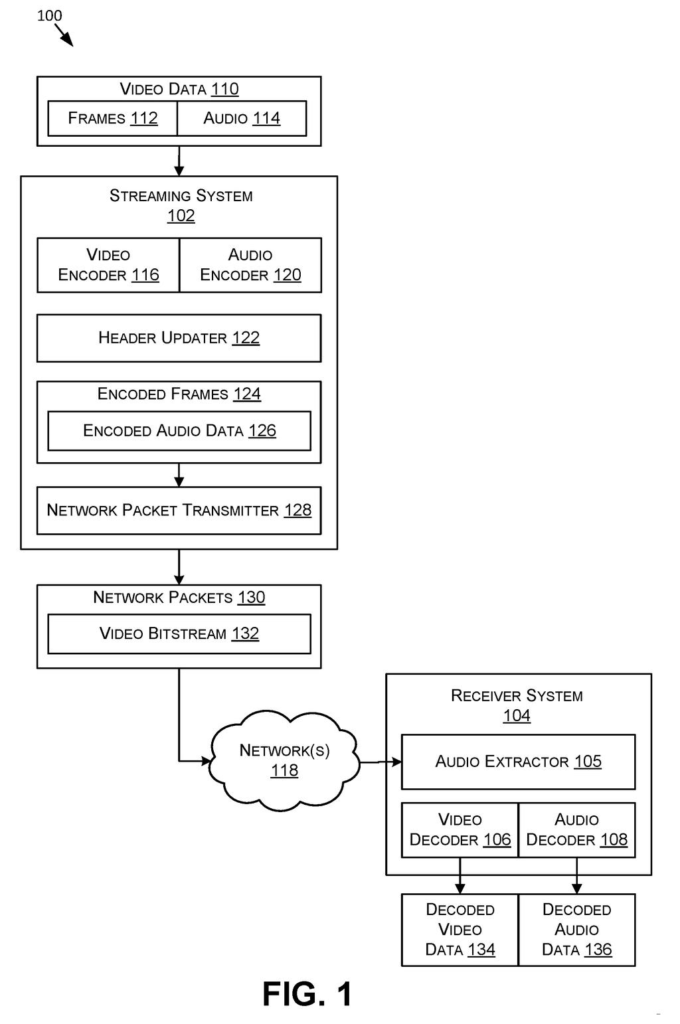
The patent describes a cloud media system that encodes video frames in the usual way, producing compressed output one frame at a time. The twist is what happens next: before those frames are sent across the network, the system takes the audio samples that correspond to each frame and encodes them separately, then writes that encoded audio into the frame header of the matching video frame.
A frame header is essentially a small block of metadata that travels with every compressed video chunk. Normally it carries things like timestamps and compression settings. This system repurposes some of that space to carry the audio payload for that exact moment in time.
The combined frames are then packed into standard network packets and sent as a single video stream. The receiving device reads each frame, strips out both the video data and the embedded audio, and plays them together.
The practical effect: if a packet gets dropped or delayed in transit, the audio and video for that moment are lost or delayed together, rather than one arriving without the other. That eliminates the most common source of drift between the two tracks during cloud playback.
- Encode video frames into compressed output
- Encode corresponding audio separately
- Write encoded audio into each frame's header
- Transmit the combined frames as one stream
… ensures that audio and video data remain synchronized by embedding the audio data within the video frames, thereby reducing the likelihood of desynchronization due to network latency or packet loss.
Translation: Locking the sound inside the video prevents lag and keeps everything lined up even if the network stutters.
What this means for cloud gaming and remote desktop streaming
For anyone using cloud gaming services or remote desktop tools, audio sync is one of those problems that sounds minor until it isn't. A fraction of a second of drift makes dialogue feel dubbed, makes games feel broken, and makes video calls feel off in a way that's hard to name but instantly uncomfortable.
the pattern in Nvidia's cloud-streaming filings suggests the company is treating low-latency, high-quality remote media delivery as a core infrastructure bet, not an edge feature. Embedding audio in video frames is a straightforward engineering idea, but if it works reliably at scale, it removes one of the more stubborn friction points in cloud-based computing products.
This is the 461st Nvidia filing in our Nvidia coverage since May, adding to work like fixing corrupted frames and splitting AI steps across chips.
Embedding audio inside video frames keeps the two in lockstep, but it means any receiver that doesn't know the special format will either ignore the audio or choke on it. That's a real cost: this only works cleanly when Nvidia controls both ends of the connection.
That constraint sets a ceiling on where the approach travels. It fits a closed cloud-gaming pipeline well, but it doesn't adapt easily to general-purpose video calls or standard streaming formats.
Packing extra data into every frame also adds overhead, and at high resolutions that compounds quickly. Whether the available space is enough for acceptable audio quality is the engineering question the patent leaves open, and the answer will determine how far the design actually scales.
There are more where this came from
We read every patent application Big Tech publishes and send you the ones worth knowing. Plain English, free, every week.
The drawings
5 drawing sheets from US 2026/0281385 A1 · click any drawing to enlarge


Want this weekly breakdown for a company we don't cover? Patentlyze Pro →