
Adobe Patents Technology to Automatically Cut Out Moving People in Videos
Cutting a moving person out of a video is one of the most tedious jobs in post-production. Adobe has filed a patent for a system that maps the skeleton of a figure frame by frame, then uses those body landmarks to draw precise masks around them automatically.
What Adobe's joint-tracking video cutout actually does
A video editor sits down to remove a background figure from a two-minute clip. Frame by frame, the person shifts, turns, and partially disappears behind furniture. Doing this by hand takes hours. You've probably seen how hard it is even in consumer apps.
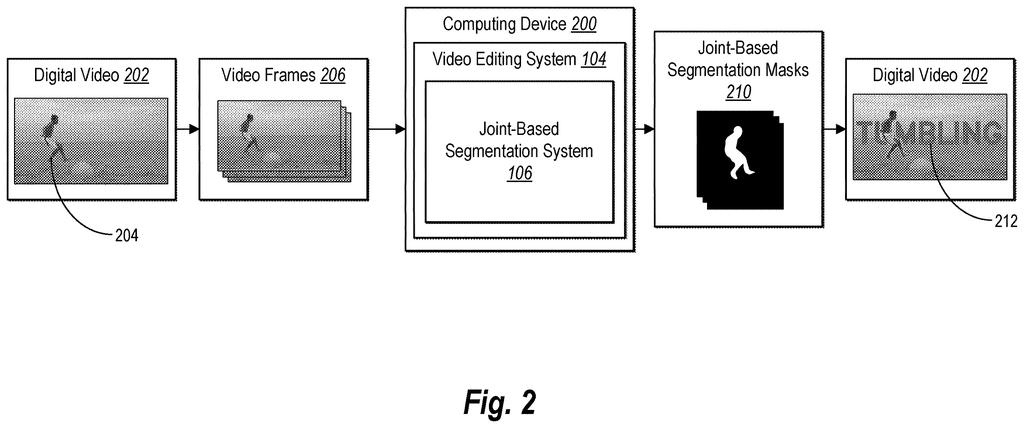
Adobe's newly patented system approaches the problem from the skeleton outward. Instead of trying to guess where a person's outline is directly, it first finds their joints: shoulders, elbows, wrists, hips, knees. It plots those points on a kind of heat map image, and then hands that heat map to a separate AI that draws the cutout around the person.
The idea is that knowing where a body's anchor points are gives the cutout AI a reliable framework to work from, even when clothing patterns, lighting, or motion blur make the person's edges ambiguous. The system tracks those joints across every frame of the video, so the mask follows the person smoothly rather than jumping around.
determining, utilizing a pose tracking neural network, a set of joint coordinates corresponding to a digital object portrayed in a frame of a digital video; generating, from the set of joint coordinates, a joint heat map corresponding to the digital object portrayed in the frame of the digital video; …
Translation: The system finds body joints in a video frame and turns them into a heat map.
How the pose map feeds the segmentation network
The patent describes a two-stage pipeline built around a pair of neural networks working in sequence.
Stage one: pose tracking. A pose-tracking neural network analyzes each video frame and produces a set of joint coordinates (think: the X,Y screen position of each major body joint). Those coordinates are then converted into a joint heat map, a grayscale image where bright spots mark where each joint is located, with brightness fading outward. This gives the second network a spatial blueprint of the figure.
Stage two: segmentation. A segmentation neural network takes the original video frame plus the joint heat map as combined inputs and generates a segmentation mask, a per-pixel map that marks which pixels belong to the object and which don't. The claim is that feeding in the skeleton heat map helps the network handle hard cases like motion blur, overlapping limbs, or partial occlusion.
The patent also mentions a multi-layer perceptron (MLP) mixer layer inside the segmentation network. An MLP mixer (a type of neural network layer originally developed as an alternative to attention-based transformers) blends visual features that flow through convolutional layers, which process image data by scanning local patches. The combination is meant to let the network share information across the whole frame without the high computational cost of a full attention mechanism.
The system is designed to run across all frames of a video, not just a single image, so the joint tracking and mask generation stay consistent over time.
… the segmentation neural network includes a multi-layer perceptron mixer layer for mixing visual features propagated via convolutional layers.
Translation: An internal neural network layer blends visual features together to track objects smoothly.
What this means for video editors and creators
For video creators, precise object isolation has always been the bottleneck between a rough cut and a polished result. Tools like background removal work acceptably on static shots, but moving subjects in complex scenes still require significant manual cleanup. A system anchored to body joints could make that process much faster and more consistent, especially for longer clips where frame-by-frame correction is impractical.
the pattern in Adobe's video AI filings suggests the company is trying to automate the most labor-intensive parts of the editing workflow. If this approach reaches Premiere Pro or After Effects, it would put high-quality rotoscoping (the technical term for tracing and cutting out moving subjects) within reach of editors who don't have a dedicated visual effects team behind them.
This is the 33rd Adobe filing we've tracked since May in the AI photo editing race, following one on repositioning people in photos and another on palette and lighting tools.
Cutting a moving person out of video footage, frame by frame, is one of the most punishing tasks in professional editing. A short clip can consume hours of careful outline correction, and that labor cost compounds across every production, every deadline, every project.
Adobe's approach starts by mapping where a person's joints are throughout the entire clip before drawing any outline at all. Human bodies move in predictable ways, and anchoring the cutout to that underlying structure gives the software something far more stable to work with than color or edge detection alone.
The gap between a patent and a shipping product is always honest to acknowledge. But when the underlying problem burns measurable time across an entire industry every single day, an approach this well-matched to its root cause deserves serious attention.
There are more where this came from
We read every patent application Big Tech publishes and send you the ones worth knowing. Plain English, free, every week.
The drawings
12 drawing sheets from US 2026/0279093 A1 · click any drawing to enlarge


Want this weekly breakdown for a company we don't cover? Patentlyze Pro →