
AMD Patents a System That Compresses AI Model Data Before It Leaves the GPU
Running a large AI model on a single chip is like trying to read a library's worth of books in a broom closet. AMD's new patent describes a way to compress the books before sliding them off the shelf, but only when that compression genuinely saves time.
What AMD's on-chip compression fix actually does for AI
AI accelerator chips have a memory problem: the models people want to run are far bigger than the fast, local memory on the chip itself. When that memory fills up, the chip has to shuffle data out to slower, cheaper storage and fetch it back later, and that back-and-forth is a known bottleneck that slows everything down.
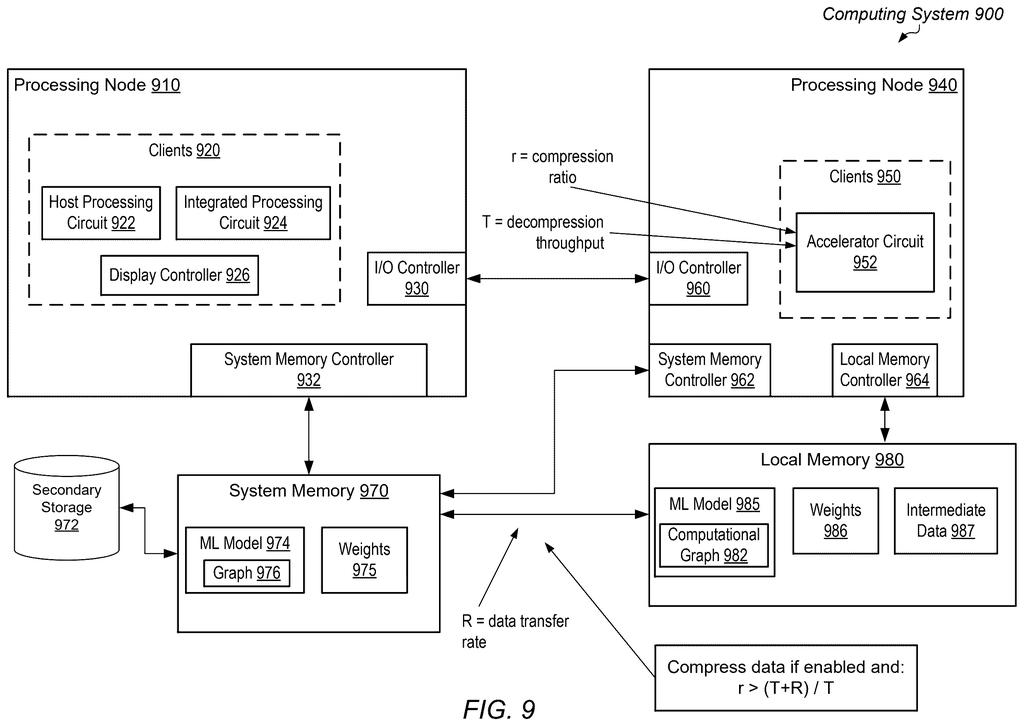
AMD's patent describes a smarter version of that shuffle. Instead of moving raw data out to slower memory, the chip first compresses it, which means smaller files traveling over the same wire, effectively making the connection feel faster. The catch is that compression takes its own compute time, so the chip only does it when the math works out: specifically, when the speed gained by sending less data outweighs the time spent squeezing it down.
For you, the downstream effect is an AI system that stalls less when the model is too big for the chip's fastest memory. It won't double speed overnight, but it chips away at one of the more stubborn friction points in local AI inference.
… compress one or more of the first subset of weights and the intermediate data, responsive to: completion of execution of the first layer; and a compression ratio for data achievable by the plurality of compute circuits being greater than a ratio based on decompression throughput for data achievable by the plurality of compute circuits.
Translation: The system compresses model weights and data only when the math speed makes it worth the effort.
How AMD's chip decides when to compress before offloading
The patent describes an accelerator circuit (think: a GPU or AI chip) paired with a host processor that runs the AI application. The AI model is broken into a sequence of layers, and those layers are executed one by one. Each layer needs a set of weights (the learned parameters that define how the model thinks) and produces intermediate data (the in-progress results passed from one layer to the next).
When the chip's local, fast memory fills up, the system normally pushes excess data out to slower memory, then pulls it back when needed. AMD's approach adds a compression step to that handoff. Before data leaves the chip, the accelerator checks two conditions:
- Has the current layer finished executing? (So the data is no longer actively needed.)
- Is the compression ratio (how much smaller the data gets) large enough that it offsets the time cost of decompressing it later?
The second check is the key innovation. The chip calculates a threshold based on decompression throughput (how fast it can unpack compressed data when it needs it again) relative to the raw data-transfer rate between memory levels. If compression saves more time in transit than it costs to unpack later, the chip compresses. If not, it skips the step and ships raw data. This ratio-based decision keeps the system from doing extra work that would actually make things slower.
What this means for running large AI models on real hardware
The memory wall, meaning the gap between how fast AI chips compute and how fast they can move data, is one of the central problems in running large AI models on local hardware. Every new generation of models has grown faster than chip memory, so smarter data-movement strategies matter a lot to anyone building AI infrastructure or consumer AI devices.
AMD's interest in AI inference efficiency shows up in multiple places across its chip roadmap. For end users, the practical payoff from a patent like this would show up as fewer pauses or lower latency when running large AI models, whether that's a local AI assistant, an image generator, or a code-completion tool. The change is invisible when it works, which is exactly the point.
That makes this AMD's 35th filing we've tracked since May in the AI chip wars, adding to work like cutting unused AI software and lighter AI vision models.
The chip described here checks whether squeezing data down actually saves time before bothering to do it. That conditional check is what separates a useful optimization from one that creates new problems while solving old ones.
For someone running a large AI model, this would show up as steadier, more predictable response times. The slow patches that happen when a system has to shuffle data in and out of fast memory become less frequent, and less severe.
You would likely notice its absence more than its presence. A model that behaves consistently feels responsive and trustworthy; one that stumbles unpredictably, even briefly, erodes confidence in the whole experience.
There are more where this came from
We read every patent application Big Tech publishes and send you the ones worth knowing. Plain English, free, every week.
The drawings
11 drawing sheets from US 2026/0278378 A1 · click any drawing to enlarge


Want this weekly breakdown for a company we don't cover? Patentlyze Pro →
Be the first to weigh in