
Nvidia Patents an AI That Writes Its Own GPU Performance-Checking Code on the Fly
Nvidia has filed a patent for a system where an AI reads a plain-English question about a GPU program, writes the diagnostic code needed to answer it, runs that code, and hands back the result. The developer never writes the profiling script themselves.
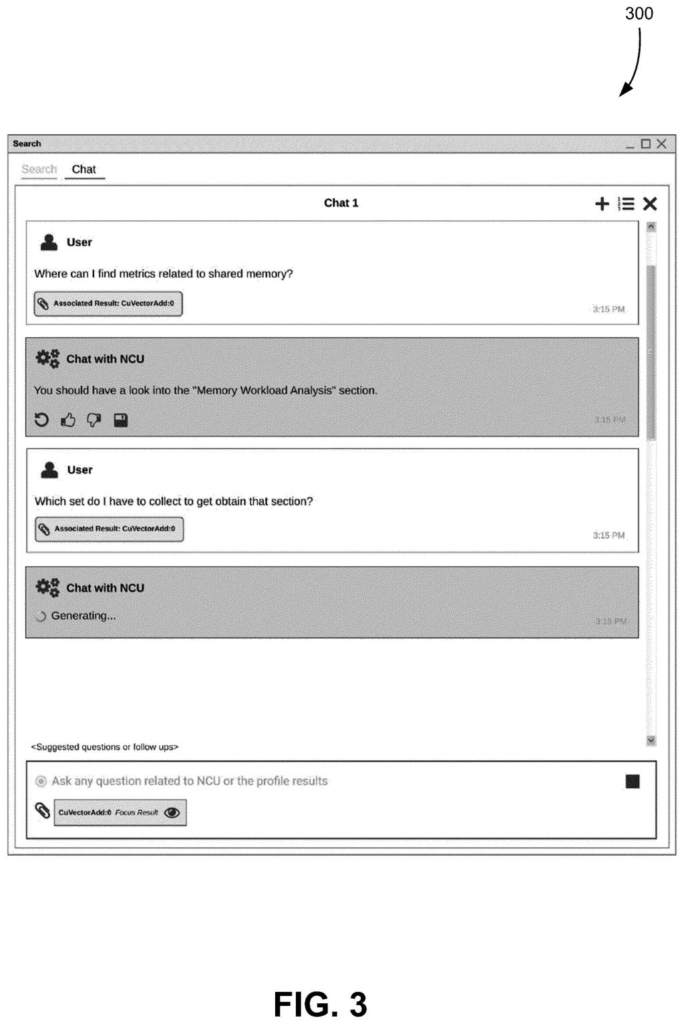
What Nvidia's AI-powered GPU profiler actually does
Today, if you want to know why a program running on a graphics chip is slow, you have to write a separate diagnostic script, run it, and interpret the numbers yourself. That extra work sits between you and the answer, and it takes real expertise to do well.
Nvidia's patent describes a system that removes those steps. You ask a question in plain language, such as "why is this shader taking so long?" The AI reads your question, figures out what code would produce the relevant performance data, writes that code, runs it on the GPU, and gives you the answer directly.
The key shift is that the system is not just retrieving a pre-written answer. It is generating fresh code tailored to your specific question and your specific program, then executing it to get live data. That makes it more like a knowledgeable colleague writing a custom script for you than a search engine pulling up a documentation page.
use one or more neural networks to generate computer program code to obtain performance information of one or more programs performed by one or more graphics processing units (GPUs) …
Translation: An AI writes software to check how well graphics cards are running specific tasks.
How the neural network generates and runs diagnostic code
The patent describes a processor with circuitry that calls one or more neural networks (AI models trained on large amounts of data) to handle GPU performance queries.
Here is the core sequence:
- A user submits a query naming one or more GPU programs they want to analyze.
- The neural network interprets that query and generates computer program code designed to extract the relevant performance metrics from those programs.
- The system then executes that generated code against the actual GPU workload.
- The output of that execution becomes the response sent back to the user.
The approach is sometimes called code-generation-as-reasoning: rather than trying to look up a stored answer, the model reasons about what measurement code is needed and produces it on the spot. The executed code then does the factual work of querying real hardware counters or profiling APIs.
This matters because GPU performance analysis is highly context-dependent. Which metrics to pull, which sampling windows to use, and how to aggregate the numbers all depend on the specific program being profiled. A system that writes bespoke code per query can, in principle, handle that variation better than one that relies on fixed templates.
… based, at least in part, on one or more user queries indicating the one or more programs and perform the computer program code to generate one or more responses to the one or more user queries.
Translation: It builds this custom code based on what the user asks and then runs it to answer them.
What this means for developers debugging slow GPU programs
For GPU developers at Nvidia's typical customer companies, profiling is a constant chore. Tools exist, but they require knowing which counters to query and how to interpret them. A system that accepts a plain question and returns a grounded, data-backed answer could cut hours of diagnostic work down to minutes.
More broadly, this is part of Nvidia has been filing around AI-assisted developer tooling as its GPU ecosystem grows more complex. As AI workloads get bigger and more intricate, the gap between "something is slow" and "here is exactly why" widens. A system that closes that gap automatically has real value, especially for teams without a dedicated performance engineering specialist on staff.
Nvidia's ninth filing we've tracked since July in our AI agents acting for you watchlist follows earlier applications like one rewriting resource plans and one filing its own bug reports.
The design makes a clear tradeoff: it bets that a neural network can generate correct, safe profiling code reliably enough to run automatically on live GPU workloads. That is not a small assumption. Code generation models make errors, and in a production or research environment, running malformed or misdirected diagnostic code could produce misleading results or, worse, interfere with the workload being measured.
The patent does not describe any explicit sandboxing, validation, or correction loop for the generated code. That is the gap worth watching. If the generated code is always run in an isolated profiling context with read-only access to performance counters, the risk is low. If it has broader execution permissions, the cost of a wrong output goes up considerably.
Still, the core idea earns its keep. GPU performance debugging is genuinely hard, the expertise required is scarce, and automating the "write a script, run it, read the numbers" cycle addresses a real friction point. The tradeoff reads as reasonable if Nvidia pairs it with strong guardrails, which the patent leaves as an open question.
There are more where this came from
We read every patent application Big Tech publishes and send you the ones worth knowing. Plain English, free, every week.
The drawings
12 drawing sheets from US 2026/0277953 A1 · click any drawing to enlarge


Want this weekly breakdown for a company we don't cover? Patentlyze Pro →