
Nvidia Patents a Way to Multiply Robot Training Videos Without Extra Recording
Teaching a robot to do something new requires enormous amounts of video footage, and collecting that footage in the real world is slow and expensive. Nvidia's latest patent describes a way to take a single video of a robot doing a task and automatically generate new versions showing the robot doing the same task differently.
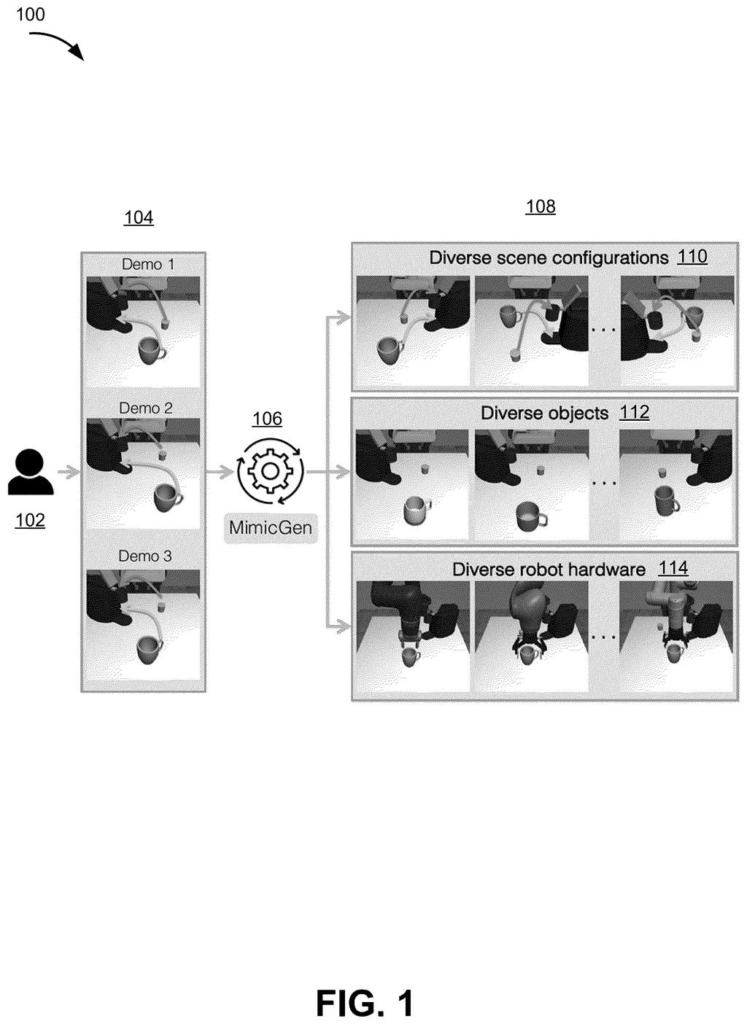
How Nvidia turns one robot video into many training examples
Ever tried to teach someone a new skill using only one example? It's hard, and robots have the same problem. The more videos a robot can learn from, the better it gets, but filming a robot doing the same task hundreds of different ways takes a lot of time and equipment.
Nvidia's patent describes a system that takes a video of a robot doing something, say picking up a cup, and generates new videos showing the robot doing that same task under different conditions or in different ways. Instead of sending someone into a lab to record 500 variations, the system creates them from a much smaller set of real footage.
The idea is that robot developers would feed in a handful of real demonstrations, then let the system expand that into a much larger training set. More training data generally means a robot that handles unexpected situations more reliably, so this is about making the whole learning process cheaper and faster.
one or more circuits to use one or more first videos of a robotic device performing a task to generate one or more second videos of the robotic device performing the task differently than depicted in the one or more first videos.
Translation: Specialized chips take original robot training footage and automatically alter it to show the task done in new ways.
How the system generates new robot task videos from old ones
At its core, the patent describes a processor with circuits that take one or more first videos of a robot performing a task and produce one or more second videos of the robot performing that same task differently. The claim is intentionally broad: it covers any mechanism that transforms existing robot footage into new, varied footage.
The practical goal is to address a well-known bottleneck in robot learning called the data scarcity problem. Training a robot to handle real-world variation, different lighting, object positions, or approach angles, normally requires collecting demonstrations for every variation you care about. That is expensive and does not scale well.
By generating synthetic or modified video from real footage, the system could produce versions where:
- The robot approaches the object from a different angle
- The object is in a different position or orientation
- The robot's arm trajectory varies from the original
The patent sits at the intersection of generative video techniques (computer systems that can create or modify video frames) and robot imitation learning (where robots learn by watching demonstrations). Essentially, it is asking whether you can use one good demonstration to bootstrap many more.
Apparatuses, systems, and techniques to generate data to train a robotic device to perform tasks.
Translation: New technology creates synthetic training data so robots can learn physical jobs without needing extra camera recordings.
What this means for how quickly robots learn new skills
The biggest obstacle to deploying capable robots outside of tightly controlled factory settings is that they need a lot of practice data, and getting that data in the real world is slow. If a system can reliably multiply training footage from a small seed set, it could dramatically cut the cost of teaching robots new tasks, which matters whether you are building a warehouse robot or a home assistant.
Nvidia's steady investment in robot training places this patent in a broader pattern. The more interesting question for anyone following this space is whether generated video is close enough to the real thing to actually improve robot performance, or whether it just creates more of the same mistakes at scale. That validation question is not answered in the patent itself.
That makes this Nvidia's 31st filing we've tracked since May in our robot grasping and movement watchlist, adding to earlier applications like one on text-guided robot arms and one on camera object tracking.
Claim 1 covers any processor that takes one set of videos showing a robot doing a task and produces another set showing that task done differently. That is the entire claim. There is no specification of how the new videos are made, what counts as "differently," or what tasks qualify.
In practice, that language would reach almost any software system that derives new robot training footage from existing recordings, whether by changing camera angles, simulating different lighting, or altering the robot's movements. Any company building that kind of tool would potentially need to contend with this patent.
The real-world stakes are straightforward: generating varied training videos is one of the most promising ways to teach robots new skills without running endless physical experiments, and a claim this broad could give the patent holder significant control over that approach precisely as robots move into homes and workplaces.
There are more where this came from
We read every patent application Big Tech publishes and send you the ones worth knowing. Plain English, free, every week.
The drawings
57 drawing sheets from US 2026/0264239 A1 · click any drawing to enlarge


Want this weekly breakdown for a company we don't cover? Patentlyze Pro →