Nvidia
Nvidia · AI / ML · Filed Feb 13, 2025 · USPTO published Aug 13, 2026 · Aug 13 release
Nvidia Patents an Automated Grading System for Robot-Controlling AI Models
Training a robot AI is only half the problem. Knowing which version of that AI is actually worth shipping is the other half, and Nvidia just filed a patent for a system that tries to automate the answer.
- Publication number
- US 2026/0233387 A1(US20260233387A1)
- Applicant
- NVIDIA Corporation
- Filed · Published
- Feb 13, 2025 · Aug 13, 2026
- Inventors
- Sida WANG, Yan CHANG, Soha POUYA, Huihua ZHAO, Wei LIU
- Status when we published
- Waiting for an examiner
- Document
- 20 claims
- US classification
- 706/14
What Nvidia's robot AI grading system actually does
Training an AI to control a robot produces dozens, sometimes hundreds, of different versions of that AI along the way. Right now, figuring out which version is actually the best one involves a lot of manual testing and guesswork.
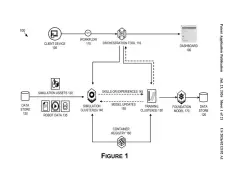
Nvidia's patent describes a system that takes all those different AI versions, runs them through a structured set of tests using both simulated environments and real-world robot data, scores each version on specific performance targets, and automatically picks the top performers. Think of it like a bracket tournament for robot brains: candidates go in, a winner comes out, and the scoring is done by the system itself rather than by an engineer eyeballing a spreadsheet.
The end goal is to make the process of shipping robot AI faster and more consistent. Instead of relying on whoever happened to run the last test, you get a repeatable, documented process that tells you exactly why one version beat another.
… evaluating each of the one or more candidate checkpoints based at least on calculated metric values associated with a set of metrics and a validation dataset; and selecting, from the one or more candidate checkpoints, one or more winning checkpoints based at least on the calculated metric values.
Translation: The system scores different versions of the robot brain against set standards to pick the best ones.
How the checkpoint ranking pipeline scores robot models
The patent describes what Nvidia calls a foundation model evaluation system for robotics. A foundation model, in this context, is a large AI trained to handle a wide range of robot tasks, rather than one trained for a single job.
During training, the model is saved at regular intervals as checkpoints (essentially snapshots of the AI at a given point in its development). The system receives all of these checkpoints and turns them into candidate checkpoints for evaluation. Each candidate is then scored against a defined set of metrics using a validation dataset (a held-aside collection of test scenarios the model hasn't seen before).
From those scores, the system selects winning checkpoints: the versions that performed best across the chosen criteria. Those winners can then be put through further, more rigorous testing before a final model is chosen for deployment on actual robot hardware.
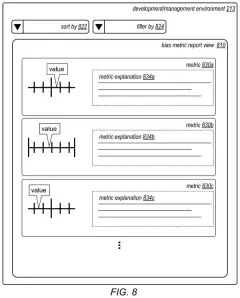
The system also covers visualization tools so engineers can see evaluation results clearly, and it supports both simulated data (virtual robot scenarios) and real-world robotics data (recordings from physical robots), which matters because a model that looks great in simulation sometimes falls apart on real hardware.
Each of the one or more versions of the robotics system foundation model may be represented by a checkpoint that describes the state of the foundation model after a given period of training, and/or after training using a specific set of hyperparameters.
Translation: Each checkpoint captures how the robot AI is performing at a specific stage of its training process.
What this means for building safer, more reliable robots
The practical payoff here is speed and accountability. Robot AI development is expensive, and every time an engineering team has to manually sift through hundreds of model versions to find the best one, that's time and money lost. An automated evaluation pipeline that produces a documented, reproducible winner is a real operational improvement for any organization building physical robots at scale.
Nvidia is one of the largest suppliers of chips and software infrastructure for AI training, and its new Big Tech patents in robotics AI evaluation are a signal that the company is positioning itself not just in the hardware layer but in the tools used to certify robot AI before it touches the physical world.
Source: US 2026/0233387 A1 at the USPTO (PDF). Full patent text and figures are in the official publication.
Get our take in your Top Stories
Liked this breakdown? Add Patentlyze as a preferred source on Google, and our plain-English take shows up more often in your Top Stories the next time Nvidia patent news breaks.
Add Patentlyze on Google
One click.
There are more where this came from
We read every patent application Big Tech publishes and send you the ones worth knowing. Plain English, free, every week.
The drawings · 15 sheets
15 drawing sheets from US 2026/0233387 A1 · click any drawing to enlarge


Show the other 7 sheets


More from Nvidia
All 645 Nvidia patents →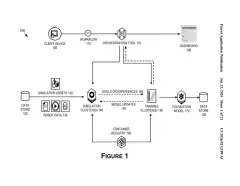
More in AI training & infrastructure
All 316 AI training & infrastructure patents →
Samsung
Samsung Patents a Robot Arm That Retrains Itself When It Fails
Nvidia
Nvidia Patents a System That Teaches Robots to Learn From Every Failure
Qualcomm
Qualcomm Patents a Negotiation System for Phones Training AI Together Over a Network
Amazon