
Intel Patents a Way to Share Space Between a Phone's Speaker and Its Antenna
There's almost no empty space left inside a modern smartphone, and that's a problem for audio. Intel has filed a patent that lets a speaker's acoustic chamber double as antenna territory, without the two components fighting each other.
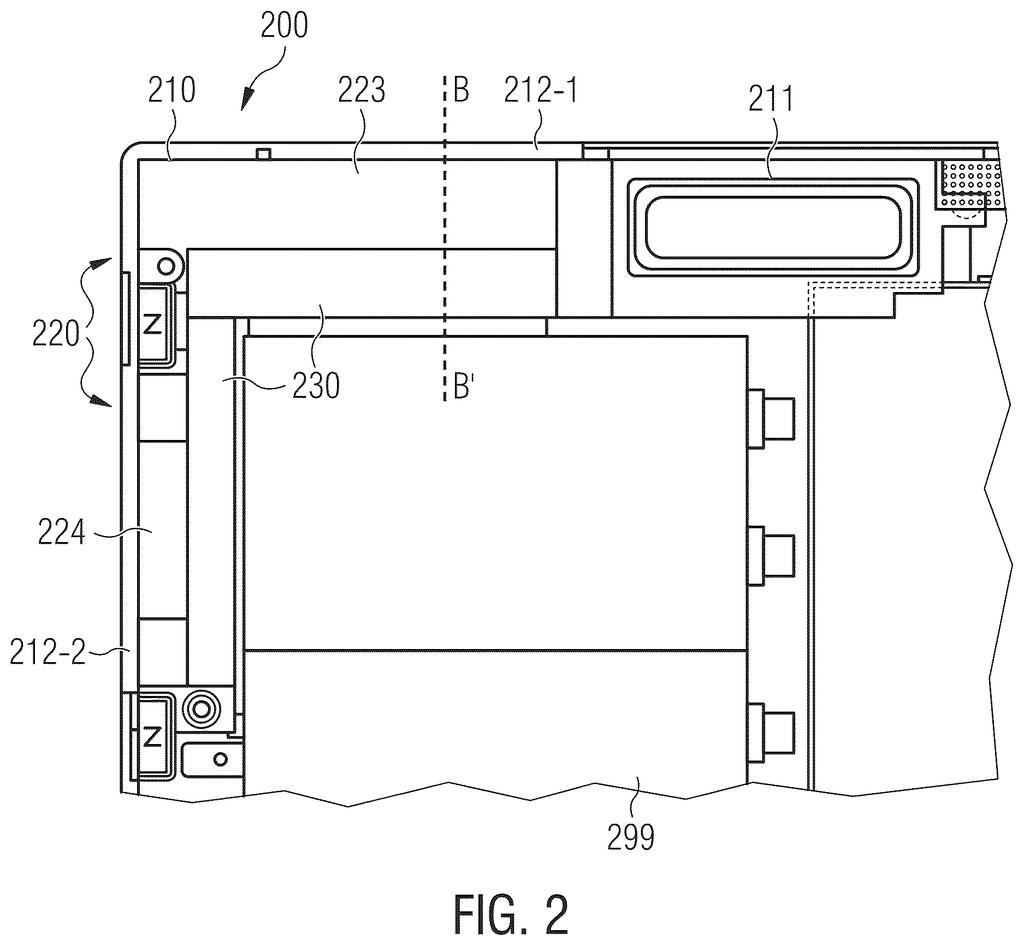
How Intel fits a bigger-sounding speaker into a tight phone
A phone sits on a table playing music, and somewhere inside its slim body, a tiny speaker is struggling. The smaller the box around a speaker, the worse it sounds, and modern phones leave almost no room for a proper enclosure.
Intel's patent tackles this by filling most of that enclosure with a special porous material that fools the speaker into behaving as if the box is larger than it really is. Better bass, more volume, no bigger phone.
The clever part is what gets left empty. The antenna that handles your wireless signals sits right next to this enclosure, and antennas are sensitive to what's around them. Intel's design leaves a deliberate gap in the filler material precisely where the antenna's active part faces the enclosure. That gap protects the antenna's performance while the rest of the space still gives the speaker its acoustic boost.
… a filler material disposed within the back volume and configured to simulate a larger back volume for the speaker driver, wherein the active region of the antenna assembly is disposed opposite a first portion of the back volume, and wherein the first portion of the back volume is unoccupied by the filler material.
Translation: Special material tricks the speaker into sounding like it is in a bigger space while leaving room for the antenna.
How the filler gap keeps the antenna from interfering
The patent describes a compact acoustic system built around three interlocking components:
- Speaker assembly: a speaker driver (the part that vibrates to make sound) sits inside an enclosure that forms what engineers call a back volume, the sealed air space behind the driver that determines how the speaker reproduces low frequencies.
- Filler material: a porous or specially structured material packed into most of the back volume. Because air molecules can move through its micro-structure, the material increases the effective acoustic compliance (think: springiness of the air) beyond what the physical size of the cavity would normally allow. The speaker behaves as if its box is larger.
- Antenna assembly: positioned directly adjacent to the speaker enclosure, the antenna has two distinct zones, an active region (the part that actually transmits and receives signals) and a ground region (a reference plane that completes the electrical circuit).
The key layout rule in the patent is that the active region of the antenna always faces the unfilled portion of the back volume. Because the filler material can affect electromagnetic fields, potentially distorting the antenna's signal, keeping that area clear preserves antenna efficiency. The ground region, which is less sensitive to nearby dielectrics, can safely sit adjacent to the filled section.
What this means for audio quality in thin devices
Thin phones are a constant compromise between audio quality and wireless performance. Manufacturers already push speaker volumes into every available millimeter, often sacrificing one for the other. If Intel's approach holds up in production, it offers a way to extract better low-frequency audio from the same physical footprint without degrading cellular or Wi-Fi reception.
Intel's track record in mobile component integration patents suggests this is part of a longer effort to make the company's hardware relevant inside smartphones and thin laptops. For you as a consumer, the practical payoff would be a device that sounds fuller at lower volumes, the kind of difference you notice most on speakerphone calls or when watching video without headphones.
Intel's second cell phone filing we've tracked since July follows one on computer-to-audio translation.
The filler material that makes the speaker sound fuller cannot go everywhere inside the speaker's chamber. The section sitting next to the antenna has to stay empty, which means the acoustic improvement is partial by design, and how much the listener actually hears depends on how much of the chamber that empty zone eats up in any given phone.
The manufacturing ask is also real. Someone has to cut a precisely shaped gap in the filler and align it to an antenna region that may shift with every new phone model, and small errors push the outcome in two painful directions at once: a speaker that sounds thin or a wireless signal that drops.
The trade is reasonable but it is still a trade. You accept a smaller acoustic gain to protect wireless performance, and you add a fiddly assembly step to protect both. For phones that keep getting thinner and running out of interior space, that bargain makes sense, but it is a bargain.
There are more where this came from
We read every patent application Big Tech publishes and send you the ones worth knowing. Plain English, free, every week.
The drawings
9 drawing sheets from US 2026/0292378 A1 · click any drawing to enlarge


Want this weekly breakdown for a company we don't cover? Patentlyze Pro →
Be the first to weigh in