
IBM Patents an AI System That Turns Business Strategy Into a Visual Action Map
Strategy consultants spend weeks building frameworks to figure out where a business should focus its energy. IBM is patenting a system that uses AI to do that mapping in minutes, spitting out a structured tree of goals, priorities, and action items.
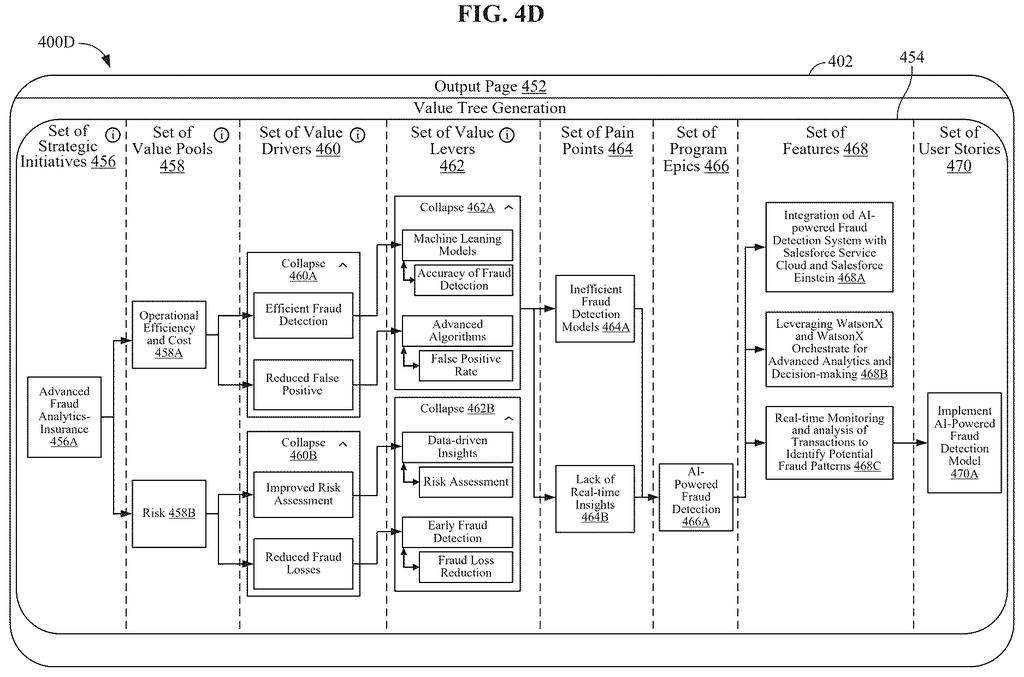
What IBM's AI-built business value tree actually does
Imagine you're a senior executive trying to figure out which of your company's initiatives will actually move the needle on revenue or cost savings. You know the goal, but connecting that goal to the specific day-to-day actions your teams need to take is a messy, expensive process that typically involves consultants, workshops, and weeks of analysis.
IBM's patent describes an AI system that automates a big chunk of that work. You tell it your business domain (say, retail or healthcare), your strategic goal (reduce operating costs, for example), and how many layers of detail you want. The AI then generates a value tree: a structured diagram that breaks your goal into value pools (the broad areas where value can be found), then into value drivers (the specific forces that affect those areas), then into value levers (the concrete actions your teams can pull).
The system doesn't just draw the map. It also uses that tree to help control which business operations get run, essentially letting the AI-generated strategy guide what happens next in your organization.
… generating, by the computer, a value tree comprising a set of nodes associated with the at least one strategic initiative of the set of strategic initiatives, the determined set of value pools, the determined set of value drivers, and the determined set of value levers …
Translation: The system builds a visual map connecting business goals to specific financial drivers.
How the language models build and control the value tree
The patent describes a two-step input process. First, the system receives first input data: the number of strategic initiatives a company wants to pursue, the industry or domain the business operates in, and the focus area for each initiative (think: cost reduction, revenue growth, customer retention).
Second, it receives second input data: how many value pools, value drivers, and value levers the user wants generated. These are essentially instructions for how granular the resulting tree should be. Value pools are broad buckets (like "supply chain efficiency"). Value drivers are the forces inside those buckets (like "inventory turnover rate"). Value levers are the actual operational knobs you can turn (like "reduce safety stock by 10%").
A set of language models (AI systems similar to large text-generating models, though the patent doesn't specify which) processes both inputs and determines the specific content for each layer of the tree. The system then generates the full value tree as a node-based structure, where each node connects a strategic initiative to its downstream pools, drivers, and levers.
Critically, the patent claims the system then uses the generated tree to control a set of operations: meaning the tree isn't just a document you look at, but an active guide that shapes which business processes get executed or prioritized.
What this means for corporate strategy consulting work
Building a value tree is standard consulting work, the kind that costs companies tens of thousands of dollars in advisory fees and weeks of calendar time. If IBM can reduce that to a prompt-and-generate workflow, the appeal to large enterprises managing dozens of simultaneous initiatives is real. IBM's run of enterprise AI filings shows a clear pattern: the company is betting that AI can replace or accelerate the early-stage analytical work that consultants currently own.
For everyday workers, the implications are more ambiguous. A system that uses an AI-generated strategy tree to automatically control operations raises a fair question about how much human judgment stays in the loop. The patent doesn't specify guardrails on that, which is the part worth watching as this kind of tool moves toward actual deployment.
IBM's 45th filing we've tracked in Enterprise AI since May follows earlier applications like shutting AI off to save cost and one that rewrites rule-breaking responses.
The problem this patent attacks is real and expensive. Large companies genuinely struggle to connect high-level strategic goals to the specific operational changes that will achieve them. That translation work is where consulting firms earn enormous fees, and where many corporate initiatives stall or lose coherence as they move down the org chart.
The question is whether a language model generating a tree structure from a handful of numerical inputs actually solves that problem, or just produces a plausible-looking diagram. Strategy consulting is expensive partly because the hard work is gathering context, validating assumptions, and negotiating priorities across stakeholders, none of which this system obviously handles.
The most interesting claim is the one about controlling operations based on the generated tree. That's where this moves from a fancy document-generator to something with real organizational teeth. How that control mechanism works in practice, and who oversees it, is where the real stakes lie.
There are more where this came from
We read every patent application Big Tech publishes and send you the ones worth knowing. Plain English, free, every week.
The drawings
10 drawing sheets from US 2026/0289466 A1 · click any drawing to enlarge


Want this weekly breakdown for a company we don't cover? Patentlyze Pro →
Be the first to weigh in