
Microsoft Patents a Way to Send Datacenter Data Through Flashing Light Patterns
Microsoft has filed a patent describing a system that encodes data as shifting, multicolor light patterns beamed through open air inside a datacenter, no physical cable required between the sending and receiving nodes.
What Microsoft's light-pattern data transfer actually does
Imagine a room full of servers that talk to each other not through cables, but by flashing colored lights in precise sequences, the way two people might communicate in Morse code, but far faster and in multiple colors at once. Microsoft's patent describes exactly that kind of system for the insides of datacenters.
The idea is to take data, convert it into a pattern of at least three colors displayed on a small screen or light-emitting device, then let another node in the same room read and decode that pattern with a camera or sensor. The physical gap between them is just air.
Why bother? Cables in datacenters are expensive to install, create heat, fail, and take time to reconfigure. A light-based system could offer a way to shuffle data around without touching the physical wiring every time something changes.
… encode the data to a set of encoded spatiotemporal patterns using the encoder, including at least three colors; and output the set of encoded spatiotemporal patterns with the display device.
Translation: It turns data into flashing patterns of at least three colors and shows them on a screen.
How nodes encode and decode spatiotemporal color signals
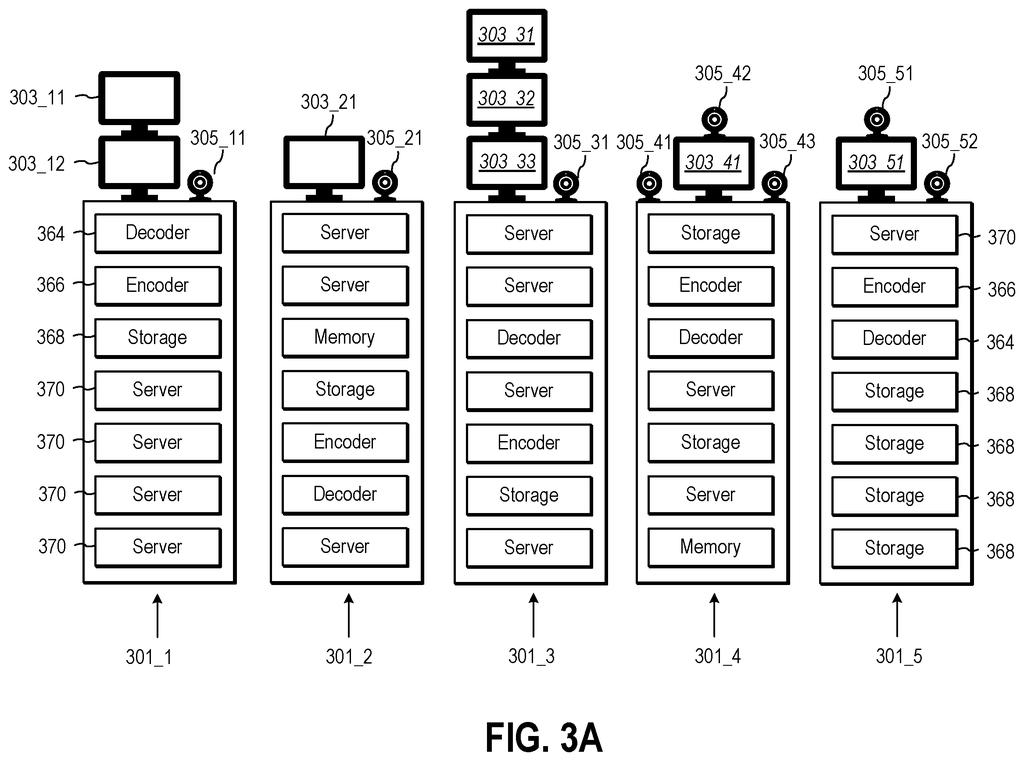
The patent covers a datacenter node (think: a server or a device sitting inside a server rack) that has four key components: an encoder, a decoder, a display device, and an obtaining device.
The obtaining device grabs the data to be sent. The encoder converts that data into a spatiotemporal pattern (a pattern that changes across both space and time, similar to how a QR code carries information in a 2D grid, except this one also changes over time and uses color). The patent specifies the system must use at least three colors, which multiplies the amount of information each frame can carry.
The display device then broadcasts that pattern into open air, and a receiving node's decoder reads and reconstructs the original data. The whole loop happens without any physical cable connecting sender to receiver.
- Data is obtained and queued for encoding
- The encoder maps binary data to color-and-position patterns across time
- A display (likely an LED array or small screen) outputs those patterns into free space
- A receiving node's camera or optical sensor captures and decodes the pattern
… encoding the data to a set of encoded spatiotemporal patterns, and outputting the set of encoded spatiotemporal patterns.
Translation: The system translates information into visual patterns and projects them outward.
What this means for the cables inside tomorrow's datacenters
Datacenters are the physical backbone of cloud computing, and the cables inside them are a constant engineering headache: they tangle, they fail, and reconfiguring them when racks are moved is slow, expensive work. A wireless optical link inside the building, if it can be made reliable and fast enough, would let operators rearrange computing resources without touching a single wire.
The broader question is whether this can keep up with the speed demands of modern datacenters, which transfer data at hundreds of gigabits per second. The patent does not make speed claims, so the filing is at an early, conceptual stage. Still, the pattern in Microsoft's datacenter-infrastructure filings suggests the company is thinking hard about what the physical layer of computing looks like when you strip away assumptions about copper and fiber.
Microsoft's 435th filing in our Microsoft coverage since May continues a thread that includes training AI on user priorities and AI-run meeting brainstorms.
Claim 1 covers any method that takes data, turns it into multicolored light patterns that shift over time, and sends those patterns out through a display inside a data center. The claim says nothing about which display technology is used, how the colors are chosen, or how far the light travels, so its reach is as wide as the basic description itself.
That breadth has real consequences. Any company using patterned light to move information between machines in a data center would have to reckon with this claim, even if their hardware looks completely different from whatever Microsoft built.
Whether that matters depends on whether light-based communication ever replaces the cables connecting machines today. The claim is written as if the problem is already solved, and that confidence alone makes it worth understanding.
There are more where this came from
We read every patent application Big Tech publishes and send you the ones worth knowing. Plain English, free, every week.
The drawings
24 drawing sheets from US 2026/0289214 A1 · click any drawing to enlarge


Want this weekly breakdown for a company we don't cover? Patentlyze Pro →
Be the first to weigh in