
Qualcomm Patents a Self-Correcting Method for Generating Images That Look Photographed
Qualcomm's latest patent describes a graphics processor that renders a 3D scene, checks its own work against a quality target, then re-renders a cleaner version, all in a self-correcting loop that could make simulated environments look far more like the real world.
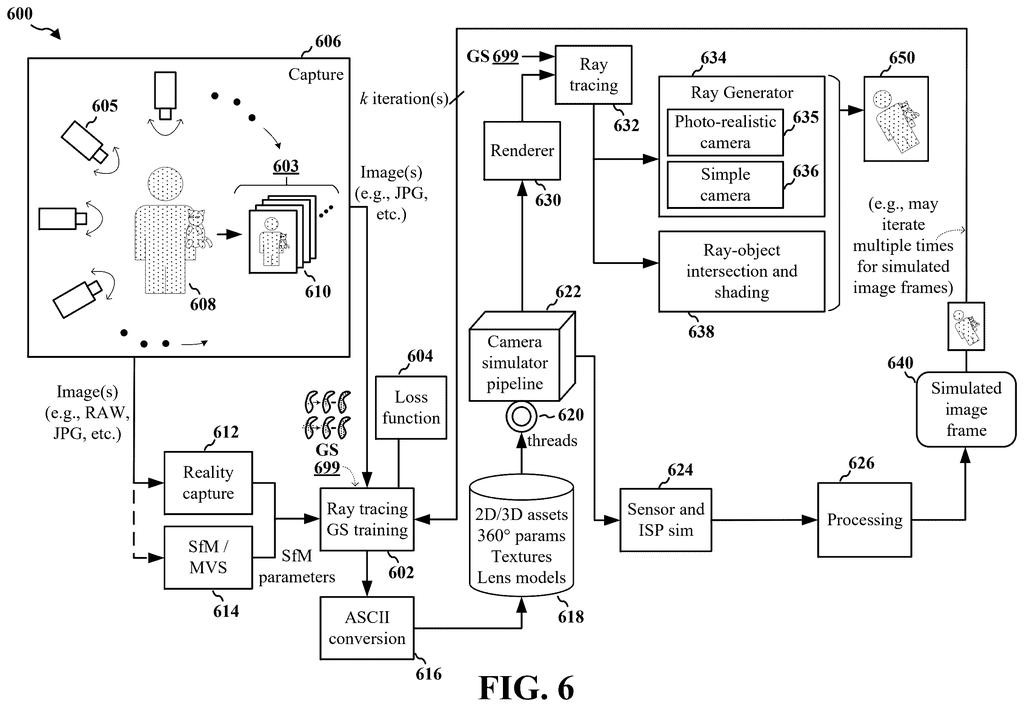
How Qualcomm's 3D image system fixes its own mistakes
Imagine you take a photo of a real room and ask a computer to rebuild that room in 3D, so realistic you could walk a virtual camera through it. The computer's first attempt might look a little off, wrong shadows, blurry reflections, colors that don't quite match. Qualcomm's patent describes a system that catches those errors automatically and produces a corrected version without a person having to step in.
The trick is a two-step process. First, the processor generates a simulated image using a method called Gaussian splatting (think of it as describing a scene using thousands of fuzzy blobs of color and light instead of hard geometric shapes). Then it measures how far off that image is from the ideal, adjusts its settings, and runs the rendering a second time to fix the gaps.
The result is a system designed to produce photo-realistic images that improve themselves. That kind of capability matters for anything from self-driving car simulation to the visual quality of AR and VR headsets that rely on Qualcomm chips to run.
generate a simulated image frame based on an input image frame and a first set of Gaussian splat (GS) parameters associated with a GS training model and a first ray tracing operation …
Translation: It creates a starting image by combining your input with a mathematical model for 3D rendering.
How the two-pass ray tracing loop refines each frame
The patent centers on a technique called Gaussian splatting combined with ray tracing. Gaussian splatting represents a 3D scene not as traditional polygons but as a large collection of semi-transparent, blob-like points in space, each carrying color, opacity, and orientation data. Ray tracing simulates how light physically travels and bounces, producing accurate reflections and shadows.
Here is how the loop works:
- First pass: The processor takes an input image frame and a starting set of Gaussian splat (GS) parameters from a training model, then runs a ray tracing operation to produce an initial simulated image frame.
- Error measurement: A loss function (a mathematical score that measures how far the output is from perfect) compares the simulated frame against a quality target and produces a second, adjusted set of GS parameters.
- Second pass: The processor uses those corrected parameters to run a second ray tracing operation, producing an optimized output frame that is measurably closer to photo-realistic.
The two-pass architecture is the core claim. By building the error-correction step directly into the rendering pipeline, the system can iteratively close the gap between a synthetic scene and a real one without human intervention.
… determine a second set of GS parameters based on the simulated image frame and a loss function …
Translation: It checks the results against a quality target to figure out how to improve them.
What sharper synthetic scenes mean for your devices
For anyone using a device that renders 3D environments, a VR headset, an AR app, a driving simulator, or a game, photo-realism directly affects how convincing and useful the experience feels. A synthetic training scene for a self-driving car that looks wrong in its lighting or reflections can introduce errors into the AI that learns from it. A headset overlay that renders poorly breaks the illusion immediately.
Qualcomm's chips power a wide range of mobile and XR (extended reality) devices, so a more efficient, self-correcting rendering pipeline at the processor level could improve visual quality across that hardware without requiring apps to do the heavy lifting themselves. Qualcomm's track record in graphics and XR patents suggests this is part of a broader push to handle more rendering intelligence inside the chip.
Qualcomm's 14th filing we've tracked since July in the GPU rendering race adds to a run that includes an AI frame polishing chip and one that converts video data mid-process.
The practical bet here is that a rendering system that catches and corrects its own visual errors will spare users from the small but persistent wrongness that erodes trust in simulated images. Bad lighting on a virtual object, a background that feels slightly off, a reflection that lands in the wrong place, these are the details that tip a convincing scene into an unconvincing one. A system that runs a second corrective pass automatically removes those failures before they reach the screen.
For someone using an AR filter, a driving simulation, or a VR environment, that means fewer moments of visual doubt and more moments of just believing what they see.
The real question is whether Qualcomm can make this fast enough to matter on the devices people actually carry. The patent describes a smart method, not a proven speed, and that gap is where the user experience either materializes or does not.
There are more where this came from
We read every patent application Big Tech publishes and send you the ones worth knowing. Plain English, free, every week.
The drawings
12 drawing sheets from US 2026/0289898 A1 · click any drawing to enlarge


Want this weekly breakdown for a company we don't cover? Patentlyze Pro →
Be the first to weigh in