
Apple Patents a Compression Method for Streaming 3D Objects in Motion
Sending a moving 3D object over the internet is far more data-hungry than sending regular video. Apple has filed a patent for a smarter way to compress those objects by tracking how smaller pieces of them move, rather than sending the whole shape from scratch every frame.
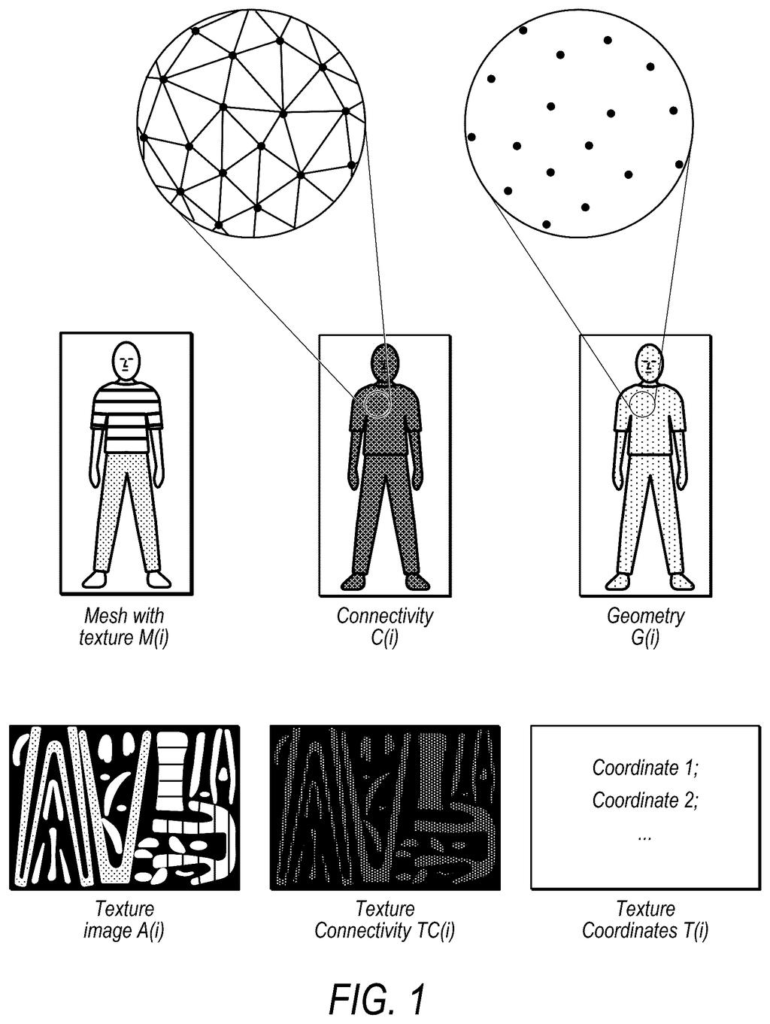
What Apple's moving 3D mesh compression actually does
Every time a 3D avatar waves its hand in a video call, your device has to receive a full description of that shape at every moment. That description, called a mesh, is a dense grid of points and triangles that together form the object's surface. Sending a fresh copy of all those points sixty times per second adds up fast.
Apple's approach cuts that down by chopping the mesh into smaller sections and sending instructions for how each section moved rather than redefining its position from zero. It's similar to how ordinary video compression works: instead of storing every pixel in every frame, it just stores what changed. The same logic now applies to 3D shapes.
The result is that your device can reconstruct the moving object using a starting shape plus a stream of small motion updates, using much less data overall. That matters for anything that needs to send 3D objects in real time, from video calls with avatars to spatial video and augmented reality.
receive a bit stream for a dynamic mesh, the bit stream comprising: a base mesh sub-bitstream comprising information for a base mesh, wherein the base mesh sub-bitstream is signaled using a plurality of sub-mesh data units corresponding to a plurality of respective sub-meshes included in the base mesh …
Translation: The system takes in data divided into smaller sections representing parts of a 3D object.
How the encoder splits, tracks, and rebuilds each mesh section
The patent covers an encoder-decoder pipeline for dynamic mesh coding, meaning the compression and decompression of 3D shapes that change over time.
The encoder starts with a base mesh, a simplified version of the 3D object. It divides that base mesh into smaller pieces called sub-meshes. For each sub-mesh, it signals a motion vector (a direction-and-distance instruction, like "this chunk moved two centimeters to the left"). Then it sends displacement information, which is a set of fine-grained adjustments applied to specific points on the mesh after it has been subdivided to add geometric detail.
On the receiving end, the decoder reads a structured bitstream (the data package) that is split into:
- A base mesh sub-bitstream carrying the basic shape, organized by sub-mesh
- One or more displacement sub-bitstreams carrying the fine surface detail adjustments
The decoder first counts the vertices (corner points) for each sub-mesh, rebuilds the shape, and then applies the displacement data to restore surface detail. The motion vectors let it reuse mesh sections from earlier frames when the geometry hasn't changed much, a technique called inter-prediction (borrowing from older frames instead of starting fresh). This is directly borrowed from how video codecs like H.265 work, now extended to 3D geometry.
To compress the three-dimensional mesh, the encoder determines displacements to be applied to sub-division locations of a base mesh. In addition to signaling displacements, motion vectors for portions of the base mesh (e.g. sub-meshes) may be signaled.
Translation: It shrinks 3D data by tracking how the base shape shifts and moves over time.
What this means for 3D video and spatial computing streams
For users, more efficient 3D mesh compression means lower data costs and better quality when streaming anything that involves real-time 3D objects: spatial video on Apple Vision Pro, avatars in FaceTime, or augmented reality overlays that have to update as you move. Without compression like this, those experiences either need a fat internet connection or they look blocky and laggy.
several Apple filings on spatial video and 3D streaming this year suggest the company is building infrastructure around Vision Pro content delivery. Claim 1 of this patent is fairly specific: it covers a decoder that reads a bitstream structured around sub-mesh data units carrying vertex counts and separate displacement data. That scope is narrower than a broad 3D-compression claim, which means it would be harder to use against a competitor using a different packaging structure, but it does plant a flag on this particular architecture.
Apple's 470th filing in our Apple coverage since May adds to a run that includes a smart TV info panel and wired-plus-wireless headphones.
Claim 1 here is a decoder claim, which means Apple is staking out the receiving side of this pipeline: how a device parses and reconstructs a 3D mesh from a specific bitstream structure. That's a meaningful but limited position. A competitor could design an encoder that packages the same ideas differently, and this claim might not reach them.
The real-world impact depends on whether this approach gets folded into an emerging standard, like the MPEG V-PCC or V3C family of standards for volumetric video. If it does, the claim gets teeth. If Apple keeps it proprietary, it mainly protects one internal implementation.
For readers curious about where Apple is investing engineering time, this filing is a signal that the company is treating 3D object streaming as a real infrastructure problem, not a demo feature. Whether this particular patent ends up mattering is a separate question from whether the underlying work does.
There are more where this came from
We read every patent application Big Tech publishes and send you the ones worth knowing. Plain English, free, every week.
The drawings
16 drawing sheets from US 2026/0292236 A1 · click any drawing to enlarge


Want this weekly breakdown for a company we don't cover? Patentlyze Pro →
Be the first to weigh in