
Samsung Patents a Phone Frame With a Hidden Slot That Acts as an Antenna
Samsung has filed a patent describing a way to build an antenna directly into the structural frame of a phone, tucked out of sight behind the display, without adding any visible antenna lines or bumps to the outside.
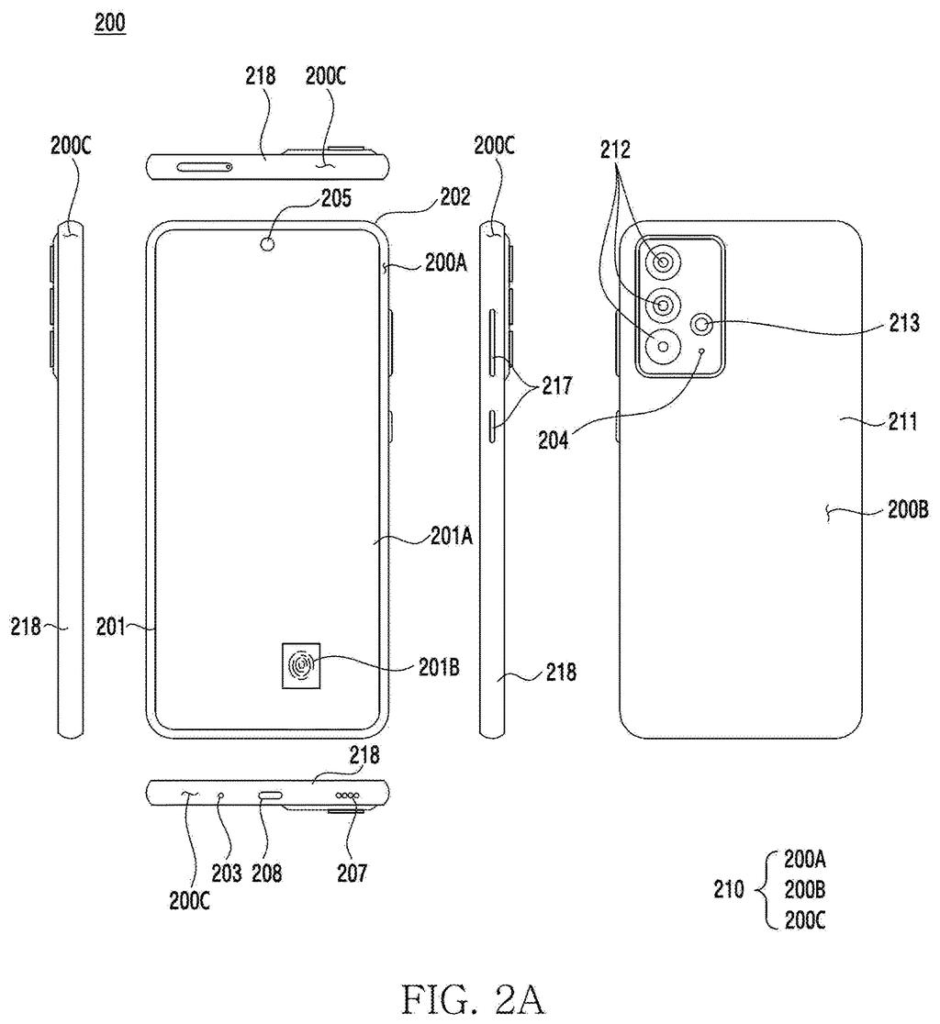
What Samsung's hidden-slot antenna actually does for your phone
Ever noticed those thin lines running across the edges of some phones? Those are antenna breaks, and they exist because every phone needs to send and receive radio signals somehow. Samsung's new patent describes a way to move much of that antenna work to a hidden spot inside the phone's body, below the screen.
The idea is to create a narrow gap (a "slot") between two metal parts of the phone's housing: one part forms the side edge you can see and touch, and another sits tucked behind the display where you'd never notice it. That gap acts as an antenna, picking up and sending wireless signals through it.
The recessed design means the inner metal piece steps back toward the rear of the phone, which shapes the slot in a way that improves how well it radiates signals. You'd see no difference from the outside, but the radio performance could improve.
… a housing comprising a first conductive portion forming a part of a side surface of the electronic device and a second conductive portion positioned below the display and at least partially separated from the first conductive portion by a slot; and a wireless communication circuit configured to transmit and receive a radio frequency (RF) signal through the slot …
Translation: The phone body uses a metal side piece separated by a tiny gap that acts as a wireless antenna.
How the slot and recess form a working antenna inside the frame
The patent describes a phone housing made of two conductive portions (metal sections that can carry electrical signals). The first is the familiar metal band around the phone's side edge. The second sits inside the device, positioned behind the display and partially separated from that outer band by a narrow gap called a slot.
The inner conductive portion has two distinct zones. The first zone sits flat, roughly in the same plane as the phone's internal support structure. The second zone is recessed, meaning it steps down toward the phone's back surface. That step creates a slot opening that faces inward toward the display rather than outward where you'd see it.
A wireless communication circuit (the radio hardware that handles calls, Wi-Fi, and other connections) is wired to transmit and receive signals through this slot. Because the slot's geometry is shaped by both the outer metal edge and the stepped inner piece, engineers can tune its dimensions to target specific radio frequency bands.
- Outer metal side band forms one wall of the slot
- Inner recessed conductive piece forms the opposing wall
- The slot faces toward the display, keeping it hidden from outside view
- The recess depth controls the slot's effective size and tuning
The recess part may include a second conductive part, recessed toward the rear cover with respect to the planar part and extending toward the side surface. The second conductive part of the recess part may form, together with the first conductive part, a slot area substantially facing the display.
Translation: An internal metal part steps down toward the back of the phone to shape the antenna gap near the screen.
What this means for thinner phones and better wireless reception
For you as a phone user, the most immediate payoff is potentially better signal without any trade-off in how the phone looks or feels. Antenna design is one of the trickiest constraints in making a thin metal phone, and engineers often have to compromise between aesthetics and radio performance. A slot built into the internal structure could free up more of the outer frame for structural or design purposes.
On the engineering side, Samsung's track record in antenna-integration patents suggests the company keeps looking for ways to pack radio hardware into tighter spaces as phones get thinner. This particular approach requires precise machining of the inner frame, so the path from patent to shipping product runs through manufacturing tolerances that are non-trivial to hit consistently at scale.
Samsung's 80th filing we've tracked in our 5G and network push since May builds on earlier applications like one controlling network access by permissions and one cleaning signals with AI teams.
Getting this idea into a real phone requires physical changes to the metal frame itself, not a software update, which means Samsung's factories would need to cut a precisely shaped groove into millions of devices and hit the same measurements every single time.
The concept is straightforward: a carefully shaped gap in the frame lets the phone send and receive wireless signals while keeping the outside surface smooth and unbroken.
If Samsung can make that groove reliably at scale, the reward is cleaner-looking phones that may also connect better, but the shortest path to a finished product runs straight through a demanding manufacturing problem that has to be solved before any of the benefits show up.
There are more where this came from
We read every patent application Big Tech publishes and send you the ones worth knowing. Plain English, free, every week.
The drawings
48 drawing sheets from US 2026/0292052 A1 · click any drawing to enlarge


Want this weekly breakdown for a company we don't cover? Patentlyze Pro →
Be the first to weigh in