
Google Patents an AI System That Keeps Your Device Running Efficiently in Real Time
Instead of waiting for your phone's processor to get hot or slow before making adjustments, Google's new patent describes a chip that predicts what's coming and changes its speed and power draw before problems start.
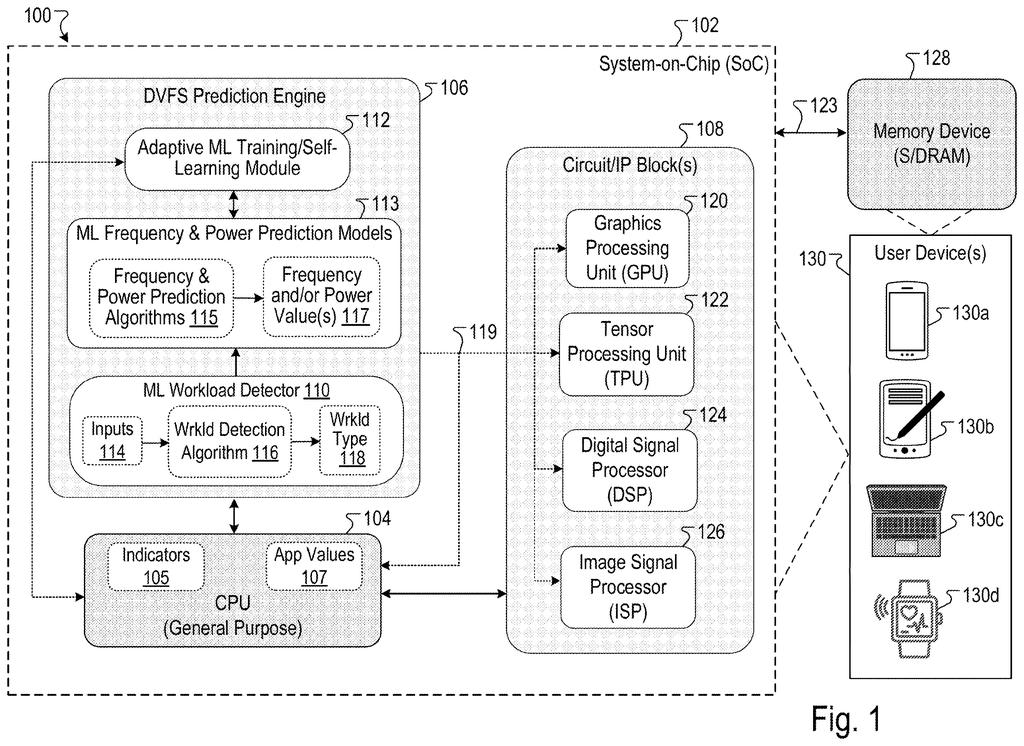
How Google's chip AI decides how fast to run your processor
Imagine you're playing a graphics-heavy mobile game and your phone suddenly stutters, heats up, and throttles the processor to cool down. That lag happens because most chips react to problems after they occur, not before.
Google's patent describes a different approach. A small AI engine built directly into the chip watches what kind of app is running and reads signals generated alongside the app in real time. From those signals it predicts, in advance, what clock speed and power level the chip will need to keep things running without hiccups or waste. Then it adjusts before the problem shows up.
The goal is a chip that hits a target level of quality (smooth video, fast response, no dropped frames) while using only as much power as necessary. That matters for battery life on phones, but also for data center servers running many tasks at once, where every watt adds up.
… computing, by a Dynamic Variable Frequency Signal (“DVFS”) prediction engine of the SoC, inferences used to achieve a threshold quality of service (“QoS”) when the application is executed at the SoC …
Translation: An internal prediction engine calculates the ideal settings to keep apps running smoothly without lagging.
How the DVFS engine reads workloads and sets clock speed
The patent centers on a component called a DVFS prediction engine (Dynamic Variable Frequency Signal, meaning a system that can change a chip's clock speed and voltage on the fly). Most chips already do DVFS, but traditionally they react: the chip gets overloaded, the governor notices, and then the frequency rises. Google's design tries to flip that sequence.
Here is how the system works according to the filing:
- The chip detects which application is running and classifies it into a workload type (video decode, heavy compute, idle background task, and so on).
- An indicator, a performance signal generated at the same moment the app runs, is fed into the prediction engine alongside that workload classification.
- The ML engine computes inferences (the chip's best guess, based on learned patterns, about future demand) and outputs a predicted frequency value and a predicted power value.
- Those predicted values are used to tune the chip's operating frequency or power output before quality degrades, hitting a defined quality-of-service threshold.
The whole engine lives inside the System-on-Chip (SoC), the single piece of silicon that combines a processor, graphics unit, memory controller, and other components on devices like smartphones or embedded computers. Keeping the prediction on-chip means no round-trip to a cloud server and no extra latency.
What predictive chip tuning means for phones and tablets
For everyday users, predictive chip management means fewer moments where your phone feels sluggish right when you need it most, and theoretically better battery life because the chip stops over-provisioning power for tasks that don't need it. Both are problems that affect every smartphone owner regardless of which brand they use.
From a chip-design perspective, Google's bet on on-device AI inference puts the intelligence as close to the hardware as physically possible. If this approach works in production silicon, it could reduce the gap between raw chip performance on benchmarks and the smoothness people actually feel when using a device day to day.
Google's 14th filing we've tracked since July in our AI chip wars watchlist follows earlier applications like one reusing CPU vector instructions and one on quantum data feeding.
The gap between this filing and a real product is smaller than most patents suggest. Every modern chip already has a system for adjusting speed and power on the fly, and swapping its simple rulebook for a trained prediction model is largely a software change, not a ground-up hardware rebuild.
What the document leaves out is telling, though. It never explains how the prediction model learns, how often it updates, or whether running it burns enough power to cancel out what it saves. Those are solvable problems, but they are the whole ballgame.
Google already builds its own chips and has the tools to train and test models like this before any public announcement. The shortest path to shipping this is a firmware update on existing hardware, which means if it works, users could see longer battery life without ever knowing a change was made.
There are more where this came from
We read every patent application Big Tech publishes and send you the ones worth knowing. Plain English, free, every week.
The drawings
9 drawing sheets from US 2026/0288543 A1 · click any drawing to enlarge


Want this weekly breakdown for a company we don't cover? Patentlyze Pro →
Be the first to weigh in