
Google Patents a Faster Way to Feed Classical Data into Quantum Computers
One of quantum computing's least-discussed bottlenecks is simply getting ordinary data in. Google has filed a patent for a method that breaks that loading process into parallel chunks, potentially cutting the cost of one of the field's most overlooked tax lines.
What Google's quantum data-loading shortcut actually does
Every time a quantum computer needs to work with real-world data, like a table of numbers or a dataset from a sensor, it has to translate that information from the ordinary digital world into quantum states. That translation step is slow and expensive, and it often erases much of the speed advantage quantum hardware is supposed to offer.
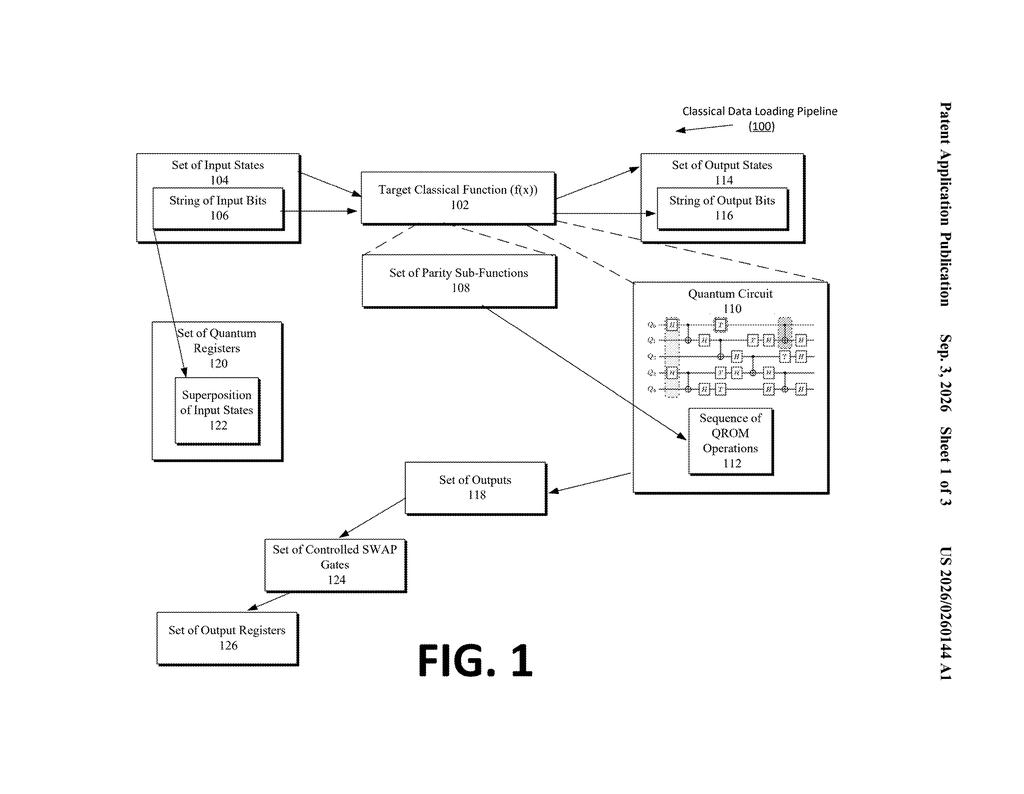
Google's patent describes a way to break that translation job into smaller pieces called parity sub-functions, each of which handles a slice of the data independently. These pieces can be processed in sequence using something called Quantum Read-Only Memory (think of it as a quantum equivalent of looking up values in a reference table), and each result gets its own dedicated output slot.
The goal is to make data loading less of a traffic jam, so the quantum computer spends more of its time actually computing rather than waiting for its inputs to arrive. It's a plumbing fix, not a flashy new capability, but plumbing determines how fast the whole system runs.
configuring a quantum circuit to implement a target classical function that is defined over a string of input bits, wherein the target classical function is decomposed into a set of parity sub-functions; …
Translation: Breaking down a standard data problem into smaller mathematical pieces that quantum computers can process.
How parity sub-functions split the data-loading job
The patent describes a method for loading classical data (ordinary binary information, ones and zeros) into a quantum computing system more efficiently than current approaches allow.
The core idea is decomposition. Instead of loading a complex data function all at once, the system breaks it into a set of parity sub-functions. A parity sub-function is a simpler mathematical operation that checks whether certain combinations of input bits sum to an even or odd number. Combining many of these simple checks can reconstruct any classical function, much like breaking a large mosaic into single tiles.
The quantum registers (the system's working memory) are first placed into a superposition of input states, meaning they hold many possible input combinations simultaneously, which is the core advantage of quantum hardware. Then a sequence of Quantum Read-Only Memory (QROM) operations runs on those registers. QROM is a well-established quantum technique that looks up and encodes values from a classical dataset into quantum states, similar to a database lookup but operating across superposed inputs at once.
Each QROM operation encodes one parity sub-function, and each result is routed to its own output register, keeping the outputs organized and independent. The sequencing and routing together are what the patent calls "quantum mass production," processing data loading tasks in a structured, assembly-line style rather than monolithically.
A sequence of Quantum Read-Only Memory (QROM) operations is executed on the set of quantum registers to generate a set of outputs.
Translation: Specialized memory instructions are run across quantum bits to produce the final results.
What this means for quantum computing's practical limits
The bottleneck this patent targets is real. Quantum algorithms that promise speed advantages over classical computers often assume that getting data into the quantum system is free or trivially fast. In practice, data loading consumes a significant share of the circuit operations (called gate budget) and can negate theoretical speedups entirely. Researchers have called this the data-loading problem, and it affects nearly every practical quantum computing application from optimization to machine learning.
Google's sustained push into quantum error and efficiency research suggests this is part of a broader effort to make quantum hardware usable on real workloads, not just benchmark problems. If the method reduces loading overhead meaningfully, it could shift which quantum algorithms become practical first, and on what hardware scale.
That makes this Google's 12th filing we've tracked since July in the AI chip wars watchlist, following one on quantum error correction and one on storing model data in fewer bits.
Getting data into a quantum computer is slow and costly enough that it cancels out the speed advantages quantum hardware is supposed to deliver. That bottleneck is not a footnote, it is the reason many quantum algorithms that look impressive on paper have failed to perform in practice.
Google's approach here is to break complex data-loading tasks into smaller, simpler pieces that can be handled in sequence, rather than all at once. Whether that actually saves time and resources depends on hardware details the patent leaves open, but the underlying logic is sound and the problem being solved is real.
Data loading matters more as quantum computers take on heavier workloads. A filing that makes this step meaningfully cheaper would enable a lot of what quantum computing is supposed to be good for.
There are more where this came from
We read every patent application Big Tech publishes and send you the ones worth knowing. Plain English, free, every week.
The drawings
3 drawing sheets from US 2026/0260144 A1 · click any drawing to enlarge


Want this weekly breakdown for a company we don't cover? Patentlyze Pro →