
Samsung Patents a Charging System That Both Powers Up and Shares Battery Wirelessly
Samsung has filed a patent for a coil assembly that nests three separate wireless charging rings inside a single phone, letting it charge other gadgets while topping itself up at the same time.
How Samsung stacks three charging rings in one phone
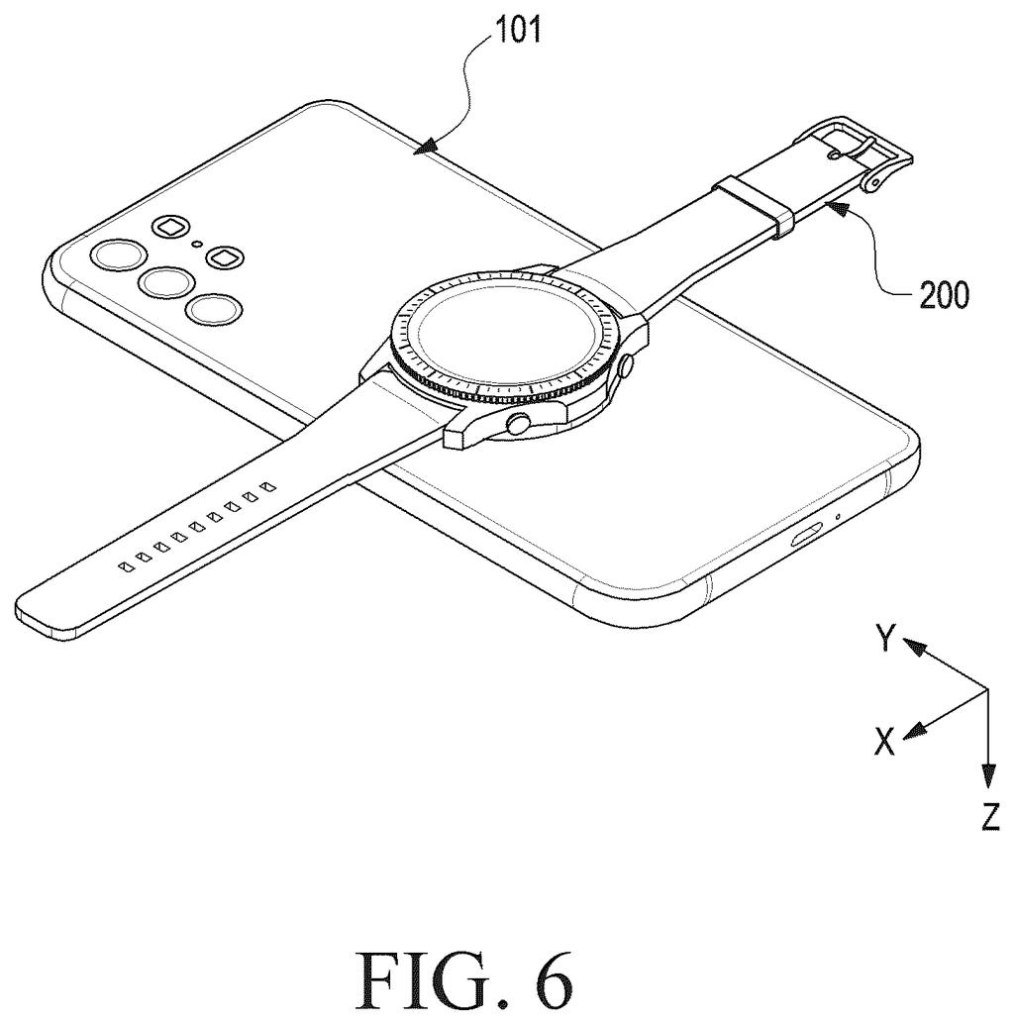
A Galaxy phone rests face-up on a charging pad while a pair of earbuds sits on its back. You have probably seen phones do one or the other, but doing both reliably at the same moment is harder than it looks.
This patent describes how Samsung wants to solve that by stacking three separate coils, each shaped like a ring, inside the phone's rear section. One ring handles sending power out to accessories like earbuds. A second ring receives power from a charging pad below. A third ring sits on the outside of the stack and can do either job depending on what the phone needs.
The clever part is how those rings are wired together. The inner two share the electrical load by running in parallel, while the outer ring is wired in series with both of them. That arrangement lets the phone shift power in and out more efficiently than a single coil could manage on its own.
… wherein the first coil and the second coil are electrically connected in parallel, and the third coil is electrically connected in series with the first coil and the second coil.
Translation: The three coils are wired together in a specific parallel and series combination.
How the parallel and series coil wiring divides the work
The patent describes a coil assembly fitted near the rear plate of a smartphone housing. It contains three concentric ring-shaped coils, each one wrapping around the outside of the one before it.
- First coil (innermost): dedicated to transmitting power outward, for example to wireless earbuds placed on the phone's back.
- Second coil (middle): dedicated to receiving power from an external wireless charger, such as a charging pad on a desk.
- Third coil (outermost): can do either job, transmitting or receiving, making it a flexible buffer for the overall system.
The first and second coils are wired in parallel (meaning they share the same voltage level and can each carry part of the current independently). The third coil is wired in series with both of them, meaning current passes through it before reaching or after leaving the inner pair. That combination gives the circuit more control over how much power flows in each direction.
Wireless charging works through electromagnetic induction, the same physics that lets one coil of wire create a current in another nearby coil without any physical contact. By separating the transmit and receive functions into distinct rings and then linking them with a specific circuit topology, Samsung aims to reduce interference between the two operations and support simultaneous bidirectional power transfer.
What this means for phones that charge other devices
For consumers, the practical payoff is a phone that can sit on a charging mat and still push power to accessories placed on its back at the same time, without the two functions fighting each other. That is not a given with simpler single-coil designs, where receiving and transmitting at once can cause efficiency losses or require the phone to alternate rapidly between modes.
Samsung's track record in wireless charging patents suggests this is part of a longer effort to close the gap with MagSafe-style ecosystems. The design also matters for third-party accessory makers, because a phone that can reliably supply power to accessories expands what those accessories can do without needing their own large batteries.
Samsung's 250th filing we've tracked in our cell phone patents since May follows work like a charging screen fix and frame with hidden antenna slot.
Fitting three concentric charging rings inside a phone forces a real sacrifice: internal space. Phone makers already treat every cubic millimeter as precious, and this layout demands more room than a single coil would.
The wiring arrangement compounds that cost. The two inner rings share one electrical path while the outer ring runs in series with them, meaning any weakness in that outer ring, whether from heat buildup or a manufacturing flaw, drags down the whole assembly's performance.
The design solves a real problem cleanly, letting the phone charge accessories and accept wireless charging at the same time without awkward software juggling. Whether that capability justifies the space and fragility tradeoffs depends entirely on whether Samsung builds an accessory lineup that makes people reach for it daily.
There are more where this came from
We read every patent application Big Tech publishes and send you the ones worth knowing. Plain English, free, every week.
The drawings
17 drawing sheets from US 2026/0291284 A1 · click any drawing to enlarge


Want this weekly breakdown for a company we don't cover? Patentlyze Pro →
Be the first to weigh in