
Samsung Patents a Way to Turn a Foldable Phone's Metal Frame Into Its Own Antenna
Foldable phones have a tricky antenna problem: folding the device in half can put two metal frames right on top of each other, which plays havoc with wireless signals. Samsung's new patent describes a fix built into the hinge design itself.
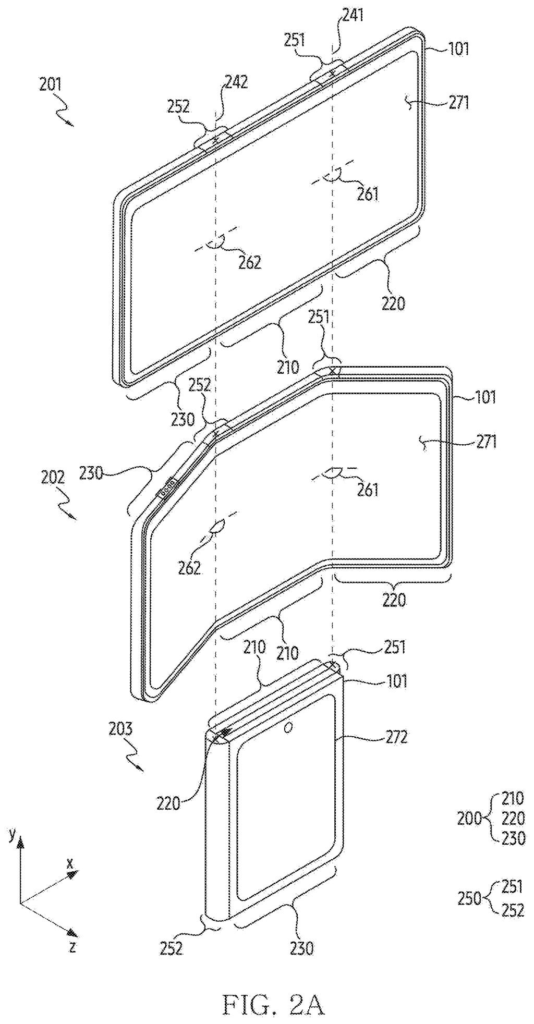
How Samsung hides an antenna inside a folding phone's frame
Ever held your phone in a weird way and suddenly lost a bar of signal? Now picture doing that every time you close a folding phone.
Samsung's filing describes a three-part foldable housing where the metal frame on one panel doubles as a radio antenna. When the phone folds shut, the second panel ends up sitting right next to that antenna, and its own metal frame can interfere. To stop that, the patent adds a small filter circuit to the second panel's frame that essentially tells stray electrical interference to stay out.
The result is that the phone's outer shell does two jobs at once: it's the structural frame and the antenna, without needing a separate antenna strip tucked inside. That could help keep foldable phones thinner while maintaining reliable wireless performance in both open and closed positions.
… a first conductive portion forming at least a portion of a first lateral side of the first housing part and configured to function as an antenna radiator …
Translation: The metal frame of the phone doubles as an actual antenna for wireless signals.
How the filter circuit keeps signals clean when the phone folds
The patent describes a foldable device with three housing sections. The first section carries a conductive portion along its side edge that acts as an antenna radiator, meaning it's the part that actually transmits and receives radio waves. That strip has two connection points: a feeding point (where the wireless radio circuit injects or receives signal) and a ground point (where the antenna connects back to the device's electrical ground, completing the circuit).
The second housing section has its own metal side frame. When the phone folds, that second frame physically overlaps the region between the feeding point and the ground point on the first antenna. Metal that close can act like an unintended extension of the antenna, shifting its tuning and degrading reception.
To prevent that, Samsung's design connects filter circuitry to a specific spot on the second frame. A filter circuit (think of it as an electrical gate that blocks certain frequencies while letting others through) stops the second frame from coupling with the antenna in a way that would distort the signal.
- Three-panel foldable housing, with one panel acting as the main antenna
- Filter circuit on the adjacent panel's frame to block interference
- The antenna is formed by the exterior metal side rail, not a hidden internal component
… a filter circuit electrically connected to a portion of a second conductive portion in a second side exterior surface of the second housing part …
Translation: Additional circuitry links different parts of the metal frame to manage signal interference.
What this means for signal strength in future Galaxy Fold phones
For anyone buying a foldable phone, antenna placement is invisible until it isn't. Dropped calls, slow data speeds, and patchy reception are often antenna problems in disguise, and foldable form factors make antenna engineering significantly harder because the device's geometry changes every time you open or close it.
By building the antenna directly into the metal side frame and adding a filter to manage interference from the adjacent panel, Samsung is describing a design that could make future foldable devices thinner and more reliable at the same time. Samsung keeps filing on foldable-device antenna management, and this filing fits a clear pattern of preparing the engineering groundwork for devices where wireless performance needs to survive a fold.
Samsung's 77th filing we've tracked since May in our foldable phone patent watchlist follows work on a screen-cradling hinge and a three-layer waterproof seal.
The ship-path question here is how far this sits from something you'd actually hold in your hand, and the honest answer is not very far. The components described, metal frames, filter circuits, connection points on a folding frame, are all standard antenna engineering built from materials and manufacturing processes that already exist.
What the patent locks down is a specific arrangement: a particular filter goes on a particular section of the frame, positioned to work correctly when the phone folds shut. That is incremental precision work that gets absorbed into a product revision rather than announced as a feature. A future foldable phone could use exactly this layout without it ever appearing on a spec sheet.
That makes the filing useful and plausibly close to production. It solves a real constraint that folding phones create for wireless signals, and it reads as careful preparation rather than a long-horizon research bet.
There are more where this came from
We read every patent application Big Tech publishes and send you the ones worth knowing. Plain English, free, every week.
The drawings
36 drawing sheets from US 2026/0291053 A1 · click any drawing to enlarge


Want this weekly breakdown for a company we don't cover? Patentlyze Pro →
Be the first to weigh in