
Apple Patents a System That Logs You Into Devices by Tracking Where You Look
Apple has filed a patent for a login system that requires no password, no fingerprint, and no tap, just your gaze. If your eyes land on a device, your credentials go to it automatically.
What Apple's eye-gaze login system actually does
Imagine you walk up to your computer wearing a headset, glance at the screen, and you're instantly logged in. No PIN, no password prompt, no button press. That's the core idea in this Apple patent.
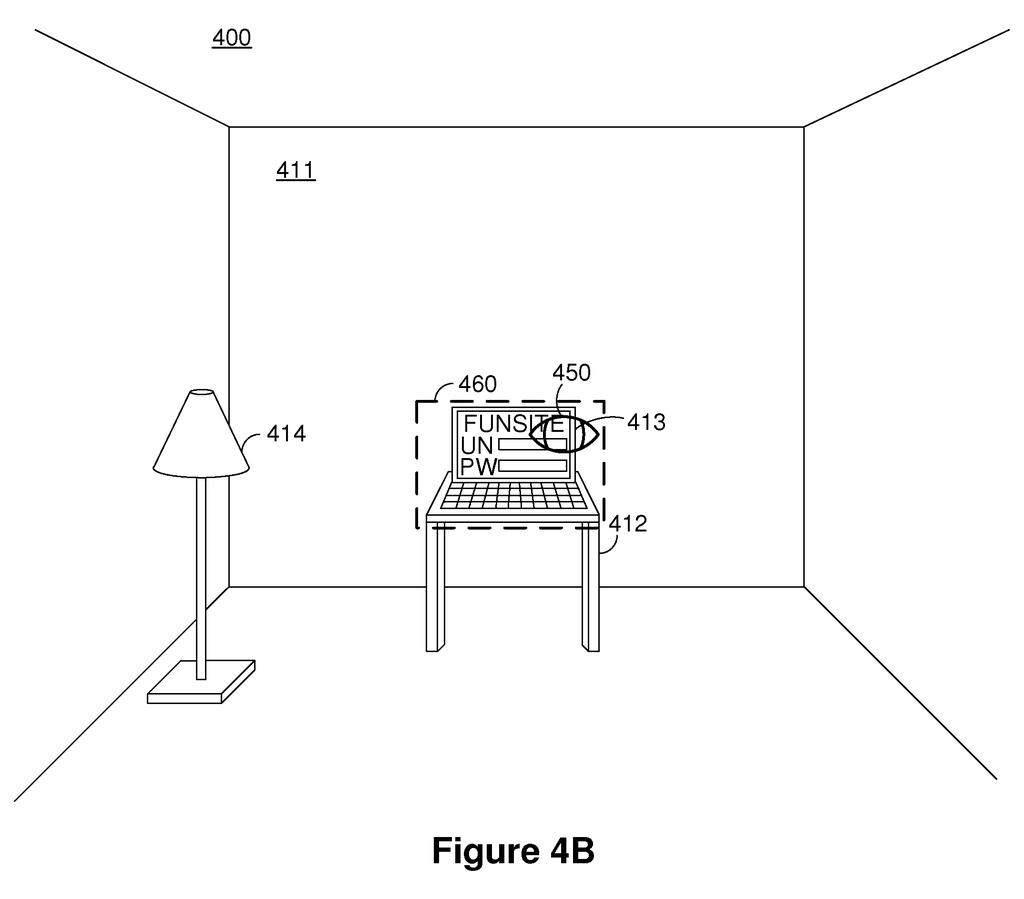
The system works from a device you're already wearing (think a headset with a camera and an eye tracker). It scans the room, spots another device like a laptop or a kiosk, watches where your eyes go, and the moment it confirms your gaze is pointed at that second device, it sends your login credentials over automatically.
The practical payoff is that authentication becomes a side effect of looking. You don't interrupt what you're doing to prove who you are. The device figures it out from the direction of your attention.
detecting a second device in a physical environment; based on detection of the second device, detecting a user action indicating the second device; in response to detecting the user action indicating the second device, transmitting unlocking data to the second device.
Translation: Your phone senses another gadget nearby and sends it a digital key when you interact with it.
How the camera and eye tracker coordinate the handoff
The patent describes a first device (the one doing the watching) equipped with a camera, an eye tracker, and a processor. That device continuously scans the physical environment around you.
When it spots a second device in the camera feed, it cross-references that location with where your eyes are pointing. Eye trackers measure the angle and direction of your gaze in real time, effectively letting the system draw a line from your eyes to whatever you're looking at in the room.
Once the system confirms your gaze is directed at the second device, it transmits unlocking data (authentication credentials) to that device. The second device receives those credentials and, presumably, uses them to log you in or grant access.
- The first device detects a second device in the physical environment via camera
- It detects a user action (specifically gaze direction) pointing at that device
- It transmits credentials to the second device in response
The patent's broader independent claim is written to cover any "user action" indicating the second device, not just eye gaze specifically, so the underlying framework could extend to gestures or other intent signals as well.
… determining that the gaze of the user is directed to the second device. The method includes, in response to determining that the gaze of the user is directed to the second device, transmitting authentication credentials to the second device.
Translation: Looking right at a screen causes your device to automatically log you into it.
What this means for AR headsets and everyday logins
For users, this kind of system removes one of the most repetitive friction points in a connected life: proving who you are every time you sit down at a new screen. If you already trust your headset or glasses to know who you are, having that identity ripple outward to other devices on a glance is a genuinely useful shortcut.
The most obvious home for this technology is Apple Vision Pro or a future headset, since those are the devices Apple ships with both a camera array and eye tracking built in. A headset that can see your desk and track your eyes already has the two ingredients this patent needs. Apple's interest in AR and spatial computing shows up repeatedly in its hardware investments, and this patent fits that pattern directly.
Apple's 32nd filing we've tracked since May in our eye and hand controls watch adds to work like pausing AI mid-conversation and dark hand tracking.
The hardware this patent describes already exists in Apple's product lineup: a headset with an outward-facing camera and a precise eye tracker. That means the shortest path to shipping this is almost entirely a software problem, not a manufacturing one.
The harder part is making "looking at a screen" feel like a deliberate choice rather than an accident. People glance at screens constantly without meaning to authorize anything, so Apple would need some minimum gaze duration or a small confirming gesture before credentials go anywhere.
If Apple solves that intentionality problem cleanly, the feature could arrive as an update rather than a new product. That makes this patent more immediately relevant than most.
There are more where this came from
We read every patent application Big Tech publishes and send you the ones worth knowing. Plain English, free, every week.
The drawings
10 drawing sheets from US 2026/0288925 A1 · click any drawing to enlarge


Want this weekly breakdown for a company we don't cover? Patentlyze Pro →
Be the first to weigh in