
Samsung Patents a Two-Chip System That Fixes Screen Colors While Your Phone Sleeps
Every time you tap your Samsung phone awake, there's a small window where the screen might look wrong, colors off, brightness mismatched to the room. This patent describes a two-processor system designed to close that window before you even notice it.
What Samsung's background color-fixing actually does
Every time you tap your phone awake, the display has to figure out what the lighting around you looks like and adjust its colors accordingly. That process takes a moment, and during that moment, what you see might not look quite right.
Samsung's new filing describes a way to split that adjustment work between two chips. One chip stays active even when your phone is mostly asleep measuring the color of whatever is on screen. By the time the main chip wakes up, much of the color-correction homework is already done.
The result, in theory, is a display that looks accurate from the first instant you see it, rather than catching up after the fact. It's the kind of thing you'd only notice if it went wrong, which is precisely the point.
based on a sleep state of the first processor being released, set, on the display, a first region-of-interest set including a plurality of regions of interest, obtain first color information for the first region-of-interest set, and compensate an image displayed on the display based on the obtained first color information …
Translation: When the main chip wakes up, the device checks specific areas of the screen and adjusts the colors.
How two processors divide the color-sampling workload
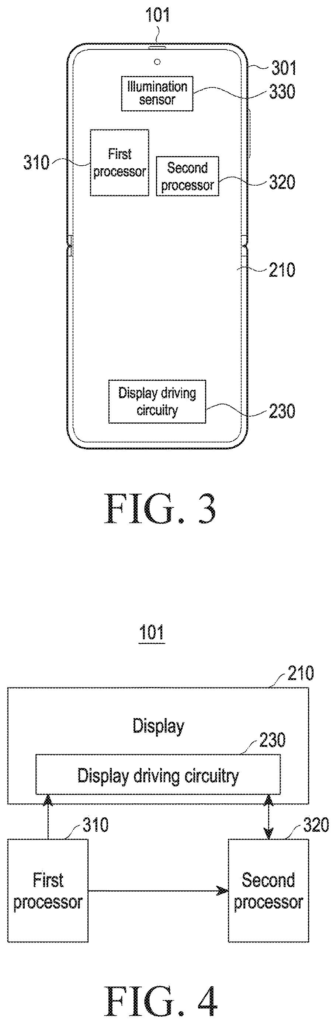
The patent describes an electronic device with two processors handling display management in shifts, depending on whether the device is awake or asleep.
When the main processor wakes from sleep, it defines a "region-of-interest set" (a collection of specific zones on the display it wants to sample) and reads color data from those zones. That color data is used to adjust, or compensate, the image so it looks correct for current lighting and content conditions.
Here is where the two-processor split becomes important:
- If the displayed image is paused or static when the main chip wakes up, the device defines a second set of sampling zones before going back to sleep.
- While the main chip sleeps, a secondary, lower-power processor measures color data from those zones independently.
- When the main chip wakes again, it combines what it measured at wake-up with what the secondary chip collected during sleep, and uses both data sets to correct the display.
The illumination sensor feeds ambient light data into this pipeline as well, so the system accounts for both what the screen is showing and how bright or warm the room is. The underlying goal is to reduce the gap between "screen off" and "screen looking correct."
… based on entering the sleep state, obtaining second color information about the second region of interest set on the basis of entering the sleep state, and compensating the image on the basis of the first color information and the second color information.
Translation: As the chip goes to sleep, it grabs more color data to fine tune the picture using information from both states.
What this means for Galaxy display quality day to day
For most people, display color accuracy is invisible when it works and deeply annoying when it doesn't. A screen that looks green-tinted, too cool, or washed-out for a second every time you pick up your phone is a small but consistent irritant. This patent targets exactly that moment.
The two-chip approach also has a practical power angle: keeping the main processor asleep as long as possible while a smaller chip handles housekeeping is a standard strategy for extending battery life. If Samsung can make this work in shipping hardware, you'd get faster-looking color accuracy without the main chip burning extra energy to achieve it. That is a real trade-off worth solving, even if the effect would be subtle.
Samsung's 109th filing we've tracked in our Samsung display technology watchlist since May builds on work like the color bleed fix and per-pixel dimming by heat.
When you wake your phone in a dim room and the screen looks briefly washed out or overly warm before settling, that moment of visual wrongness is what this patent is designed to erase. The system samples the colors already on screen before your eyes fully adjust, so the display is compensating before you consciously register a problem.
The practical payoff is small but consistent. Every time you pick up your phone, you skip a subtle recalibration lag that most people attribute to their eyes rather than the screen.
Whether you ever notice this working depends on your environment and how sensitive you are to color. If it functions well, you will simply never have that slightly off feeling at wake, which is exactly the right kind of invisible improvement.
There are more where this came from
We read every patent application Big Tech publishes and send you the ones worth knowing. Plain English, free, every week.
The drawings
12 drawing sheets from US 2026/0301627 A1 · click any drawing to enlarge


Want this weekly breakdown for a company we don't cover? Patentlyze Pro →
Be the first to weigh in