
Nvidia Patents a Map-Based System That Sets Speed Limits for Delivery Robots
A robot that barrels through a warehouse at the same speed whether the path is clear or crowded is a liability. Nvidia's latest patent describes a system that reads a map, spots obstacles ahead, and sets a different speed limit for each stretch of the route before the robot even gets there.
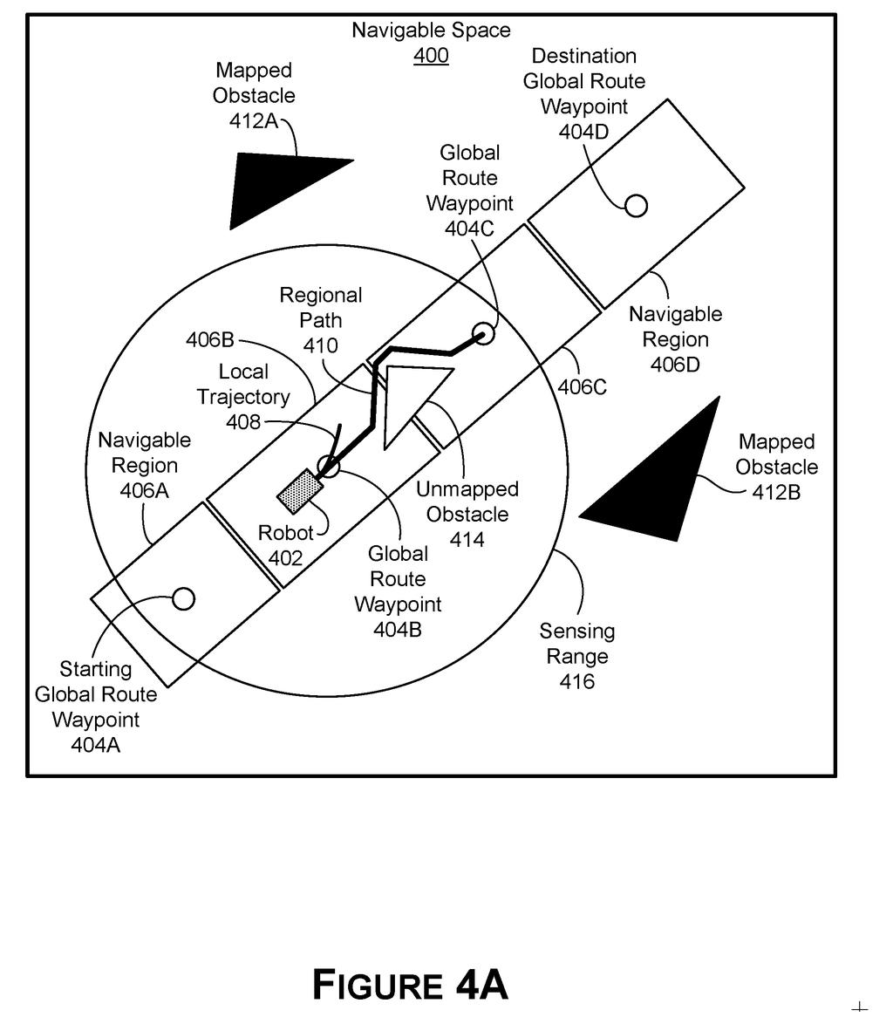
How Nvidia's speed-limit system works for mobile robots
Today's mobile robots often treat speed as a simple on/off decision: go until something blocks you, then stop. That reactive approach wastes time and creates safety risks when a robot suddenly brakes near people or equipment. Nvidia wants to change that by giving robots a smarter way to plan their speed in advance, section by section.
The idea is to use maps of the robot's environment to identify obstacles along the planned route, then assign a specific speed limit to each stretch of the path that has a hazard nearby. Once those limits are set, the system figures out the best possible speed curve that obeys all of them at once.
For you, the practical picture is a warehouse robot that already knows to slow down before a busy intersection and speed up again on a clear corridor, rather than reacting only when it nearly collides with something. It's the difference between a new driver who pumps the brakes in a panic and an experienced one who reads the road ahead.
… generating, based at least on the one or more obstacles, one or more speed constraints, each speed constraint specifying a speed limit for a respective portion of the path …
Translation: It creates speed limits for different parts of the route based on what obstacles are nearby.
How the time-space path search picks the right speed profile
The patent describes a three-step planning process that runs before the robot moves.
Step 1: Obstacle identification. The system ingests one or more maps of the physical environment, such as an occupancy grid or a semantic map, and checks which parts of the robot's planned route have obstacles nearby. An obstacle can be a static object like a shelf or a dynamic one like a person walking through the space.
Step 2: Speed constraints. For each segment of the path that has a nearby obstacle, the system generates a speed constraint, essentially a local speed limit. A tight corridor gets a lower limit; an open stretch gets a higher one.
Step 3: Time-space search. This is the technically interesting part. The system builds a two-dimensional representation called a path time-space region. One axis is the robot's position along the route; the other is time. Every speed constraint becomes a forbidden zone in this diagram. The system then searches for a speed profile (a curve through that diagram) that threads between all the forbidden zones. That profile becomes the robot's instruction set, telling it exactly when to accelerate, coast, or decelerate at each point along the route.
The approach is closer to how autonomous vehicles plan motion than how most warehouse robots operate today, where speed decisions are usually reactive rather than pre-planned.
… generating one or more speed change decisions specifying actions to be performed by the mobile robot to cause a speed profile of the mobile robot to satisfy the one or more speed constraints …
Translation: The system figures out what actions the robot must take to make sure it obeys those speed limits.
What this means for warehouse and delivery robots near people
For companies running fleets of mobile robots in warehouses, hospitals, or logistics centers, this kind of pre-planned speed control could cut both accidents and downtime. A robot that decelerates smoothly before a hazard rather than stopping hard is faster on average and easier on its motors and cargo.
A growing pile of Nvidia robotics filings suggests the company is building out a full software stack for robot navigation, not just the AI chips that power the machines. This patent sits in the motion-planning layer of that stack, the part that turns a map and a route into precise, moment-by-moment movement instructions. If Nvidia can own that layer across many robot platforms, the chip sales follow naturally.
Nvidia's 47th filing in our robotics patents coverage since May builds on work like one on warehouse item placement and one on multiplying training videos.
Planning a robot's speed before it moves, rather than reacting on the fly, is a software-only idea. No new hardware needs to be built or bought, which removes the biggest barrier between a patent and a working product.
What has to exist first is a reliable, up-to-date map of the space the robot operates in. That map is already standard in serious warehouse operations, so the shortest path to shipping this is slotting it in as a planning layer on top of infrastructure that likely already exists.
That makes this closer to a deployable feature than most patents ever get, and it matters because controlling speed intelligently is what separates a robot that can share a space with people from one that cannot.
Get our take in your Top Stories
Liked this breakdown? Add Patentlyze as a preferred source on Google, and our plain-English take shows up more often in your Top Stories the next time Nvidia patent news breaks.
There are more where this came from
We read every patent application Big Tech publishes and send you the ones worth knowing. Plain English, free, every week.
The drawings
15 drawing sheets from US 2026/0295828 A1 · click any drawing to enlarge


Want this weekly breakdown for a company we don't cover? Patentlyze Pro →
Be the first to weigh in