
Nvidia Patents an AI System That Tells Robots Where to Move Every Item in a Warehouse
Nvidia has filed a patent for a system that lets robots manage inventory on their own, using live camera feeds, a 3D copy of a room, and language models that can take plain-text orders and translate them into physical movement.
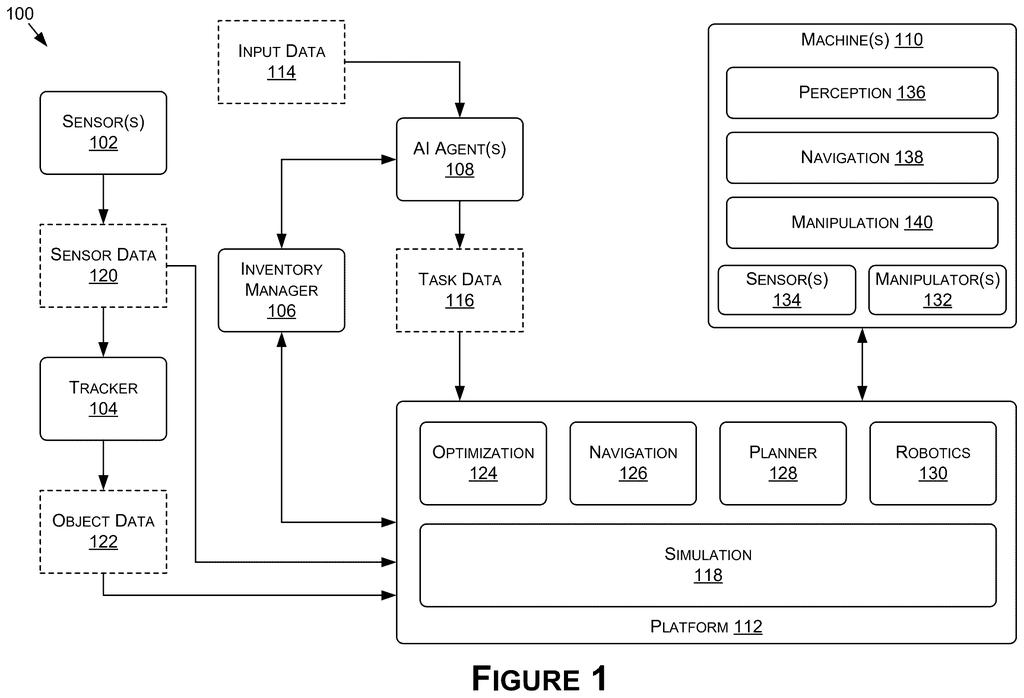
What Nvidia's AI inventory robot actually does
Every time a shelf runs low in a large warehouse or retail store, a human worker typically has to notice the gap, find the right item, navigate the floor, and restock it. Nvidia's filing describes a system that hands most of that process to robots.
The system watches an environment through cameras, builds a running 3D replica of the space (called a digital twin), and uses that replica to track where every item is at any given moment. When a task comes in, say, "move the blue boxes from aisle 3 to the loading dock", an AI model reads that plain-English instruction and figures out which robots are closest, which path they should take, and how their arms should grip the item.
You don't reprogram anything. The system interprets the request, checks the live 3D map, and sends the robots off. The whole loop is meant to run continuously, with the digital twin updating as the real world changes.
generating, based at least on using one or more language models to process input data corresponding to a request, text data representing one or more tasks associated with moving one or more items in an environment; …
Translation: The system uses language models to turn a basic user request into specific tasks for moving warehouse items.
How the digital twin picks robots and plans their routes
The patent describes a multi-layer pipeline that ties together several AI components.
First, a language model (the same category of AI behind chatbots) reads an incoming request about moving items and converts it into structured task data the rest of the system can act on. This means operators could theoretically issue instructions in plain text rather than writing code.
Second, camera images of the environment feed into a module that builds and continuously refreshes a digital twin, a simulated, spatially accurate copy of the real space. That twin is used to locate items and machines in real time.
Third, the system uses the digital twin to select which machines from a fleet are positioned close enough to the items that need moving. It then calculates optimal travel routes for those machines.
- Grasp planning: 3D models of individual items (generated from the same image data) are used to calculate exactly how a robot arm should approach and grip each object.
- Control commands: The system sends those grasp instructions down to the robot's physical manipulators, closing the loop from language input to physical action.
- Continuous updates: As robots move items, the digital twin reflects those changes, keeping the whole system in sync.
… the systems of the present disclosure may use the virtual representation of the environment to select optimal machines for moving items, select optimal paths for the machines to follow, etc.
Translation: The software uses a digital twin of the warehouse to figure out which robot should move an item and where it should drive.
What this means for warehouses and retail stock floors
Warehouses and large retail operations already use robots, but most systems today require a lot of human programming for each task type. A system that takes plain-language requests and figures out the physical steps on its own would lower the setup cost and make it easier to handle unusual or changing tasks without calling in a software team.
For everyday shoppers, the downstream effect would be shelves that stay stocked more consistently. For logistics companies, the appeal is fewer human hours spent on repetitive movement tasks. several Nvidia filings on autonomous physical systems this year point toward the company building a broader software stack for robotics, not just selling chips to run them.
Nvidia's 33rd filing we've tracked in our robot grasping and movement watchlist since May builds on earlier applications like one multiplying training videos and one scoring robot software.
The core idea here is a software layer, not new hardware. It links existing cameras, a live 3D map of a space, and robotic movers into one continuous decision loop, which means the building blocks are already sitting on shelves waiting to be connected.
The shortest path to a real product runs through a warehouse, not a store. Controlled lighting, predictable shelf arrangements, and minimal foot traffic give that coordination loop the best chance of working reliably before anyone attempts the harder problem of a busy retail floor.
What the patent does not address is the actual connective work, keeping cameras, maps, and moving machines in sync when real-world conditions shift unexpectedly. That gap between a described system and a working one is where most of the effort will go.
There are more where this came from
We read every patent application Big Tech publishes and send you the ones worth knowing. Plain English, free, every week.
The drawings
26 drawing sheets from US 2026/0299557 A1 · click any drawing to enlarge


Want this weekly breakdown for a company we don't cover? Patentlyze Pro →
Be the first to weigh in