
A New Google Patent Has Your Phone Force a Stray Tracker to Beep
Your phone could spot a tracker it doesn't recognize, tell Google where it saw it, and then order that tracker to start beeping. The same order also slows down how often the tracker's owner can check its location.
What Google's unwanted-tracker patent does
What would you do if a coin-sized tracker were riding along in your bag and you had no idea? Small Bluetooth trackers are built to help people find lost keys, but the same tiny signal can be used to follow a person.
Google's patent application turns your phone into a watchdog. When it spots a tracker it doesn't recognize, it tells a Google server where it saw it. The server can send back an order, your phone passes it along, and the tracker switches into a protective mode. In that mode it becomes much easier to find, because it will beep for your phone without needing the owner's permission.
Your phone can also warn you directly. It looks at clues like whether you just stepped out of your car or whether it's the middle of the night. And it holds back in places like airports, where bag trackers are everywhere.
… responsive to determining that the tracking device is unknown to the computing device, sending, by the computing device and to a remote computing system, a location report that includes a location of the tracking device …
Translation: When your phone spots an unfamiliar tracker, it alerts a remote server to where that tracker is.
How your phone turns a tracker into a beeper
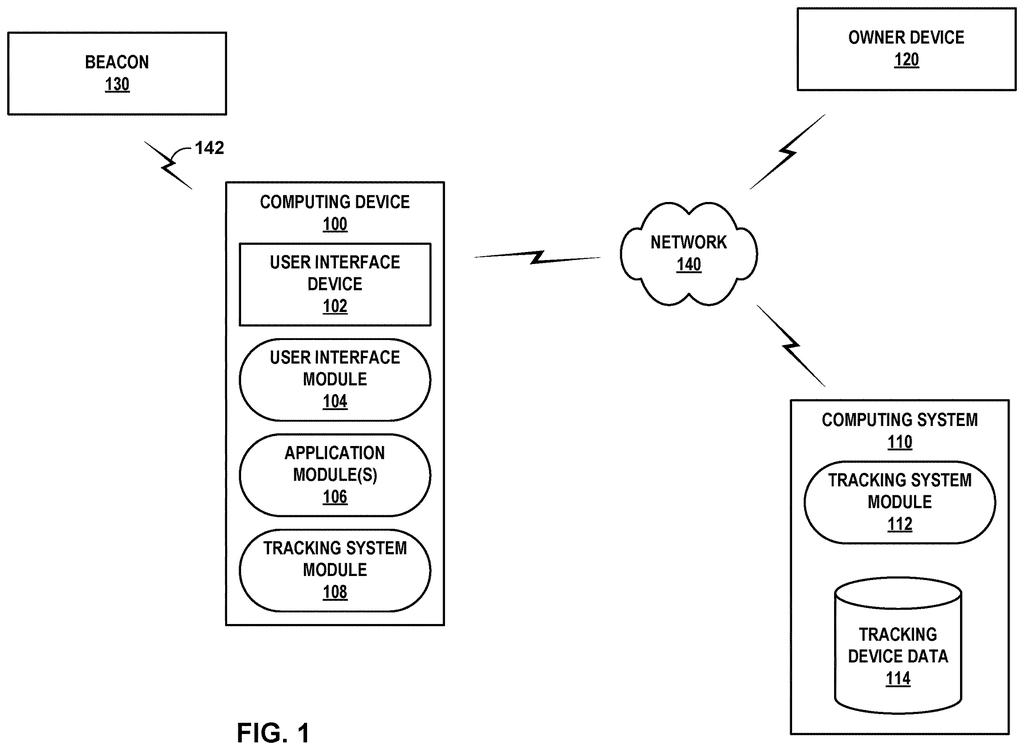
The main claim covers a simple chain of events. A phone (or any computing device) detects a tracker nearby, using background Bluetooth scans or signal strength (how strong the radio signal is, a rough stand-in for distance). It checks whether the tracker is known, either against its own records or by asking a server. If the tracker is unknown, the phone sends a location report to a remote system, gets back a command, and relays that command to the tracker over the short-range link.
The command puts the tracker into an unwanted tracking prevention mode. The description lists several things that mode can do:
- Stop cycling its Bluetooth address, so nearby phones can notice the same tracker keeps showing up.
- Broadcast a flag saying it is separated from its owner.
- Beep when any nearby phone asks, with no owner credentials needed.
- Trigger server-side limits, such as letting the owner look up its location only once every 20 minutes for the first 24 hours, then hourly.
Alerts depend on context. The phone checks whether you moved a set distance and the tracker is still with you, whether your phone is sitting still on a known Wi-Fi network, whether you just left your own car, or what time it is (10 PM to 4 AM is one example). Reports are skipped at saved places like your home, inside geofenced zones (virtual boundaries on a map) such as airports, and for a set time after airplane mode ends. Location reports are encrypted, and the tracker's identity rotates (one example is every 10 minutes) to protect privacy.
… receiving, by the computing device and from the remote computing system, a command to cause the tracking device to operate in an unwanted tracking prevention mode …
Translation: The phone gets instructions from the server to force the stray tracker into anti-stalking mode.
Why Google must balance alerts and privacy
If you've ever worried about a tracker hiding in your bag or car, this filing describes a safety net that goes beyond a warning. Your phone can help make the tracker easier to find and harder to use against you. Because the phone that spots the tracker is a different device from the owner's, protection comes from the crowd of phones around you.
The design also admits that too many alerts are a problem. Airports, home addresses and the minutes after airplane mode ends are all handled so you aren't buried in warnings you'll learn to ignore. For Google, the filing shows how a crowd-sourced finder network can also protect people who never bought a tracker.
Google's 831st filing we've tracked since May adds to a health-sensing thread that includes a heartbeat forecasting watch method and a lens case wear tracker.
Every protection here costs somebody something. When a tracker gets flagged as suspicious, its real owner can check its location only once every 20 minutes, then hourly after that. Someone hunting a lost suitcase waits longer so that someone being followed gets breathing room.
The quiet zones carry a harder cost. Skipping alerts near home addresses, in airports, and right after a phone reconnects to a network cuts false alarms, but it also means a tracker slipped into a bag inside a busy terminal raises no warning while it stays there.
The trade reads as worth it. A slower location update costs a lost-bag owner a few minutes, while a flood of false alerts costs people's trust in the warnings, and a missed stalker costs far more. The open question is whether the assumptions baked into those quiet zones hold up as well in messy real life as they do on paper.
Get our take in your Top Stories
Liked this breakdown? Add Patentlyze as a preferred source on Google, and our plain-English take shows up more often in your Top Stories the next time Google patent news breaks.
There are more where this came from
We read every patent application Big Tech publishes and send you the ones worth knowing. Plain English, free, every week.
The drawings
4 drawing sheets from US 2026/0313368 A1 · click any drawing to enlarge


Want this weekly breakdown for a company we don't cover? Patentlyze Pro →
Be the first to weigh in