
Adobe Patents AI That Guesses the Whole Room's Lighting From One Photo
Drop a shiny metal robot into a photo and it usually looks pasted on, because the photo shows only a sliver of the light around it. Adobe's patent has an AI fill in the rest of the scene, lamps and sky included, and lets you adjust the light yourself.
What Adobe's lighting-guess patent actually does
Every time someone drops a 3D object into a photo, the same problem shows up: the object looks fake. A mirrored ball or a chrome robot is supposed to reflect everything around the camera, but the photo only captured a narrow slice of that scene. The filing says the photo typically holds 10% or less of the environment.
Adobe's patent has an AI imagine the missing 90%. It starts by guessing where the lights are in your photo and how bright they are, then builds a full 360-degree picture of the surroundings with realistic brightness, including the glare of a lamp or the sun.
You also get a say. The guessed lights show up as settings you can nudge, so if the AI picked the wrong mood, you can move a light or dim it and the surroundings update to match.
accessing a field of view (FOV) image that has a field of view less than 360 degrees and has low dynamic range (LDR) values; generating a lighting image based on lighting parameters estimated from a scene depicted in the FOV image; …
Translation: The system starts with a standard, narrow photo and figures out its lighting details.
How the AI rebuilds a 360-degree light map
The system takes a regular photo with a narrow view and ordinary low dynamic range (LDR) brightness, meaning bright lights get clipped to plain white. From that, it produces a full 360-degree panorama with high dynamic range (HDR) values, which keep the true difference between a dim wall and a blazing light bulb.
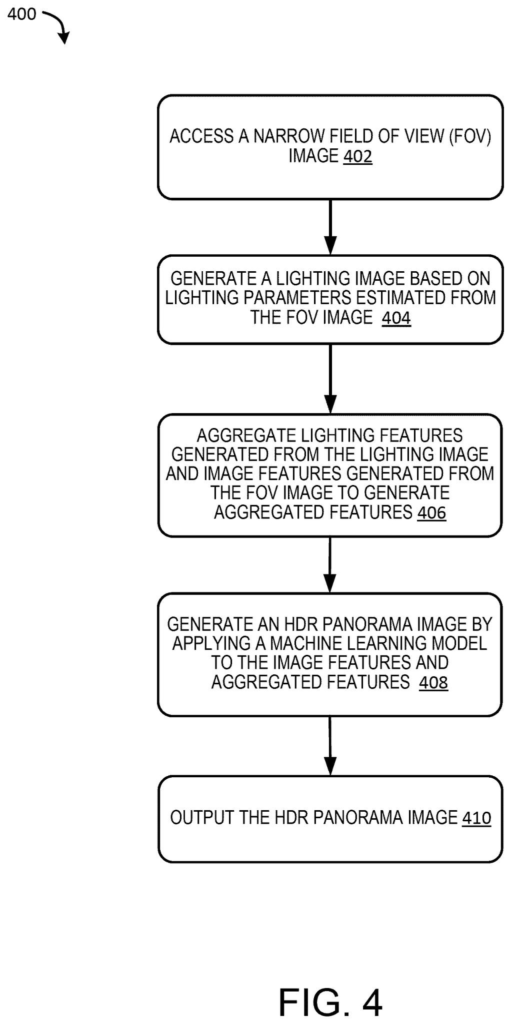
Here is the pipeline described in the claims:
- Estimate the lights. A neural network (software trained on many examples) guesses each light source's position, size and intensity. The description says it uses one method for indoor scenes and another for outdoor ones.
- Draw a lighting image. Those guesses become a spherical picture of the lights, using blobs called spherical Gaussians (smooth, glowing spots).
- Merge the clues. The photo, the lighting image and a burst of random noise (added for fine detail) are each converted into numbers and combined.
- Generate the panorama. A generative adversarial network (two AIs, one creating images and one judging them) builds the HDR panorama. The photo is its main input, and the merged clues feed in through a side channel.
One variation makes an ordinary panorama first, then adds the lighting image on top to get the HDR result. The filing says this makes training more stable. Training data came from converting a large set of ordinary panoramas into HDR ones.
Why fake objects in photos still look fake
If you edit photos, build mockups or design product shots, the practical payoff is believable 3D objects without a photo studio. Shiny objects are the hardest case, and the filing shows a metal robot with plausible reflections of night lights and balls with sharper shadows. It also frames the light controls as an artistic tool, since several lighting setups can look realistic for the same photo.
Adobe's image apps are a natural home for this, though the patent names no product. It is also a continuation of an earlier application, which the cross-reference describes as already allowed, so this is a refinement of an idea Adobe has been pursuing rather than a new one.
Adobe's 43rd filing we've tracked since May in the AI photo editing race continues a run that includes one on video object tracking and one on auto mode selection.
The problem here is real and a bit costly. Anyone who has pasted a product or a character into a photo knows the result looks off, and the usual fix is a lot of manual lighting work. The photo holds only a sliver of the scene, so some guessing is unavoidable.
Adobe's answer fits that problem well. The AI makes the guess, and then it hands the controls to you, which matters because the filing admits many lighting setups can look plausible for the same photo. A tool that guesses once and offers no way to correct it would frustrate editors fast.
The approach is incremental and fairly narrow, but it aims at a stubborn, everyday irritation in 3D and augmented reality work. It deserves to be taken seriously for that reason alone.
Get our take in your Top Stories
Liked this breakdown? Add Patentlyze as a preferred source on Google, and our plain-English take shows up more often in your Top Stories the next time Adobe patent news breaks.
There are more where this came from
We read every patent application Big Tech publishes and send you the ones worth knowing. Plain English, free, every week.
The drawings
9 drawing sheets from US 2026/0311299 A1 · click any drawing to enlarge


Want this weekly breakdown for a company we don't cover? Patentlyze Pro →
Be the first to weigh in