
Adobe Patents an AI That Picks the Right Photo Editing Mode for You
Adobe has filed a patent describing an AI image editor that automatically recognizes what kind of edit you want, then blends the right behavior behind the scenes to produce a cleaner result.
What Adobe's multi-mode image editing actually does
You're touching up a photo and you want to fill in a missing patch of sky, swap out a background, or extend the frame beyond its original edges. Right now, most AI editors make you choose the right mode yourself, and picking the wrong one means a messy output.
Adobe's patent describes a system where the AI figures out which type of edit is happening based on the shape and context of the region you've marked, then uses that information to guide the image it generates. The result is a single model that can handle different editing tasks without you needing to manually configure anything.
Adobe Firefly already lets users paint over areas and generate new content, so this kind of automatic mode detection feels like a natural next step for tools people are already using.
… computing a noise estimate based on the first mask type using a classifier free guidance operation including a first term based on a first mode corresponding to the first mask type and a second term based on a second mode corresponding to the second mask type; …
Translation: The system calculates the proper editing adjustments by blending different AI behavior modes together.
How the system blends two editing modes in one pass
The patent centers on a process called classifier-free guidance (a technique where an AI model mixes two versions of its own output: one that follows a specific instruction and one that doesn't, then blends them to get a better result). Adobe's twist is applying this to mask types rather than text prompts.
Here's the flow:
- The user supplies an image and draws a mask, a highlighted region marking where the edit should happen.
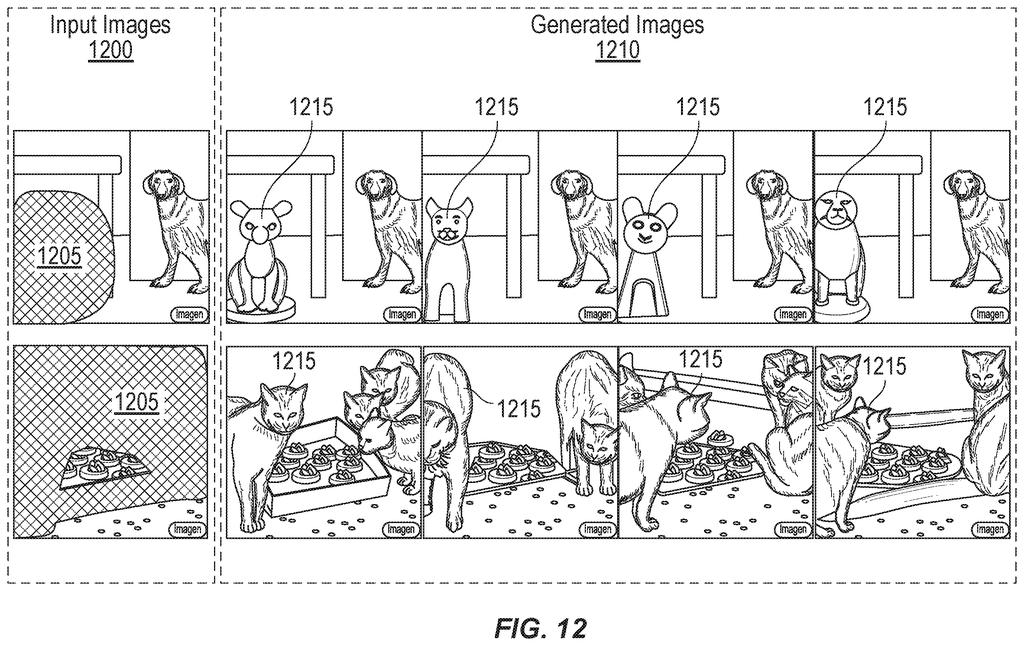
- The system automatically identifies which of several preset mask types the selection falls into, for example whether you're filling a hole inside an image, replacing a background, or outpainting beyond the image border.
- It then computes a noise estimate (the AI's internal guess at what pixels should go in the empty space) using a blend of two modes: one tuned for the detected mask type and one for an alternate type.
- The image generation network uses that blended estimate to synthesize the final output.
The key idea is that by combining signals from two modes during the generation step, the model can handle edge cases where a single mode would produce artifacts or inconsistencies. The mask type detection happens automatically, so the user never touches a mode selector.
An image processing system obtains an input image (e.g., a user provided image, etc.) and a mask indicating an edit region of the image.
Translation: The software takes your picture and the specific area you highlighted for changes.
What this means for AI photo tools like Firefly
For everyday photo editing, this could mean fewer failed AI fills when you're working near image borders or around complex subjects. The system is purely software, which means it could ship as an update to an existing app rather than requiring new hardware.
For Adobe's long bet on generative image tools, this patent represents infrastructure work: the kind of under-the-hood plumbing that makes AI editors feel reliable rather than unpredictable. If the approach works as described, it narrows the gap between what AI photo tools promise and what they actually deliver on tricky edits.
Adobe's 41st filing we've tracked in our AI photo editing race since May builds on work like rewriting video frames from a photo and fixing dark corner borders.
The shortest route from this patent to a shippable feature is pretty direct. The method is software-only, works within an existing image generation architecture, and targets a problem that Adobe's own Firefly users already bump into. There's no new sensor, no new chip, no dependency on unreleased hardware.
The actual technical contribution is fairly narrow: using automatic mask classification to steer a well-known guidance technique. That's incremental, not transformational. But incremental improvements to reliability are exactly what separates a demo from a tool people trust with real work.
The main open question is how well the automatic mask-type detection performs on ambiguous selections in practice. The patent describes the mechanism but doesn't show accuracy data, so the distance between the idea and a polished product still depends on training quality.
There are more where this came from
We read every patent application Big Tech publishes and send you the ones worth knowing. Plain English, free, every week.
The drawings
20 drawing sheets from US 2026/0289867 A1 · click any drawing to enlarge


Want this weekly breakdown for a company we don't cover? Patentlyze Pro →
Be the first to weigh in