
Samsung Patents a Fix for Foldable Phones That Block Their Own Camera
Fold a phone shut and one of its cameras can end up staring at the other half of the phone. Samsung's patent has the phone swap in a different camera before the app notices.
What Samsung's foldable camera swap actually does
Imagine you've folded your phone shut and opened a video call on its outer screen. The app asks for the camera it always uses, but on a foldable, that lens is now pressed up against the other half of the phone and sees nothing useful.
Samsung's patent has the phone sort this out on its own. When an app asks for a camera, the phone first checks how far it is folded. If the requested lens is blocked, the phone hands the job to a different camera that can actually see, and the app carries on as if nothing changed.
It also handles details you would otherwise notice. A lens on the other side of the phone can be flipped upside down compared with the original, so the phone corrects that before the picture reaches the app. Settings like zoom or portrait blur can carry over too.
… identify that a request for acquiring image data via a first camera among the plurality of cameras has been generated from the application; in response to the identified request, initiate an operation of the first camera …
Translation: The phone detects when an app tries to use a specific camera.
How the phone reroutes a blocked camera request
When you open a camera or video-call app, it sends a request through the phone's API (the standard commands apps use to talk to hardware), naming a camera by number, such as camera 1 for the front lens.
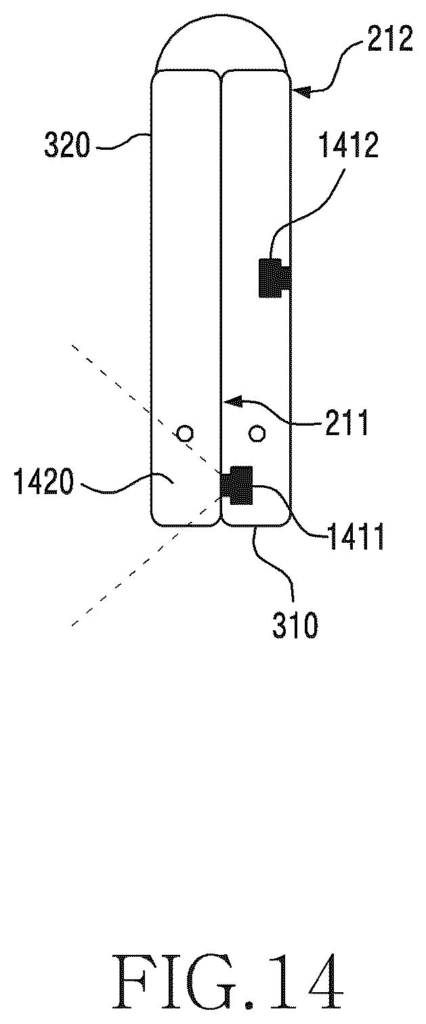
Before obeying, the phone checks its state information, mainly the folding angle between its two halves, read by a Hall sensor (a magnet-based sensor in the hinge). The filing gives example ranges: under 10 degrees is folded, 10 to 170 is in between, and 170 or more is flat. It also checks whether the requested camera is hidden by the other half, already in use, or broken.
If the requested camera is out, the phone picks a replacement that faces the way the original would have in the flat position. It then swaps the camera number in the request, so the app gets images from the new lens without knowing. If the new camera's attributes (such as which way is up) differ from the original's, the phone edits them first, for example flipping the orientation by 180 degrees.
The filing also covers switching mid-use. If your preview moves from the inner flexible screen to an outer screen, the phone changes cameras and can carry over earlier settings, such as zoom ratio, portrait blur or a wide-angle mode.
… state information of the electronic device, which is related to the form of the electronic device, indicates a first state.
Translation: Sensors check how the foldable screen is currently bent.
Why your foldable's camera apps won't break
If you own a foldable, this is about camera apps that just work. The filing says apps written without folding in mind can fail to get a working camera when the phone changes shape. Handling the swap inside the phone means app makers would not have to rebuild their apps, and your video call or social app would not show a blank or upside-down picture.
The hardware described is two housings joined by a hinge, a flexible inner screen and an extra outer screen, the layout of today's foldables. A fix like this could live in the software of a future Galaxy Z Fold or Z Flip, though the filing names no product.
Samsung's 83rd filing we've tracked since May joins earlier work on a locking LED cover and wiring for expanding screens in our foldable phone applications.
Claim 1 is short and wide. It asks for a device with several cameras and a flexible screen, an app that requests one camera, and a phone that uses one lens in one shape and a different lens in another shape. Folding, hinges, angles and the camera-number swap all show up only in later claims.
That wording is wide enough to describe any bendable, rollable or sliding device that sends camera requests to a different lens depending on its shape, whatever the mechanism. If granted as written, that is a lot of ground for one idea about foldable cameras.
Claims this wide often get narrowed along the way, so the later pieces (the folding-angle check and the upside-down correction) show what Samsung most plausibly cares about. As an idea, it is practical housekeeping for foldables, and a covered lens should never break your video call.
Get our take in your Top Stories
Liked this breakdown? Add Patentlyze as a preferred source on Google, and our plain-English take shows up more often in your Top Stories the next time Samsung patent news breaks.
There are more where this came from
We read every patent application Big Tech publishes and send you the ones worth knowing. Plain English, free, every week.
The drawings
15 drawing sheets from US 2026/0313245 A1 · click any drawing to enlarge


Want this weekly breakdown for a company we don't cover? Patentlyze Pro →
Be the first to weigh in