
Samsung Patents a Fix for Jagged Lines on Screens That Show 3D Without Glasses
Glasses-free 3D screens have a quirk: straight lines can look broken, and thin white lines can split into red, green and blue stripes. Samsung's patent application describes a software fix that blends pixel values in just the trouble spots.
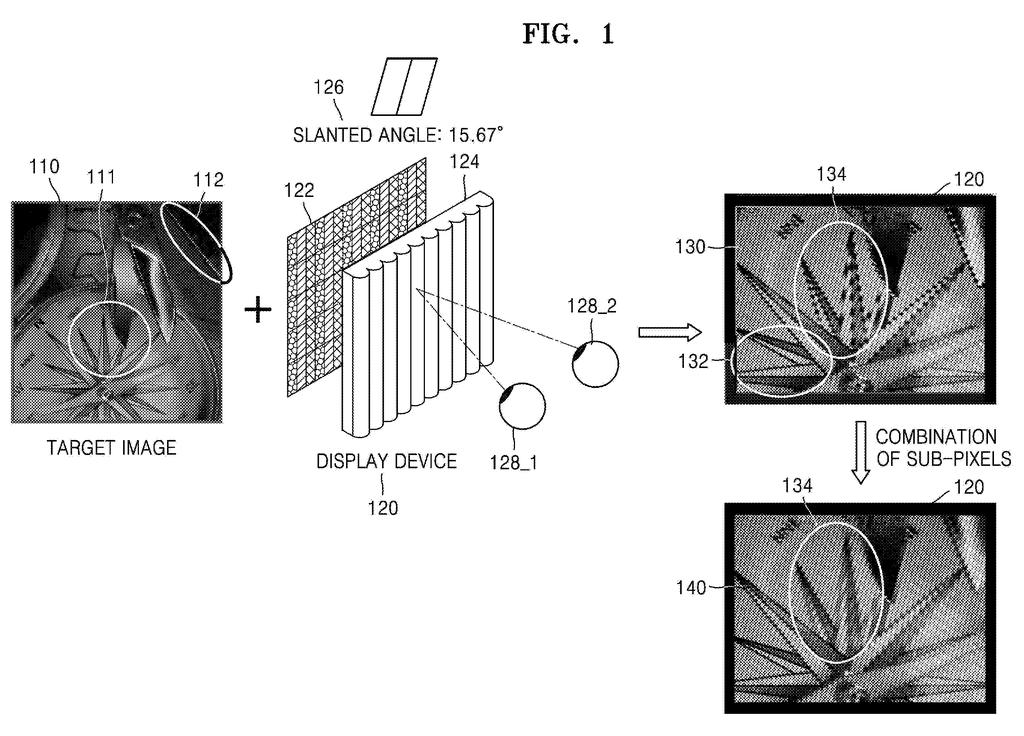
What Samsung's 3D-screen line fix actually does
Ever watched a perfectly straight line on a screen turn into a little staircase? On some glasses-free 3D displays, that really happens. These screens put a sheet of tiny ridged lenses over the pixels so each of your eyes sees a different image. The side effect is that some lines look chopped up, and thin white lines can split into separate red, green and blue stripes.
Samsung's patent application describes a software fix. The screen scans the picture for the spots most likely to go wrong, then blends the brightness of neighboring dots there. Instead of a harsh jump from black to white, you get a gentle fade, and your eye reads that as one clean line.
The screen only touches the problem areas. Everything else in the picture is left exactly as it was.
… identifying, by the display device, at least one area in the target image, which comprises at least one edge within the target image, which is slanted with respect to the display axis at a second slanted angle that is within a preset range from the first slanted angle …
Translation: The screen searches for image lines running at nearly the same tilt as its internal lens layer.
How the screen finds and blends problem pixels
The display sits behind a lenticular lens (a sheet of tiny side-by-side ridges that sends different pixels to each eye). The sheet is tilted slightly against the pixel grid. That tilt, called the slanted angle, is stored in the device's memory, and the filing's example is 15.67 degrees. Each ridge covers a strip of pixels called a pitch section.
The main claim covers fixing broken edges, in four steps:
- Turn the frame to grayscale and run edge detection (finding where brightness changes sharply).
- Build a mask image (a black-and-white map that flags problem zones) marking edges whose angle is within a preset range of the lens tilt.
- For each flagged sub-pixel (one red, green or blue dot), select the sub-pixels in the same row inside its pitch section.
- Replace their values with an average, weighted sum or weighted average.
Only some sub-pixels in a strip get magnified for a given viewing position, so a hard black-to-white edge looks like a step. Averaging turns it into a gradual brightness ramp.
Dependent claims add a second fix for thin white lines. The screen boosts contrast, applies a morphological operation (an image trick that shrinks and regrows shapes so thin lines vanish), then subtracts the result to isolate those lines. It blends vertical neighbors, for example two sub-pixels above and three below, so red, green and blue mix back into white. The filing also says an AI model could produce the blend values.
… selecting, by the display device, a plurality of sub-pixels of a same row as a first sub-pixel included in the identified at least one area, and allocating, by the display device, a first combination value to an output value of each of the plurality of sub-pixels …
Translation: It then blends together the neighboring dots in that same row to smooth out the jagged edges.
Why glasses-free 3D screens need this cleanup
If you ever buy a glasses-free 3D screen, sharpness is the whole selling point, and broken lines or rainbow-edged text undercut it fast. This patent application goes after exactly those flaws using only math on the image, so the same fix could apply to any screen with this lens design. The filing lists ad monitors, gaming monitors, TVs, photo frames, laptops and VR or AR devices as possible hosts.
The cost is small but real: corrected thin lines come out dimmer and thicker than the original. Because the fix is simple averaging, the filing says it can be processed rapidly, which matters when every frame of a video needs it. It is also a continuation of an earlier application filed in 2024, so this is a refinement of an existing idea.
Samsung's 113th filing we've tracked since May in our display technology work, this application follows one on blocking signal disruption and one on balancing screen signals.
The shippable part is easy to spot: it is all software. The lens and its tilt are fixed when the screen is built, so the display already knows the angle it needs, and the fix is a bit of averaging on the pixels it is about to light up.
That makes the route to a product short. A screen maker could fold it into the chip that already prepares each frame, or a set-top box or game console could do the correction before the picture reaches the screen, which the filing describes as an option. The only thing that has to exist first is a glasses-free 3D screen to apply it to.
The filing admits a trade-off: corrected thin lines come out dimmer and thicker. On a 3D display full of text and outlines, a small softening is a fair price. A product team would likely want this polish step before launch.
Get our take in your Top Stories
Liked this breakdown? Add Patentlyze as a preferred source on Google, and our plain-English take shows up more often in your Top Stories the next time Samsung patent news breaks.
There are more where this came from
We read every patent application Big Tech publishes and send you the ones worth knowing. Plain English, free, every week.
The drawings
23 drawing sheets from US 2026/0313085 A1 · click any drawing to enlarge


Want this weekly breakdown for a company we don't cover? Patentlyze Pro →
Be the first to weigh in