
Apple Files Patent for a Food Tracker That Asks When It's Unsure
Apple has filed a patent for a food tracker that admits when it's confused. When it can't tell mashed potatoes from ice cream, it asks you mid-meal, and you can answer with a look.
What Apple's ask-when-unsure food tracker does
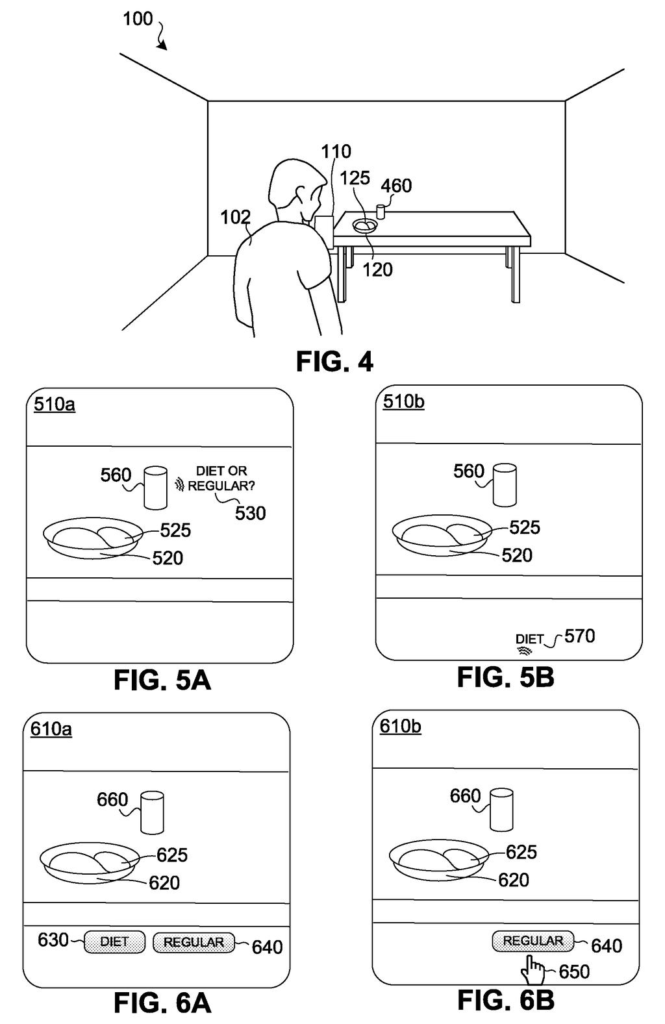
Imagine you're eating dinner while wearing a headset that keeps your food diary for you. Its camera spots a pale, scoop-shaped lump in your bowl and can't tell whether it's mashed potatoes or ice cream. Instead of guessing and getting your diary wrong, it asks.
In Apple's patent application, two labels float next to the bowl and you simply look at the right one. You could also say the answer out loud or point at it, so you never have to put down your fork.
The device only speaks up when it is truly unsure, and not too often. The filing describes limits like one question every two minutes. Answer in the moment, and your end-of-day food log needs far fewer fixes later.
… presenting content requesting user input identifying whether the food was of the first food type or the second food type; and receiving input identifying whether the food was of the first food type or the second food type.
Translation: The system asks the user to clarify what they are eating when the sensors cannot tell the difference.
How the headset decides when to ask you
The system starts with sensor data collected while you eat. A camera on a head-mounted device looks at the table in front of you, and the filing also mentions sound, depth, motion and location sensors. A machine-learning model (software trained on lots of examples) guesses what each food is and attaches a confidence score to the guess.
When the scores are murky, the device asks. The filing gives examples: no single guess clears a threshold such as 60 percent, two guesses both score above 35 percent, or the top two guesses land within 5 percent of each other. In one example, the device is 45 percent sure the food is mashed potatoes and 45 percent sure it is ice cream.
The question can take several forms:
- Floating text labels next to the food, such as "ICE CREAM" and "MASHED POTATOES"
- Simple 3D pictures, like an ice cream cone and a whole potato
- A spoken prompt placed near the item, such as "DIET OR REGULAR?"
You answer by holding your gaze on an option, speaking, pointing, or moving a device such as a ring. To avoid nagging, the filing describes caps like one request every 2 minutes or three per meal, prompts that fade after a few seconds, and asking within about 5 seconds of a new item landing on your plate. The claims also cover ear-worn devices.
… use user input received approximately around the time of food consumption to confirm and/or revise food predictions, e.g., regarding type of food, volume, etc.
Translation: It relies on quick feedback while eating to check and correct guesses about the meal and portion size.
Why a one-glance answer could fix food logs
Food logging is a chore, and most of the work lands ultimately, when you have to remember what that blob on your plate was. Asking at the table, while the food is still in front of you, turns a tedious cleanup into a one-second glance. It also means your daily totals start from better data.
The idea depends on a device that can see your plate, which the filing places in head-mounted and ear-worn gear. That ties it to wearables people would need to actually wear at meals. It is a patent application, and nothing in it points to a finished product or a launch.
Apple's 84th filing we've tracked since May on our AR glasses watchlist builds on earlier work like the patent on angled avatar detail and the one covering a 3D stadium view.
Claim 1 requires just five things: a device with a processor, sensor data gathered around mealtime, a determination that the food could be one of two types, a prompt asking which one, and your answer. No headset, no eye tracking, no confidence scores, no limits on how often the device can ask. That is a very wide net.
In practice, that language would reach any food-logging app that spots ambiguity in what you ate and asks you to choose between two options, whether on a phone, a watch, or anything else with a camera and a screen.
The dependent claims add the interesting details, like gaze control, voice, gestures, and head-mounted hardware, but those refinements only matter if claim 1 survives. If it does, the basic act of asking a person to resolve a food-recognition guess becomes protected ground.
Get our take in your Top Stories
Liked this breakdown? Add Patentlyze as a preferred source on Google, and our plain-English take shows up more often in your Top Stories the next time Apple patent news breaks.
There are more where this came from
We read every patent application Big Tech publishes and send you the ones worth knowing. Plain English, free, every week.
The drawings
4 drawing sheets from US 2026/0311842 A1 · click any drawing to enlarge


Want this weekly breakdown for a company we don't cover? Patentlyze Pro →
Be the first to weigh in